
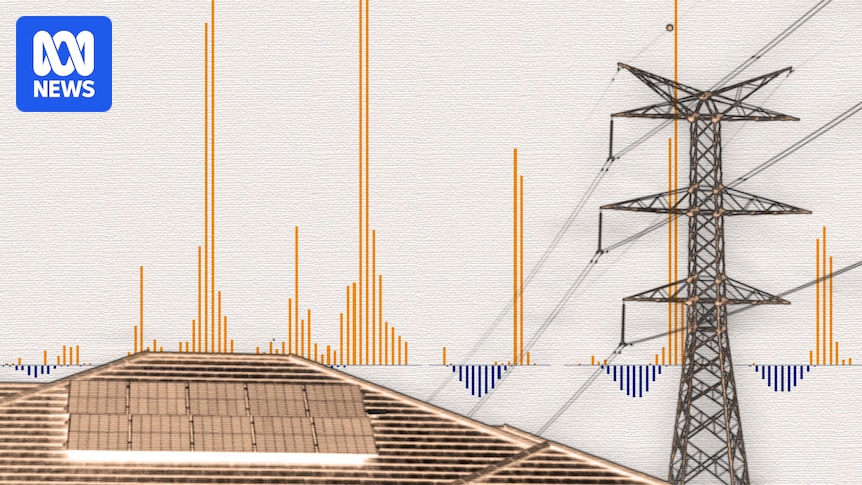
On any given day in Australia, from its west coast to its east, there is a fair chance spot power prices will plunge to remarkably low levels.
In fact, perhaps nowhere else on earth is this phenomenon more likely to happen than in Australia.
And yet the prices paid by Australian consumers for electricity have rarely been higher.
It’s a confusing, and some might even say maddening, contradiction.
Josh Stabler from analysis firm Energy Edge says many of the answers can be found in moments of unpleasantness.
Australians, he says, are feeling the heat because of the times when spot electricity prices rise uncomfortably high.
“You can have a lot more time holding onto the ice cube than you can the stove,” Stabler says.
As Australia’s energy system enters a “once-in-a-century” transition, wild price volatility has become one of its most striking features.
David Dixon, an analyst at global consultancy Rystad, says Australia is not alone in experiencing increasingly volatile power markets.
But he says it is an outlier.
“What we’re seeing in the market in Australia, to put a global lens on it, is the highest volatility in the world in electricity markets,” Dixon says.
“And that has been the title that Australia has held for actually a number of years in a row.”
A wild price pendulum
This whipsawing has a few causes, Dixon says.
For starters, he says the national electricity market, which covers Australia’s eastern seaboard, is by design prone to big swings in spot prices.
The National Electricity Market — or NEM, as it’s known — is an “energy-only” market, meaning generators are only paid for the power they produce.
And in order to win the right to produce and sell that power, they have to compete on price every five minutes.
Bids from the lowest-cost generators are accepted first, followed by the next lowest-cost and on up the cost curve.
Crucially, it is the price offered by the most expensive plant needed to meet demand at any given time that is paid to all generators for that five-minute period.
Dixon notes that, in theory, an energy-only market is designed to drive down prices by spurring competition.
Indeed, it’s the intense competition between generators — driven largely by Australia’s riches of solar power — that often drives spot prices towards zero to negative levels in the middle of the day.
So low are spot prices falling, in fact, they are often going below zero.
That is, generators are having to pay someone to take their output off their hands more and more of the time.
But Dixon says there’s a flip side to these markets.
When supply is scarce relative to demand, prices can skyrocket.
“And the NEM particularly stands out here,” he says.
In the NEM, Dixon notes, prices can fall as low as minus $1,000 a megawatt hour.
But they can rise much higher — as high as $20,300/MWh.
“So it is an enormous spread from the floor to the ceiling,” he says.
“And for context, you don’t see those kinds of spreads between floor and ceiling in very many markets around the world.”
In Australia’s electricity market, energy producers compete on price every five minutes. (ABC Rural: Meg Powell)
The national market sets prices every five minutes to reflect the fact that conditions change and supply must therefore constantly adjust to meet demand.
When demand for power from the grid is low — such as the middle of the day when rooftop solar floods into the system — prices can plummet.
The Australian Energy Regulator (AER) has noted the extraordinary growth of negative prices as the share of the energy mix coming from renewable sources has increased.
“In 2024, across the NEM, negative prices accounted for 15 per cent of all prices, up from 3.5 per cent in 2020,” the AER noted in its most recent State of the Energy Market report.
By contrast, however, when demand for power from the grid is high — typically in the evening when the sun has set — prices almost invariably rise.
And sometimes they soar.
As the regulator noted, trading intervals in which prices rose to $300/MWh or above rose from 0.4 per cent in 2020 to 1.8 per cent over the same period in 2024.
“Despite their greater frequency, negative prices have a relatively modest impact on average spot prices compared with high prices,” the regulator found.
“High prices apply to a greater proportion of the electricity that is dispatched and therefore have a larger impact.”
A look at South Australia between January and March and July and September in 2024 illustrates that point.
While negative prices reduced average prices for the quarter by $8.33, those above $300/MWh increased them by $23.68.
It was even more pronounced between July and September, where negative prices cut the average by $7.79 but intervals above $300/MWh added $115.18.
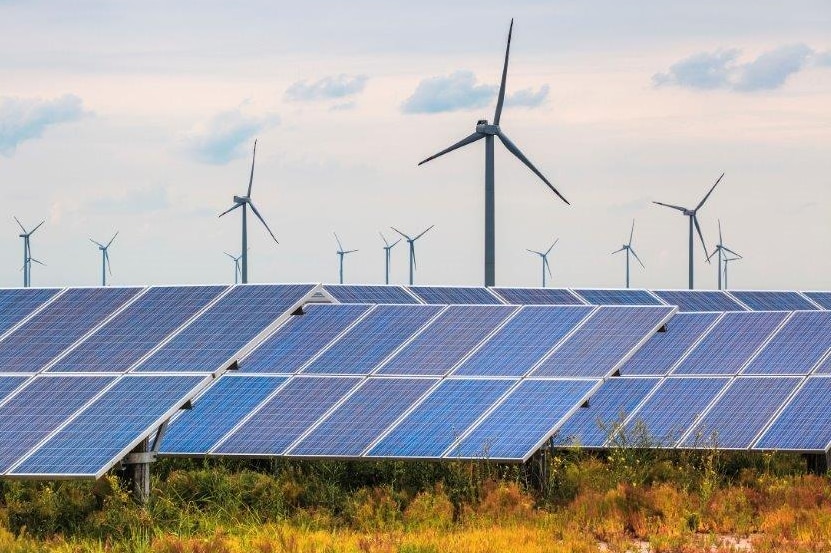
South Australia frequently sets records with high percentages of renewable energy. (Supplied: Tadgh Cullen (DP Energy))
Dixon, from Rystad, said the benefits of negative prices were completely outweighed by extremely high ones.
“You do the maths in terms of an hour or 30 minutes at that market cap,” he says.
“And you realise how many hours of minus $50/MWh you have to make up for that very short duration at a very high price.
“It’s just such a dramatic difference in magnitude … that even very short durations at the market cap have such a massive influence on price.”
Expensive gas fills peaks
Part of the reason for the big price swings, Dixon says, is simply the mix of generation in Australia’s electricity systems these days.
On the one hand, he notes there is so much rooftop and large-scale solar that it is washing over the grid every day, suppressing spot prices as it does.
However, the sun doesn’t shine around the clock and he notes that when it sets, the market must turn to more expensive sources to meet the demand.
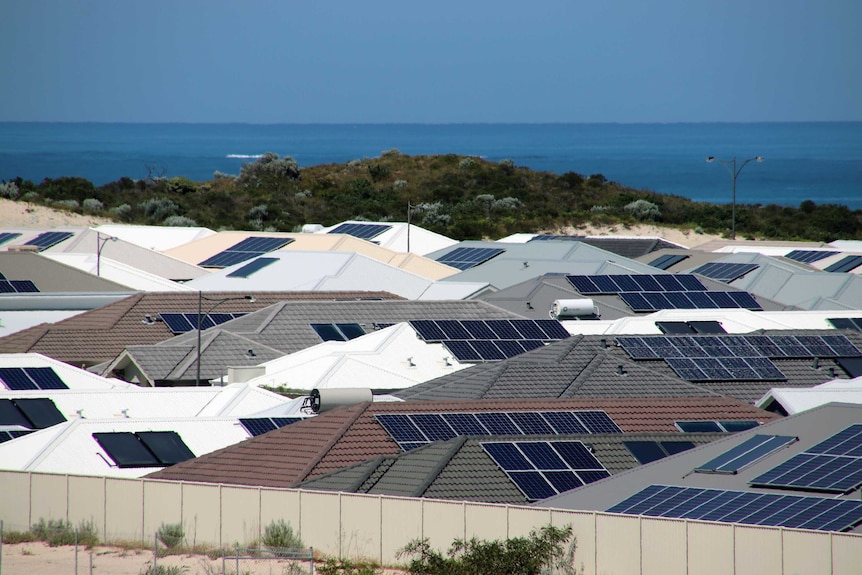
When the sun goes down, expensive gas often fills the evening peak. (ABC News: Briana Shepherd)
And Dixon says that source is often gas, which in Australia is one of the highest-priced fuels around.
“You get this constant juxtaposition intraday between low and high, between the solar and the gas,” Dixon says.
Throw in the risk of an unplanned coal plant outage and he says prices in the NEM can get extremely high, extremely quickly.
Such volatility matters.
Stabler of Energy Edge says the wholesale component of an electricity bill — that part relating to the generation of power — is the equal-biggest chunk of what we pay.
Wholesale costs typically make up about 40 per cent of an average bill — roughly the same as those for networks, or the poles and wires.
Since Russia’s invasion of Ukraine sent fossil fuel prices into orbit in 2022, Stabler says wholesale costs have doubled.
And while the extraordinary prices from that time might have eased, he says they remain well above the years leading up to the conflict, averaging about $100/MWh.
Part of that is because retailers — the companies that sell consumers the electricity — are still paying for the sky-high prices they locked in during and immediately after the crisis.
But Stabler says structurally higher coal and gas prices, and inflation, generally mean electricity simply costs more to produce now than it did before 2022.
“You can say not much changed four years in a row now, basically,” Stabler says.
“This isn’t finished. We’re not suddenly going back to a $40 average price or something like that.”
Another cause of volatility is what Dixon describes as the “very weak” interconnection between the states and even within them.
By this, he means the high-voltage power lines that plug Queensland into New South Wales, and New South Wales into Victoria, and so on.
Compared with other developed economies, such as those in Europe or America, Dixon says the capacity of Australia’s transmission lines is modest.
“Why that matters is the ability to utilise another state’s generation is what can dampen volatility,” he says.
Effectively, Dixon says this lack of interconnection means states can sometimes struggle to share power.
When there is high demand in one state, it cannot necessarily buy cheaper power from another state with excess supply.
Batteries, big and small, ease burden
Such high prices and volatility may have a technological solution.
Bruce Mountain, the director at the Victoria Energy Policy Centre, says “huge variability” in wholesale costs during the day is a boon for those able to exploit it.
Among them are those households able to install batteries and solar panels that can meet much of their own supply.
In doing so, Professor Mountain says they avoid higher prices from the grid.
He says they could even profit by selling excess power from their batteries back to the grid during periods of high prices.
“But the vast majority of customers can’t do that or are not willing to do that,” he says.
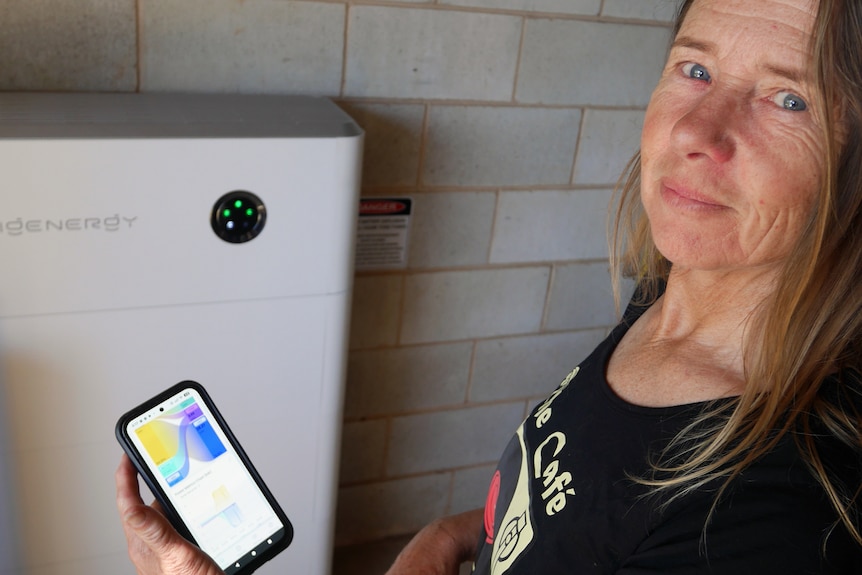
Household battery owners can avoid peaks, or even ‘game’ the system. (ABC News: Cath McAloon)
Beyond wholesale costs, Professor Mountain notes consumers are also wearing the effects of rising network investments.
He says the shift from a centralised electricity system defined by a few big coal plants to a decentralised one of much more diffuse sources of renewable energy meant a major expansion of the poles-and-wires network.
For Dixon, there is light at the end of what has been a dark tunnel for electricity users.
He says an extraordinary investment splurge in new batteries will transform the NEM in the coming months and years.
All told, Dixon says about 17 gigawatts of battery capacity is either online or on its way across a national market, where typical demand “is in the order of 22 to 24 gigawatts”.
“The key point at the moment, though, is we haven’t seen the effect of that yet,” Dixon says.
“We’ve got about 14 gigawatts under construction and commissioning at the moment.
“That will hit the market in the next 12 to 24 months.”
When that capacity does hit the market, Dixon says, two big changes will occur.
Why do we waste renewable energy?
Firstly, he says wind and solar farms, which currently have to turn down or switch off at times of high output and low demand, will no longer need to “curtail” nearly so much.
Secondly, Dixon says the wave of large-scale — and even some small-scale — batteries will begin to supply serious amounts of power during the evening peak.
In the parlance of the energy industry, they will start to “shift the load”.
“They’ll naturally compete in that evening peak,” he says.
“You effectively have put downward pressure on the price during that evening peak, and they’ll allow more dispatch of renewables.
“So yeah, they will put downward pressure on prices for sure.”
Huge amounts of storage added in the last quarter of 2025 seemed to have had the desired effect. Battery discharge on average “nearly tripled”, according to the Australian Energy Market Operator (AEMO), and wholesale prices tumbled.
Volatility in the market was down, with the AEMO noting spot prices above $300/MWh “added only $3/MWh” to the average for the quarter.
But both Dixon and Stabler say the technology won’t be a panacea.
There will always be times, they say, when demand is particularly high or supply from renewable energy is particularly low, such as cloudy, calm days in winter.
At these times, battery capacity is likely to be exhausted.
Renewables pass 50pc milestone
Analysts say these periods of vulnerability for the grid will still need other forms of backup.
And, right now, the most obvious choice is a combination of long-duration or “deep” storage technologies, such as pumped hydro schemes like Snowy 2.0 and — crucially — gas power.
“There are going to be periods of the year where we just have low renewables,” Dixon says.
“So gas is critical from a security of supply perspective, but it won’t be used in high volume.”