
Back to Article List
The icy moon Europa transits Jupiter tonight, followed by its shadow. Now past opposition, moons and their shadows are well separated.
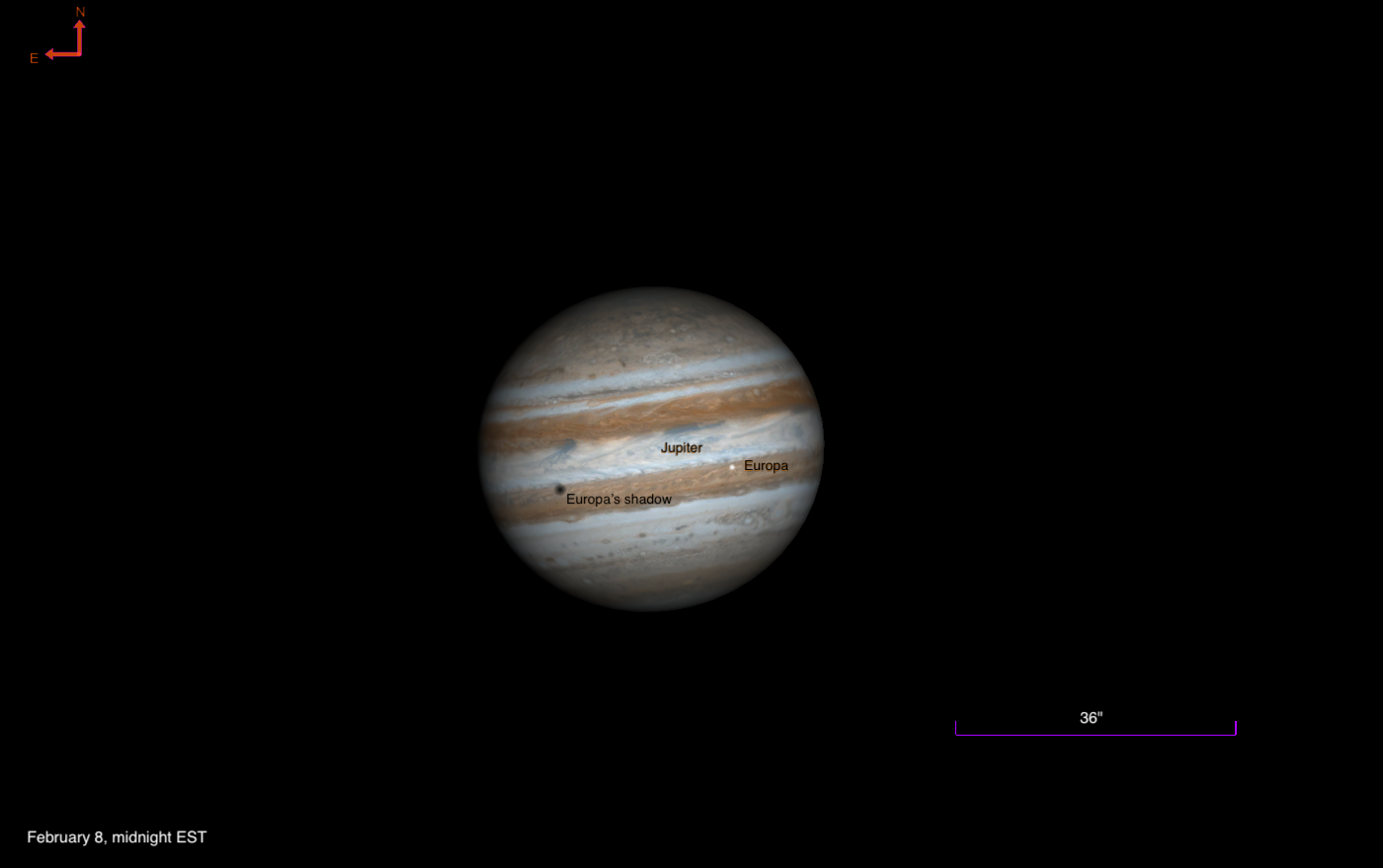
Around midnight EST on February 8, Europa and its shadow are visible together as they cross the face of Jupiter. Credit: Alison Klesman (via TheSkyX)
Looking for a sky event this week? Check out our full Sky This Week column.
February 7: Ganymede disappears
Tonight, the icy moon Europa passes in front of Jupiter in a transit, bringing with it its dark shadow, visible on the cloud tops.
The transit begins shortly before 10 P.M. EST, with Jupiter still high in the sky. Once again, look for the bright gas giant (magnitude –2.6) hanging below Castor and Pollux in Gemini the Twins. Zoom in with a telescope before the event begins and, like last night, you’ll see three moons on one side of the planet and one on the other. Now it’s Io alone on the western side, with Europa closing in on the east. Ganymede lies farther east, and Callisto beyond it.
Europa finally moves in front of the disk at 9:54 P.M. EST. It takes nearly an hour and a half for its shadow to follow, appearing around 11:20 P.M. EST. By then Europa is roughly halfway across the disk. An hour later, both Europa and its shadow are clearly visible, straddling the central meridian with Europa approaching the western limb and the shadow now well separated from the eastern limb. Europa’s transit ends around 12:45 A.M. EST (now the 9th in the Eastern time zone only), and its shadow again follows suit almost an hour and a half later, disappearing shortly before 1:15 A.M. EST (now the 9th for the eastern half of the U.S.).
The time between moons and their shadows crossing has been increasing since Jupiter’s opposition last month and will continue to do so as we move farther from that date.
Sunrise: 7:01 A.M.
Sunset: 5:28 P.M.
Moonrise: —
Moonset: 10:02 A.M.
Moon Phase: Waning gibbous (54%)
*Times for sunrise, sunset, moonrise, and moonset are given in local time from 40° N 90° W. The Moon’s illumination is given at 10 P.M. local time from the same location.
Last Quarter Moon occurs at 7:43 A.M. EST on Monday, February 9. This phase is best viewed in the early-morning hours; early risers can catch it before dawn, and our satellite remains visible in the sky even after the Sun has risen.
An hour before dawn this morning, the Moon floats high in the south, amid the stars of Libra and to the right of the claws of Scorpius. (We’ll return here tomorrow morning as well, as the Moon moves into Scorpius in preparation for a close pass of the bright star Antares tomorrow night.)
The Last Quarter Moon is lovely to view through binoculars or a small scope. Night has reached midway across the nearside, cloaking half in darkness while half remains in sunlight. Still visible this morning in the lunar north just on the sunward side of the terminator dividing night and day are the Apennine Mountains, curving gently along the edge of Mare Imbrium (the Sea of Rains). Just below Imbrium is a bright, round crater with a large, tangled set of rays stretching outward in all directions like a cartoon Sun. This is Copernicus, some 58 miles (93 kilometers) across and less than a billion years old. Those rays reach outward some 500 miles (800 km) across the surrounding terrain, visible because they are the lighter material from beneath the surface excavated during the impact that formed the crater.