
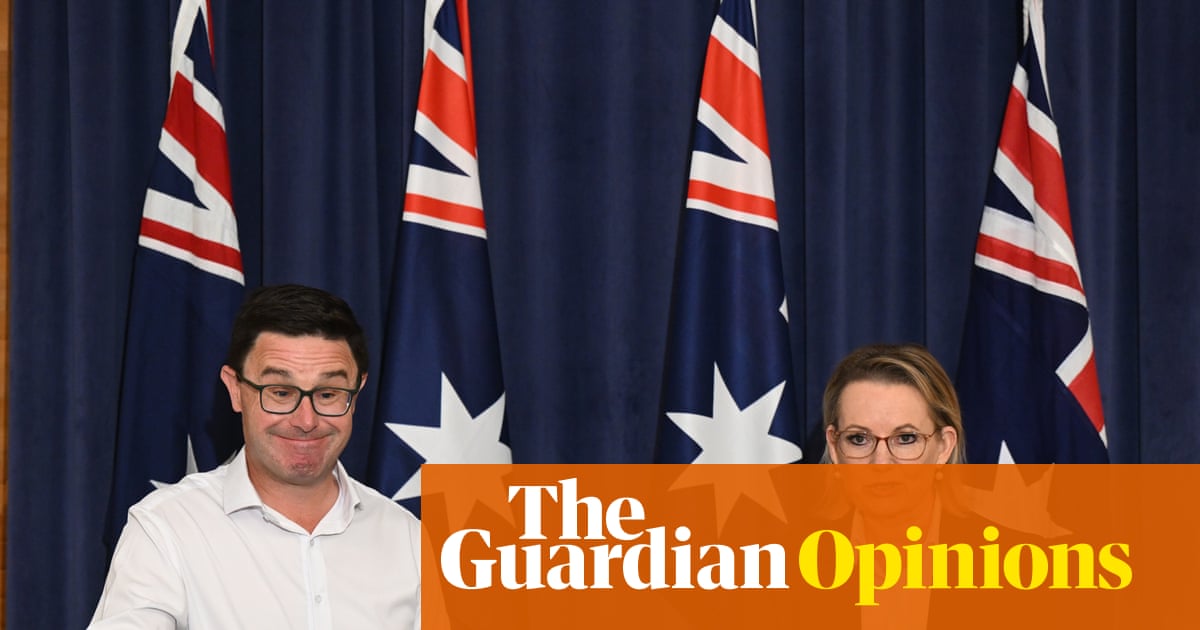
There’s a joke from The Naked Gun which has become a popular internet meme – a man in a suit, calling for calm as buildings explode behind him and others frantically run for cover.
“Nothing to see here”, the man insists. “Please disperse”.
When Sussan Ley and David Littleproud fronted a press conference on Sunday to announce their hitherto warring parties had “resolved those differences” and they were reforming the Coalition, there were no exploding buildings, just four Australian flags.
But the performance had all of the conviction of the grey-haired man in the meme: two leaders trying desperately to assure voters there was “nothing to see here” as political chaos erupted around them.
Less than three weeks ago, an enraged Littleproud blew up the Coalition and declared it was “untenable” under Ley’s leadership following a split over hate speech laws drafted in response to massacre at Bondi beach.
It appeared the Liberal-National union – so often strained, in particular on climate policy – had finally snapped under the pressure of irreconcilable differences.
But no.
Just after 12.30pm on Sunday, a smiling Ley and a smiling Littleproud announced the parties were reuniting after a negotiating an 11th-hour peace deal.
“It’s been a difficult time for millions of our Coalition supporters and many other Australians who rely on our two great parties to provide scrutiny and national leadership, but the Coalition is back together and looking to the future, not the past,” Ley said.
How could voters believe Ley’s rosy assurances, given the clear animosity between the two leaders and their parties that has been laid bare over the past three weeks?
“They can [trust me] because we are standing here together, and we have made a strong, clear statement about the Coalition,” she said.
Nothing to see here.
So how did we get from “untenable” under Ley to happily together again in 17 days?
The two sides are privately claiming the other capitulated but the truth is that both gave ground.
Ley was adamant the Coalition would only reunite if the three Nationals senators who crossed the floor on the hate speech laws – Bridget McKenzie, Ross Cadell and Susan McDonald – served a six-month suspension on the backbench.
She ended up accepting six-week bans.
Littleproud, for his part, was insistent that the Nationals did nothing wrong and shouldn’t be punished. His party room eventually accepted a punishment.
But while both leaders made concessions, the internal repercussions will be far more serious for one than the other.
Littleproud’s leadership was assured last week after Colin Boyce’s attempted challenge predictably failed. Nationals MPs appear content with Littleproud’s egalitarian style, which makes the party room as a whole more powerful than the leader.
Ley hasn’t yet faced her own leadership challenge, but it is coming – and might have been accelerated by the decision to reunite with the Nationals.
As has so often been the case throughout her leadership, Ley confronted a no-win scenario when weighing up whether to reform the Coalition.
Pushing ahead with a permanent Liberal-only frontbench – as she intended to do if the peace talks collapsed – would have gone against the advice of John Howard and other senior colleagues such as James Paterson, Dan Tehan and leadership rival Angus Taylor.
Taylor might very well have used it as the pretext to launch a leadership spill.
But if the opposition leader accepted the peace deal primarily to avert that prospect, she has seriously miscalculated the anger among other Liberal MPs about the conduct of the Coalition junior partner.
Many Liberal MPs were more than comfortable with an extended time apart from a party that is mostly preoccupied with fighting Pauline Hanson and Barnaby Joyce’s One Nation.
After Sunday’s reunion, some expect it is only a matter of time before the Nationals again front-run a policy position with little regard for the Liberals, as they did on the voice to parliament and net zero emissions target.
Ley narrowly defeated Taylor 29 votes to 25 in the post-election leadership ballot on the back of support from a broad coalition of moderate, centre-right and unaligned MPs.
When Taylor’s next challenge inevitably comes, perhaps as early as this week, Ley might not be able to count on the same coalition to save her. Even some of her own supporters admit as much.
When Guardian Australia put that scenario to Ley on Sunday afternoon, she dismissed it out of hand.
“They are your characterisations of a series of events and opinions. They are not mine, and I want to repeat what I said: the overwhelming majority of my party room knows that the Coalition is stronger together,” she said.
Nothing to see here.