
Loading
It is a dark day for a nation that has 28 Davis Cup titles on its resume and made the final in 2023 and 2024.
Former world No.1 Hewitt seemed to understand de Minaur’s absence, at least publicly, but made it clear he wanted Popyrin to play, particularly on clay, which he won a junior grand slam title on in 2017 before reaching the last 16 at Roland-Garros last year.
But there is a bigger problem here: Australia’s tennis stocks on the men’s side – pretty much besides de Minaur – are in rough shape, and have been trending this way for a while.
Tennis Australia chief executive Craig Tiley laughed off this masthead’s reference to there being only two Australian men younger than 24 inside the top 500 while announcing the Australian Open’s new partnership with Mecca in December.
Tiley’s quip in response at the time about 25 not being old – designed to downplay the state of the men’s game here – drew laughs from a bunch of influencers and PR people in the background.
But no one at Tennis Australia is laughing about the situation now, although the Mecca deal certainly delivered plenty of money and exposure for both sides.
Those two players younger than 24 are James McCabe (world No.208) and Edward Winter (No.488). Neither is a top prospect. McCabe, 22, did not even score a main draw wildcard into last month’s Australian Open.
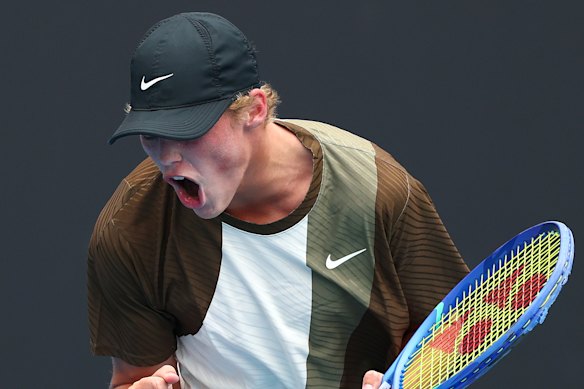
Cruz Hewitt looks the biggest long term hope for Australian men’s tennis.Credit: Getty Images
Lleyton’s son, Cruz Hewitt, who turned 17 in December, is probably Australia’s best prospect, but how he handles everything that comes with being the “son of” could decide where his career heads. It won’t be easy.
Worth noting also is that Cruz was never ranked higher than No.38 in juniors, so we should keep expectations in check, but as if that will happen.
This masthead asked Tiley again last week about Tennis Australia’s development pathway, and he pointed to the “per capita” numbers suggesting that “we are punching above our weight”.
Our response was to point out that we are one of four countries with the distinct advantage of hosting a grand slam.
“We’re a grand slam country, so we should be high,” Tiley conceded. “I think the cycle of replacing older players with younger players is a long cycle. It’s not a year or two-year cycle. Buying players is an option, but it’s not an option we take.”
There is finally a promising group of Australian players on the women’s side, but the cracks were covered for years from the likes of Daria Saville, Ajla Tomljanovic and the Rodionovas – Anastasia and Arina – switching allegiances to Australia.
Loading
More recently, and with a personal motivation, Daria Kasatkina followed suit. Maya Joint at least has an Australian father, but grew up and developed in the United States.
Tiley contends that all those players wanted to play for Australia, and were not chased or bought.
Hewitt is not above criticism either. He receives something in the range of $500,000 in his role, so that comes with significant responsibility. Like de Minaur, Hewitt went through a stage where he was the only genuinely relevant Australian man on tour.
This horror Ecuador result will create a temporary stir, but fixing the bigger-picture story needs to be the priority at Tennis Australia headquarters.