
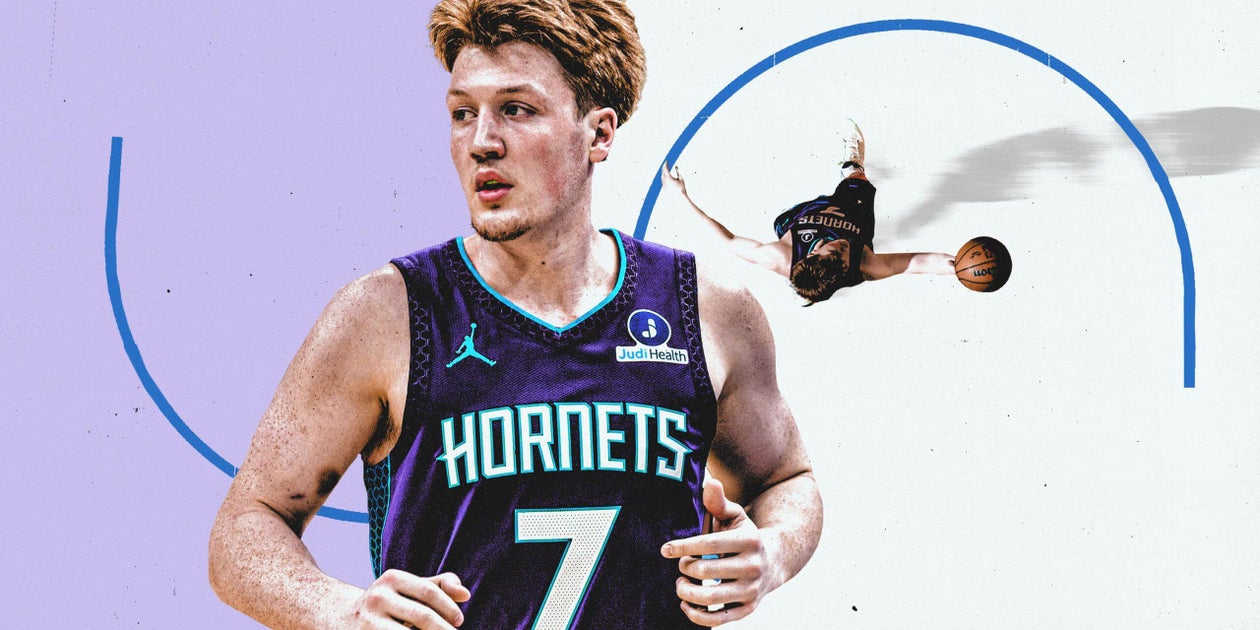
Kon Knueppel wasn’t nervous. Not even a little bit. But he had every reason to be.
The 20-year-old rookie for the Charlotte Hornets took the court at Fiserv Forum in Milwaukee, back in November, and glanced over at 6-foot-11 Bucks superstar Giannis Antetokounmpo. One of the greatest players on the planet was now mere inches from him.
“Seeing a player across from me who did so much for the team I rooted for growing up,” Kon says, “was awesome.”
Growing up just a short drive from the arena, the 6-foot-6, 215-pound guard had been a Bucks fan all his life, cheering for the team when Milwaukee had endured losing season after losing season. And now, in his first NBA game in his hometown, Knueppel heard his name called in the starting lineups with a roar so loud you’d think he played for the Bucks. About 2,000 people from his hometown, many of them friends and family, came to see him play, forming a sea of turquoise and white No. 7 Hornets jerseys. Bucks staffers had never accommodated a group that large; many would have to wait hours after the game in the bleachers for a picture with their hometown hero.
Right before tip-off, Knueppel could feel the magnitude of the moment. And yet, he didn’t feel jitters. He knew, deep in his bones:
I really belong out here, he thought to himself.
And since that night, when he scored 32 points, including four 3-pointers, plus three assists and three steals, he hasn’t run from a challenge from any of the league’s other superstars. With 162 3s made, he has the most by any player in league history through the first 49 games of his career.
Knueppel is much more competitive than his disarming image portrays. The Boy Next Door with floppy reddish-brown hair, shy upon first meeting someone, reveals a completely different side on the court:
“He has this bravado, this façade, where he doesn’t give you much. He stays even keeled,” says Charles Lee, Hornets head coach. “But he’s a f—ing killer.”
Knueppel has never backed down. He played so hard at Duke, where he spent his freshman season in 2024-25, that each day he came to practice with either a black eye, a twisted ankle or a busted lip, prompting Duke associate head coach Emanuel Dildy to tell NBA scouts in the predraft process: “Kon’s a hockey player. He just happens to be great at basketball.”
He carries himself with a refreshing sincerity and maturity; a been-here-before ease that not many 20-year-olds embody. It’s a quiet confidence that doesn’t need to announce itself to be felt. Heard.
“He’s so mature for his age,” says Pat Connaughton, his former teammate in Charlotte. “He’s internally motivated.”
Knueppel’s coaches and teammates call him an old soul. It’s not just that he has an appreciation for old-school players who have come before him — not ’90s; not even ’80s; he’s a history buff who has a deep knowledge of players from the ’60s and ’70s. It’s his personality, too. And his interests. His favorite movie is 1987’s “The Princess Bride” (Knueppel was born in 2005). He enjoys ’80s music, including soft rock, loves the band Chicago and will often turn to his Hornets teammates, many of them older than he, and joke about a song: “You don’t know anything about this one.”
Knueppel has brought an excitement, a deeply felt joy, to a long-struggling Hornets franchise. For him, having fun isn’t just a cliché mentality, but a genuine part of what makes him as poised as he is — and as fitting a leader for this team. Centering joy is a lesson his parents, Kon I and Chari Knueppel, both former star college players, taught him from a young age. In car rides after games, they wouldn’t discuss strategy. They’d simply ask if he had fun and say: “I love watching you play.”
“You should be having fun with your teammates. You should have fun competing,” Knueppel says. “That’s really the most important.” He knows how many veterans can lose that joy. “It is hard. It is a job. It’s a lot of travel. It’s a lot of time away from home, and there’s a lot of money involved, so it’s really easy to lose that. I just think for me personally, it’s important to keep that [fun] because it’ll just help me perform better.”
It’s how he shrinks the moment — is able to dominate without getting lost in the glow of it all. Basketball, as he plays it — as he sees it — is simple. Find the open man. Don’t force things. Shoot when you’re open. Make a play when your team needs it. Be aggressive, but let the game come to you. He has a perspective, a healthy distance from the game, while still burning to be great at it, that came from surpassing not just others’ expectations, but even his own:
“I didn’t think I’d play in the NBA.”
Knueppel has a laser focus on this morning in mid-January to make each shot he takes along the 3-point line. The Hornets are shooting around at Santa Monica College during a West Coast road swing, and many players are loose. Joking around. Going trick shot after trick shot. Kendrick Lamar’s “Not Like Us” blasts in the background.
Knueppel drills seven in a row, then breaks into a smile. Before five minutes pass, teammate after teammate comes over to give him a high-five. At one point, veteran forward Grant Williams has his arm around Knueppel, as the two share a laugh. The vibes are high. And the Hornets would go on to beat the Lakers that week, with Knueppel dropping 19 points, seven rebounds and four assists. At one point, he looked as if he had the comfort of a 10-year veteran, taking a handoff and driving hard to the rim to finish as three players closed in on him.
He was selected to play in the Rising Stars mini-tournament and the 3-point contest at this week’s All-Star Weekend, and is a surprise contender for Rookie of the Year behind Dallas Mavericks star Cooper Flagg, his former Duke teammate and roommate.
“When the moment’s the biggest,” says Hornets guard Sion James, also a former Duke teammate, “he wants to be the guy that steps up. He’s always like, ‘Give me the ball. Find me. I’ll get open.’ He’s not afraid.”
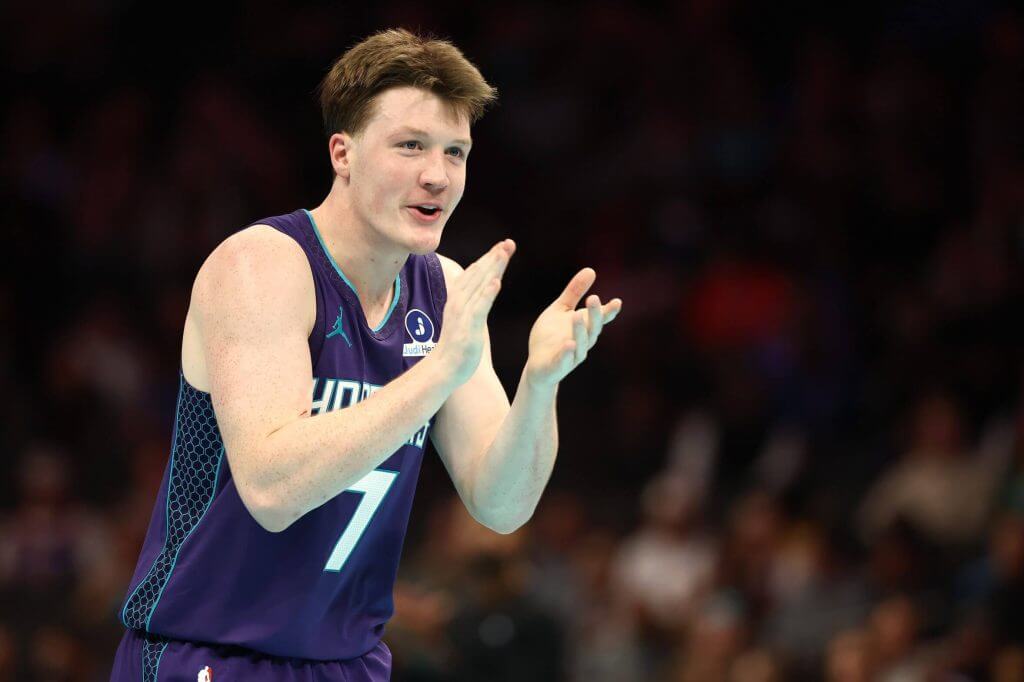
Kon Knueppel got out to an early lead in the Rookie of the Year race, but is now neck and neck with former Duke teammate Cooper Flagg. Knueppel is currently averaging 18.9 points, 5.5 rebounds and 3.6 assists per game. (Jared C. Tilton/Getty Images)
He’s had his rookie moments, though. In his second NBA game, against Philadelphia, he remembers his Welcome to The NBA Moment: getting clocked on a screen. He could feel his chest, his entire body, absorb the shock. “(Andre) Drummond got me pretty good,” Knueppel says, then cracking a smile — a genuine expression of respect. “Oh, man. That was a good screen.”
He still has rookie duties, too. “I have phone chargers, and I carry the plane stool for cards,” he recently told his family.
And as confident as he’s been against the Giannises of the world, even he can’t help but geek out sometimes when facing some of his superstar peers.
“You do a little bit, especially when you’re doing scout work or you’re watching tape. You’re like, ‘Man. I’m about to play this guy?!’ But once you get out there, the ball goes up, and you’re competing — it’s fun.”
He isn’t embarrassed to walk up to some of them after the buzzer sounds, though — including Nikola Jokić after the Hornets faced the Nuggets in December.
“He was one of my favorite players, so I told him that,” Knueppel says. “He was like, ‘Thank you, my brother.’”
Knueppel remembers meeting Khris Middleton, the longtime former Buck now on the Mavericks. “Man! One of my favorite players ever,” Knueppel says. “That was cool.”
According to his father, Knueppel approached Draymond Green after the Warriors game in December, telling him that he was impressed by how he affects the game in many different ways. Green was impressed by his size, according to Knueppel’s father; Green hadn’t realized Kon was that “big” and “strong” in person.
As much fun as Knueppel is having, he’s equally serious about his craft. He’s constantly asking the coaches how he can be better. He’s almost always studying film. His biggest asset might be his basketball IQ. He’s able to make an adjustment immediately in the game.
“Which is really hard to do,” says Hornets assistant coach Blaine Mueller. “Especially for young players.”
But it’s not just on the offensive end.
“Defensively,” Lee says, “you really see his basketball intelligence.” “He understands player tendencies really well. He’s really able to understand how to close out: What are the angles I even need to take to closeout on somebody? If I’m shifting on somebody, at what level or depth do I need to be at? If a guy is a lesser shooter. He’s a little bit flatter in his shifts; if the guy’s a better shooter, he’s higher in his shift to not allow a direct pass to that guy.
“He also does a really good job of understanding how to get to contest and do it without fouling,” Lee continues, praising Knueppel’s instinct to box out when a shot is released. “Most guys like to relax. Even if his guy doesn’t crash (the boards), he’s coming in to get a hit on somebody else’s guy, to make sure they’re almost sandwiching that person so they can’t get up.”
Lee often asks the team: “Who rewatched the game last night? What did you see?” He remembers a session in Cleveland in December when “(Kon) was the very first one to raise his hand,” Lee says. “For a rookie to feel comfortable saying something that early, I thought it was great. It was awesome.” What’s more, Knueppel raised points that the coaches had planned to as well — and did so without stealing the floor for too long. “It wasn’t a lot of fluff,” Lee says; Knueppel likely prepared what he was going to say.
He has had a photographic memory since he was a child. He’s always has his head in a book. He remembers random sports trivia in extraordinary detail from both the NBA and NFL. He’ll be out with his family and say randomly, “Remember the 2009 Packers playoff game when this or that happened?” Recently, he called a former college teammate and said: “Let’s list off guys from the 1996 NBA Draft.”
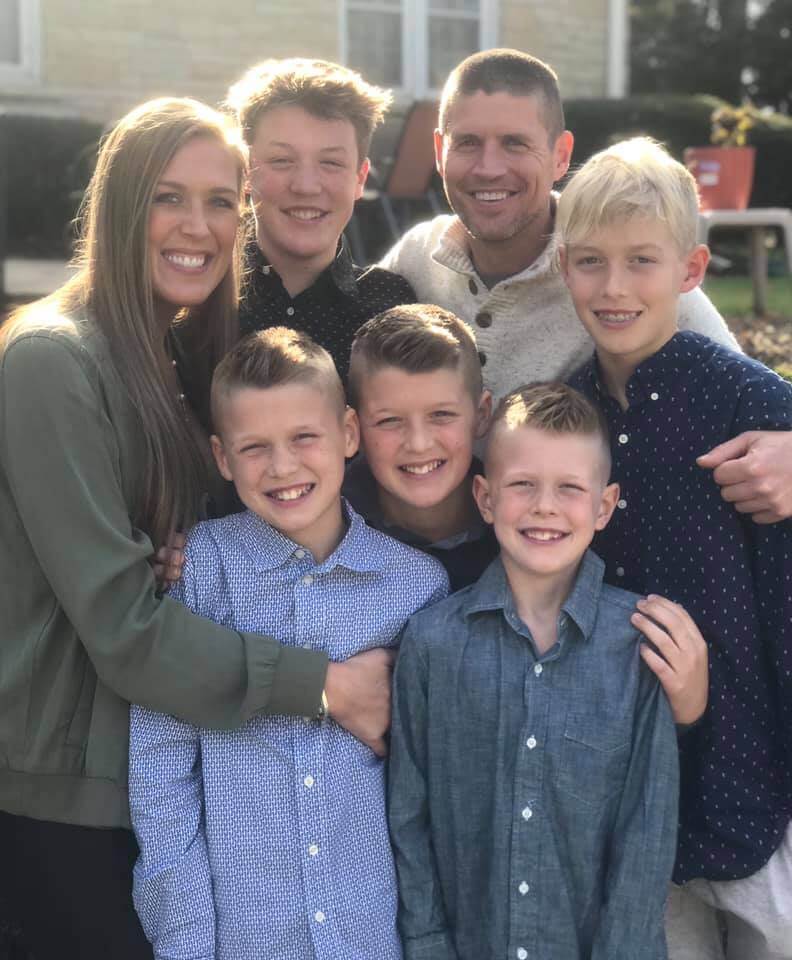
The Knueppel family, all boys, is packed with basketball talent. (Courtesy of the Knueppel family)
Whenever his inner circle praises him for his play, he’ll text back that he needs to be better with his turnovers. “Kon never thinks he’s arrived,” Dildy says. “He never thinks he’s made it.”
But he has — at least enough to be followed. His family remembers leaving the hotel during NBA Draft week to walk about six blocks to where draftees were supposed to meet. They were astounded to see dozens of people not just waiting outside the hotel but following Knueppel all six blocks.
Knueppel has become accustomed to people asking him for autographs wherever he goes, but it is still somewhat jarring.
“It’s a little weird,” Knueppel says. “That people want your time or want an autograph or picture.”
It’s still that way for his parents, too. “Mind blown,” Chari says. “Continually.”
She recently received fan mail for Kon from someone in South Korea.
Chari and Kon I never expected any of this, either. “We were just like work hard, get as good as you can,” the father says. Sometimes they laugh, though, thinking maybe it was meant to be, since Chari’s name is actually Charlotte. Besides maintaining faith and working hard, the elder Kon really had one rule for his boys.
He grins: “Stay out of foul trouble.”
All of the Knueppel boys play basketball, and they all have “K” names. There’s Kager, 18, who is 6-10 and a high school junior; Kinston, 17, 6-6, sophomore; Kash, 15, 6-4, freshman; Kidman, 14, 5-10, eighth grade. Then, Chari jokes: “K2, 20, 6-6, college dropout.”
The family calls Kon “K2” to distinguish him from Kon I; but to Chari, no matter how famous her son gets, he will always be “Konnie” to her.
When Knueppel was growing up, the home couldn’t be missed. They had a sign out front that read: “KONPLEX.” They still do but have added a Hornets flag.
His father was a Hall of Fame member at Wisconsin Lutheran College. His mother, formerly Chari Nordgaard, was a Hall of Famer at the University of Wisconsin-Green Bay, becoming the school’s all-time leading scorer. Chari was a post player, hitting buckets with finesse; Kon I was more of an outside shooter. They agree Kon II is the best shooter in the family, though the dad still plays in a men’s league that the family has run for over 20 years.
The family group chat is filled with commentary from Knueppel’s Hornets and his father’s men’s league games. And Knueppel isn’t too big-time to still learn from his dad. Kon I recently had a poor game. He was 0 of 9 in the first quarter but kept shooting, ending up going 9-of-9 in the third.
“Boys, trust your reps,” he wrote in the chat.
Recently, a college coach came to watch Kager play in his high school game. His NBA brother wrote some advice: “Play like you would when no one is watching. Make the right play. You will make mistakes. Do it aggressively. Dominate.”
Chari and Kon I always share the boys’ stats in the chat, too.
“People think it’s funny I still take stats for K2’s NBA games,” Chari says.
As obsessed as Knueppel is nowadays, he wasn’t immediately into hoops from the beginning. Quite the opposite.
“Dad,” 5-year-old Kon said to his father. “I don’t like sports.”
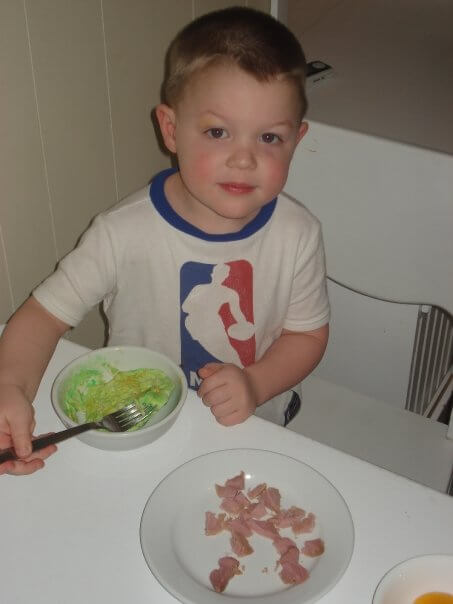
Basketball was an early passion for Knueppel. (Courtesy of the Knueppel family)
When he was around 7, he and his brothers begged their parents for a Nintendo Wii video-game system. Chari was initially against it, not wanting her kids to become hooked. But eventually, she relented. The first game Knueppel played was NBA Jam, and he studied the players with a fervor. One day, his parents came home, and he was blurting out facts about David Robinson and Tim Duncan.
But in his first year of playing as a kindergartner, he went the whole season without scoring. And the one time that a teammate dared pass him the ball, young Knueppel ducked. The ball sailed out of bounds.
But soon, Knueppel began to fall in love with the game, becoming competitive when he wasn’t even in the game. He wasn’t even playing. His dad was. When the father lost a tournament, young Kon sat in the bleachers, crying.
His hoops IQ began to develop. He knew where to make a pass before a teammate even cut. His uncle, Jeff Nordgaard, who was drafted by the Bucks in the second round of the 1996 NBA Draft, coached him for a few years in AAU ball.
“When he was a fourth grader,” Nordgaard says, “he played like an upperclassman in high school.”
Knueppel soaked up so much basketball from his parents and always had his nose in a basketball book, obsessed with every detail of the game he could find. Not content to just make shots, he made sure, as he got to high school and played on the EYBL circuit, that he defended, too.
“He’s sneaky athletic,” says Michael Nau, his EYBL coach. “He guarded the one through the four.”
After Knueppel performed well at a team camp at Marquette, the university’s coach, Shaka Smart, called to offer him a scholarship. As soon as Knueppel hung up the phone, he didn’t begin jumping around, celebrating. Instead, he said to his mom: “Whoa. I gotta get a lot better.”
Even he didn’t believe in his own hype; he was too focused on his improvement. Chari knew he was getting the offer a couple of days before he received it. She was elated — and could barely keep it in.
“I expected him to be that thrilled, too,” Chari says. “He was certainly happy, but his immediate reaction was to make sure he got good enough to warrant the offer.”
Knueppel spent nearly every night after practice shooting, according to Ryan Walz, his coach at Wisconsin Lutheran High in Milwaukee, who was worried he might be putting too much stress on his body. When told he might need to slow down, Knueppel looked nearly dejected.
“But coach,” he pleaded. “I love to shoot.”
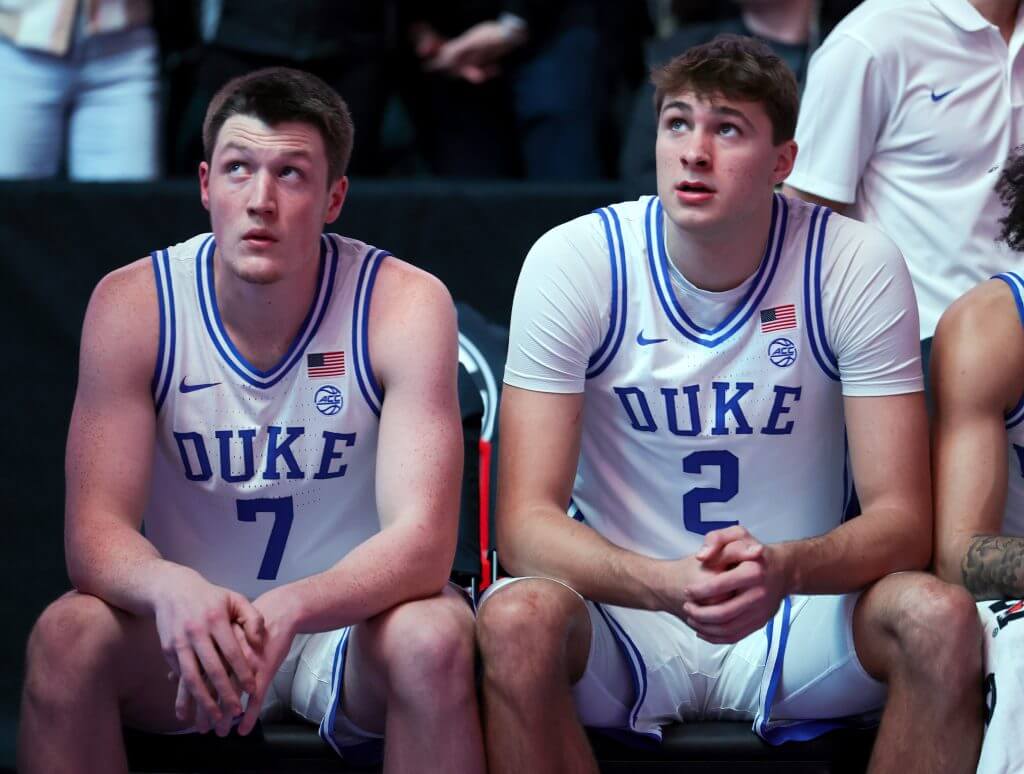
Knueppel and Cooper Flagg were roommates at Duke and remain close. (Ethan Miller/Getty Images)
The work paid off, as he headed to Duke, wanting to challenge himself against the best players he could, even if some critics thought he would ride the bench.
“I wanted to get as good as I possibly could,” Knueppel says, “and I thought going to Duke and practicing against the best players every day would for sure make me better … and (have) the most fun competing against the best guys.”
His first pick-up game at the university as a freshman, he didn’t try to play it cool or take it easy.
“I just remember him, like not getting on people, but wanting us to play faster and push the pace more and more,” says Neal Begovich, a former Duke teammate. “I remember on that first day being like, ‘Wow. This kid, he’s ready.’”
But inside, Knueppel was struggling with homesickness. All his life, he had done nearly everything with his four younger brothers and parents. Watching the Packers on Sundays. Rebounding for each other after school. Eating breakfast together. He felt so isolated when his parents left him at Duke during his first week that he asked if he could FaceTime during the family breakfast. He missed his friends from back home, too, who mostly stayed in the area.
“That was hard,” Knueppel says, “being away from people that you care about.”
He was also being pushed to his limit physically. He was playing well — and his coaches even told him so. Still, Knueppel didn’t agree. “I was being hard on myself,” he says.
The homesickness wouldn’t subside, either, as the summer turned into fall. The official season would start soon. Chari was close to driving the family Ford Expedition to Durham, N.C., and temporarily moving there. “We were really worried,” says Dildy, the Duke coach, “that Kon would go home before the year started and decide not to come back.”
One day, Knueppel asked his parents: “What’s it worth? What’s all this for?” Did he finally reach his limit? He questioned everything, but his parents encouraged him to keep his spirits up. To remember that all the work he was putting in would pay off for the rest of his life. He would find his way. He would be OK.
Knueppel kept pushing but struggled, also on the court. He went 5 for 20 against Kentucky in a loss. And against No. 1 Kansas, Duke put the ball in his hands late, with just three seconds remaining, and he turned the ball over. Duke fell in overtime. He berated himself more than any of his coaches could have, so much so that Dildy would come up with a few phrases for Knueppel to learn to let go of mistakes: “Nobody cares. Nobody gives a s—.”
“You think the world is ending,” Dildy would tell him, “but nobody cares in the grand scheme of things. Keep working.”
Knueppel learned to keep a short-term memory and began to blossom. He looked like one of the best players in the country. About a month into the season, Duke head coach Jon Scheyer told Knueppel’s parents: “Get ready for this train. Because this is how good your son is.”
But Knueppel had not just found his footing, but his peace. He realized something that would prepare him for the NBA more than any drill or tryout could. “I don’t want to have all of these emotions. I just want to get out there and play,” his parents remember him telling them one day.
“I don’t want to be that person that is mad, sad or angry because of a basketball game, because of how I played,” Knueppel told them. “I want to be grateful and happy and live my life not based on how I did on the basketball court.”
He would give his all each time he stepped on the floor but would no longer allow a poor performance to wound him. Define him. He would dedicate himself to being the best player he could be but would try to keep a balanced mind at the same time. “Basketball,” he says, “it really isn’t truly who I am.”
He started to enjoy playing with his teammates, even making friends on campus. He learned to be independent, to cherish his time with family but make a way for himself while away from them. And, as he would be named MVP in the ACC Tournament, when Flagg went down with an ankle injury, he proved how valuable he was — and how valuable he could become to an NBA franchise.
“Everybody thought we would lose,” Dildy says, “And Kon literally just put us on his shoulders and didn’t let us lose.”
Soon, it was clear Knueppel could become a lottery pick — something few could have predicted before the season began. But when preparing for the draft, he sprained his ankle. “That was very scary,” Chari says. He was laid up on his family’s couch for a week or more, Chari remembers. He enlisted a chiropractor, PT, and scheduled orthopedic surgeon appointments. The ankle held him out of the combine drills, but he was able to recover quickly. He was selected No. 4 overall.
He quickly meshed with his new teammates — and coaches. Mueller, the assistant coach, is also from Wisconsin. The two built trust early when he and Knueppel would watch Packers games together.
“He’s an easy guy to root for because he always plays hard. He’s always trying to make the right play,” Mueller says. “And his teammates know that, they see that. They appreciate that, and they feed off of it.”
Knueppel even had the entire team over to his home for dinner, back in November, during his Milwaukee homecoming trip. Kidman tried to dunk on LaMelo Ball in the family room hoop. Chari made 25 pounds of chicken fajitas with all the fixings: beans, rice, corn; even churros and watermelon, too. They had one can of Cherry Crush left from an earlier party, but everyone wanted it. Mason Plumlee ended up with it. Chari saw Brandon Miller and Miles Bridges a second time when they came to Milwaukee again, and they asked why they hadn’t been invited for dinner.
“They said they plan on an invite every time they come to town,” Chari says. “That is the best.”

The Hornets team dinner at the Knueppel house in November. (Courtesy of the Knueppel family)
It felt special to her — and to Knueppel — that his teammates were interested in getting to know him better. Every single player showed up.
Knueppel can often be found hanging out with not just his teammates, but staff, including trainers, video staffers and even Dell Curry, Hornets broadcaster and legend. Even though he is still just a rookie, he is assuming some leadership duties already.
“He’s quick to call you out if you’re not competing at his level that you’re supposed to be competing at,” James says. But he balances that with his own “humility,” James continues, “to check himself first and make sure that he’s where he needs to be.”
He’s playing at an elite level, averaging 18.8 points, 5.4 rebounds, 3.6 assists and 3.3 3-pointers in 32 minutes per game. Twice, he was named Eastern Conference Rookie of the Month, leading rookies in 3-pointers made, ranking third overall in the NBA in that category behind Stephen Curry and Donovan Mitchell.
Many back home in Milwaukee, people who aren’t even basketball fans, have told Knueppel’s parents that they’ve bought NBA League Pass just to watch him play — even though they don’t know the intricacies of the game. They like that he appears to have stayed the same, kept his Midwest values, despite his growing stardom. That appears to be the case.
His family still treats him the same, too. His grandmother, Eleanor Nordgaard, still bakes him his favorite banana bread — moist and perfectly baked; on one trip, arena security wouldn’t let her bring in the Ziploc bag of bread to a game, so the family hid it outside behind a rock and grabbed it after to hand to Knueppel.
Most of his conversations with his family, these days, aren’t even about basketball.
But the second he steps on the floor, he forgets about all of that. Where he’s from. What others think of him. He’s there to compete — and to have fun.
And to be the killer his team needs him to be.