
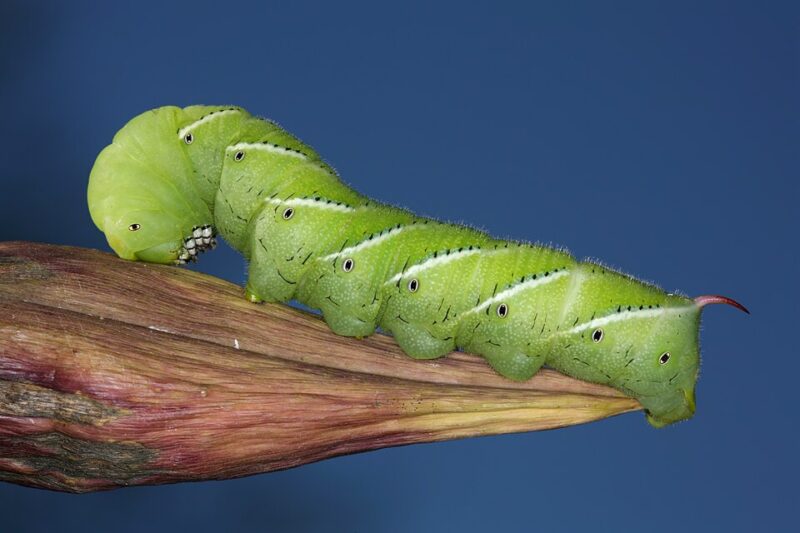
 A team of scientists has discovered tobacco hornworm caterpillars hear through tiny body hairs. Image via Daniel Schwen/ Wikimedia Commons (CC BY-SA 4.0).
Researchers from Binghamton University in New York have discovered that tobacco hornworm caterpillars (Manduca sexta) can detect airborne sound using microscopic hairs on their bodies. The researchers said on January 28, 2026, that their study shows for the first time how this species, a common garden pest, senses sound despite having no ears.
The study was carried out in Binghamton, New York, inside one of the world’s quietest, echo-free chambers. The researchers presented the information in January 2026 at the 6th Joint Meeting of the Acoustical Society of America and the Acoustical Society of Japan.
Without ears, caterpillars still detect sound
The research began with a long-standing observation by Carol Miles, associate professor of biological sciences at Binghamton University. She noticed that caterpillars startled whenever she spoke near them. Miles said:
Every time I went ‘boo’ at them, they would jump. And so I just sort of filed it away in the back of my head for many years.
The observation raised a question: were the caterpillars reacting to sound in the air, or to vibrations traveling through the plants they rested on?
Caterpillars hear airborne sound, not just vibration
To answer that question, researchers brought caterpillars into Binghamton’s echo-free chamber, a room designed to eliminate echoes and outside noise. They played both low- and high-frequency sounds while carefully controlling surface vibrations. Ronald Miles, distinguished professor of mechanical engineering, explained:
It allows us really extremely accurate control over the sound field. So we can give the animal just sound and no vibration, or just vibration and no sound.
Caterpillars responded 10 to 100 times more strongly to airborne sound than to vibrations through the surface beneath them. Sara Aghazadeh, a PhD candidate in mechanical engineering, added:
We wanted to find out whether they are responding to this airborne sound or just the sound-induced vibration of the base.
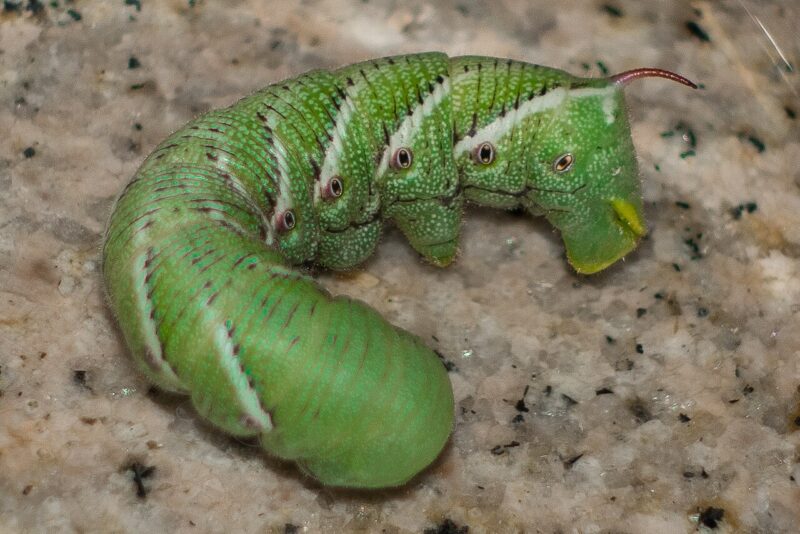 No ears? No problem! Caterpillars can hear without ears, responding strongly to airborne sounds rather than just vibrations beneath them. Image via Exilpatriot/ Wikipedia (CC BY-SA 4.0).
Microscopic hairs as sensory tools
After confirming that caterpillars detect airborne sound, the researchers identified the sensory structures responsible: tiny hairs covering the caterpillar’s body, particularly on the abdomen and thorax. To test this, the researchers performed hair removal on the caterpillars’ bodies. Afterward, the caterpillars were significantly less able to detect sound. Ronald Miles said:
A lot of other insects respond to sound, because sound causes motion of the air, and they have little hairs that can respond.
The hair removal procedure did not cause pain. Caterpillars lack nervous systems capable of conscious suffering, and the hairs are part of the outer exoskeleton. Removing them temporarily reduces sensory input rather than causing injury, and in many cases the hairs regrow during the next molt.
Caterpillars hear the sound of danger
The frequencies that triggered the strongest responses – around 100 to 200 hertz – match the wingbeat sounds of predatory wasps. According to PhD candidate in biological sciences Aishwarya Sriram:
The wing beat frequencies of these predatory wasps are around 150 or 100 to 200 Hz. So I think the caterpillars think that there is a predatory wasp hovering near or above.
This may explain why caterpillars react with sudden jumps, freezing or twitching when they detect sound.
Watch a video summarizing the new research.
An inspiration for technology
Beyond insect behavior, the findings may inform the design of more sensitive microphones. Ronald Miles said:
There’s an enormous amount of effort and expense on technologies for detecting sound. And the way it’s always been done is to look at what animals do and learn how animals detect sound.
The study shows that a familiar garden caterpillar can reveal new insights into hearing and inspire approaches to microphone design.
 Even familiar garden caterpillars can surprise us: their tiny body hairs detect the wingbeats of predatory wasps, a discovery that could inspire next-gen microphones. Image via Brixiv/ Pexels.
Bottom line: Scientists discovered that caterpillars hear airborne sounds using tiny body hairs. This helps them detect predators and can offer insights for advanced sound technology.
Source: Manduca sexta caterpillars hear using hairs
Read more: This amazing hummingbird chick looks like a caterpillar
Read more: Australian bogong moths navigate using starlight, says study
Cristina Ortiz
View Articles
About the Author:
Cristina Ortiz – based in Granada, Spain – is EarthSky’s defender of animals with her “lifeform” videos at EarthSky YouTube. Discover the most fascinating facts about all the beings with whom we share Earth. Are you ready for the adventure? Cristina has been an EarthSky.org editor since 2021. She has a master’s degree in translation and interpreting, specializing in science and technology. “Since I was a kid,” she says, “I could feel that passion for science and communication.”