
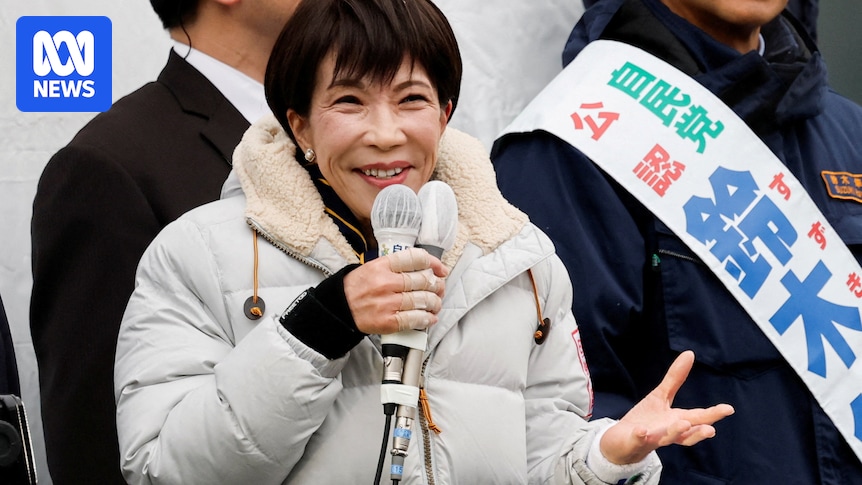
A stomping victory by the ruling coalition government of Japanese Prime Minister Sanae Takaichi has opened the way for a major geo-strategic realignment in the Asia-Pacific region, with big implications for Australia.
The size of the victory by Japan’s first female prime minister has not just been seized on by her as an endorsement of her robust approach to China since taking office, but also cleared the way for a potential historic constitutional change.
The conservative Takaichi is projected to have won 316 of the 465 seats in the lower house of the Japanese Diet.
Japan’s ‘Iron lady’ PM re-elected in landslide
The super majority gives the Prime Minister’s Liberal Democratic Party its largest majority since it was founded in 1955.
That’s just on 68 per cent of seats in its own right.
Its coalition partner, the Japan Innovation Party, won 36 seats, meaning the Prime Minister will hold 75 per cent of the seats in the lower house.
But perhaps more significant than the sheer size of the win — or the fact that she was endorsed by US President Donald Trump — is the way Takaichi framed her mandate on Sunday night as the results came in.
A new mandate
Takaichi said in a television interview that “this election involved major policy shifts”.
“Particularly a major shift in economic and fiscal policy, as well as strengthening security policy,” she said.
“These are policies that have drawn a great deal of opposition. If we have received the public’s support, then we truly must tackle these issues with all our strength.”
Trump congratulated Takaichi on social media, saying she would be able to pursue her “Peace Through Strength Agenda”.
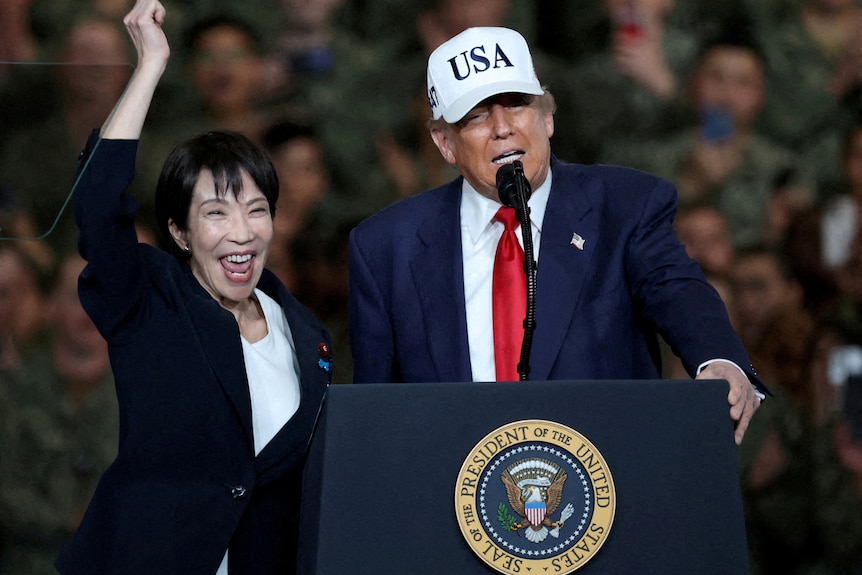
Donald Trump has endorsed Ms Takaichi, who he called a “strong, powerful and wise leader”.
(Reuters: Kim Kyung-Hoon)
All these comments point to the fact that Takaichi has taken a much more aggressive public approach to China than her predecessors, notably over Taiwan.
And that voters have endorsed that strategy.
Takaichi’s approach to China
Just after becoming prime minister in late October, Takaichi was questioned in parliament over how Japan would respond if China conducted a military blockade of Taiwan.
“I believe any action involving the use of force, such as China deploying naval ships, can only be described as a survival-threatening situation,” she replied.
The phrase “survival-threatening situation” is a benchmark necessary for Japanese military involvement — a scenario which might justify Japan exercising its right of collective self-defence under its current laws.
The China-Japan diplomatic row
Japan’s capacity, and willingness, to engage in military confrontation has been constrained since 1945 by its constitution and by a political aversion to the idea of engagement after the catastrophic impact of the World War II.
But here was the new prime minister confirming she may lead her country to respond to an escalation in Taiwan with military force and become embroiled in regional conflict.
Needless to say, Beijing was not impressed.
It issued travel warnings against Japan, resulting in an estimated 500,000 Chinese travellers cancelling their plans to visit their near neighbour.
‘Turning point in security policy’
Takaichi had already brought forward plans to double defence spending to 2 per cent of GDP.
But beyond the tougher rhetoric, and the extra spending, the prime minister’s new super majority means she easily has a two-thirds majority — at least in the lower house of the Japanese Parliament.
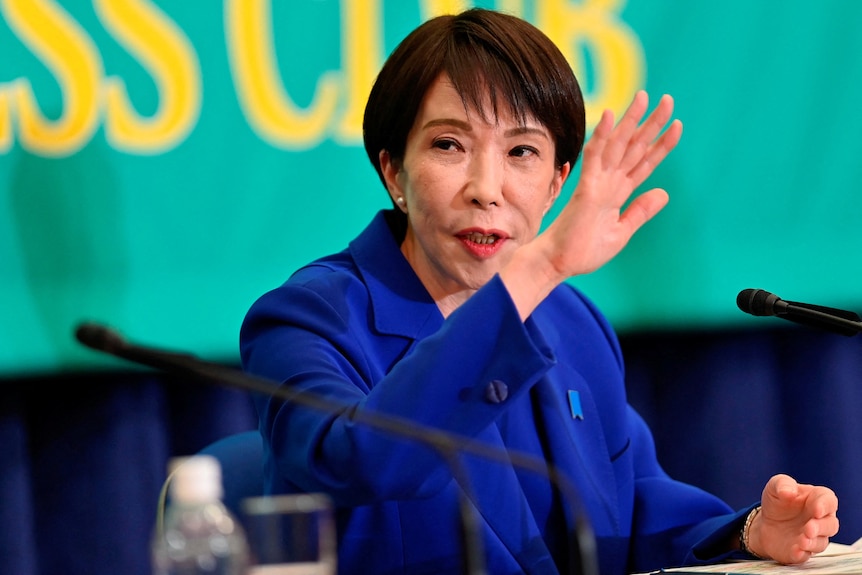
Sanae Takaichi has found herself in a prolonged diplomatic spat with China. (Reuters: David Mareuil)
That means she could push through a change to the constitution, originally framed by the United States after Japan’s crushing defeat in 1945.
She has committed to pushing a change in Article 9 of the constitution — which renounces war and constrains the use of military force.
While she still does not have the numbers in the upper house to achieve the change, analysts are speculating that the very size of her majority in the lower house will make it hard for the upper house to stand in her way.
Profound consequences
The day-to-day focus of the election campaign was on the cost of living, but Takaichi made clear her ambitions when it came to defence and security policy.
“We want to ask voters about a major turning point in Japan’s security policy,” she said in a party leaders’ debate on January 26.
There are a range of other implications flowing from the win relating to Japan’s security architecture.
That includes reforms to its intelligence agencies, removal of restrictions on defence equipment exports, and a prohibition on nuclear weapons being brought into Japan.
Coming at a time when the United States’ commitment to the Asia-Pacific is long on rhetoric, but heavily focused on getting allies like Japan to increase their spending and role, the Japanese election result will have profound consequences for our region.