
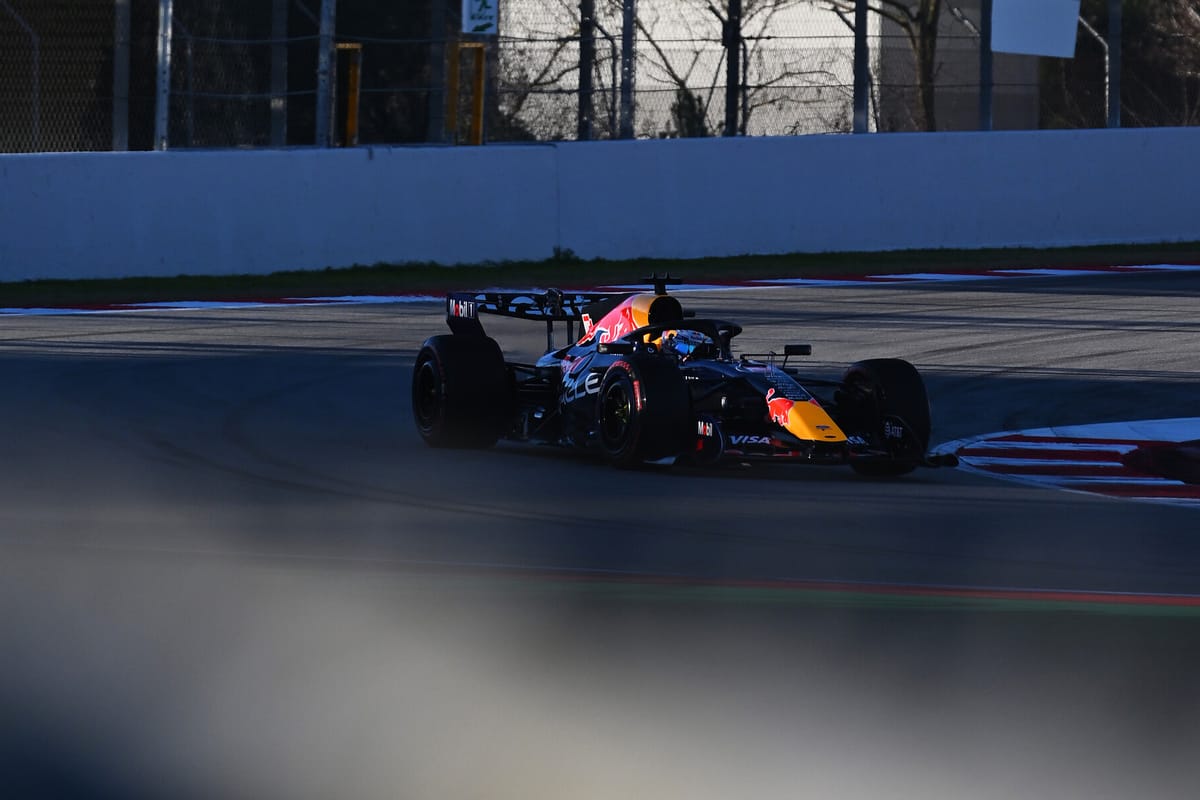
McLaren CEO Zak Brown has highlighted the performance of the new Red Bull-Ford Formula 1 engine as a surprise of the Barcelona pre-season shakedown test held last month, describing it as “very, very strong”.
The best-placed car on the timesheets powered by the engine, Max Verstappen’s Red Bull, was only seventh and 1.238s off the fastest time set by Ferrari’s Lewis Hamilton.
However, with headline times largely meaningless, the first power unit produced by Red Bull Powertrains completed significant mileage and showed promising performance.
“The Red Bull-Ford engine seems very, very strong, so hats off to them,” said Brown when asked what surprised him from what he saw at the Barcelona test. “Not only did it seem to be very quick, but also very reliable.
“The reliability in general seemed to be very strong for very sophisticated, new, immature regulations that will develop over time. The amount of running everyone got in was impressive.
“So I think those are the things that stood out, the [Red Bull] Ford engine and the general reliability on what are very sophisticated new rules.”
McLaren team principal Andrea Stella has also talked up Red Bull’s power unit performance, describing it as one of three suppliers, along with Mercedes and Ferrari “who have all got off to a good start”.
While Mercedes – which supplies defending champion McLaren – is widely regarded as having the strongest power unit package based on the limited evidence so far available, there remains a question mark of rivals’ attempts to push through a rule change to tackle its perceived design advantage.
This is because while the regulations state that the maximum permitted 16:1 compression ratio of cylinders in the V6 engine is measured at ambient temperature, Mercedes is believed to have found a way to exceed this when running hot.
However, Brown has dismissed this as “typical politics” of F1 and downplayed the advantage Mercedes has gained from any such design. He also echoed Mercedes team principal Toto Wolff’s comments about the legality of the engine, albeit in less incendiary terms.
“The engine has been designed and [is] totally compliant within the rules,” said Brown. “That’s what the sport is about, no different than things like double diffusers that we’ve seen in the past where they’re compliant within the rules.
“I don’t believe there’s a significant advantage as being represented by the competition, but of course their job is any perceived advantage, they’ll make some story out of it. But reality is the engine is completely compliant, passed all its tests and I think HPP [Mercedes’ High Performance Powertrains division] has done a good job.
“It’s a Mercedes topic. We obviously don’t build and design the power unit. So HPP does a good job of keeping us in the loop because obviously we’re very interested, but we don’t sit in the power unit working group where those conversations happen.”
Brown also dismissed the possibility that a rule change might be pushed through that could prevent it and its three fellow Mercedes-powered teams from competing.
“I can’t imagine that you wouldn’t have Mercedes teams on the grid in Australia,” said Brown, when asked by The Race if there could be a scenario where the cars can’t run owing to a rule change.
“We’re not privy to those conversations, so I wouldn’t even know from a power unit point of view what would be required to change the regulations. But we’ll have all the Mercedes teams on the grid in Australia, I’m sure.”
Where the FIA stands
Mercedes’ rivals are understood to be working on a proposal to change F1’s engine rules in time for the first race, and FIA single-seater director Nikolas Tombazis has reiterated the governing body’s desire to resolve this issue before the Australian Grand Prix in early March.
“We’ve spent a lot of time discussing how we solve those issues,” said Tombazis, in a Q&A session published on the FIA’s YouTube channel. “Our intention is, of course, to solve them for the start of the season.
“We don’t want to have controversies. We want people to be competing on the track and not in the courtroom or in the stewards room.”
Tombazis said the compression ratio limit had been lowered from 18:1 to 16:1 for 2026 to support F1’s new engine manufacturers in their quest to be competitive against the established ones, and that teams looking for grey areas and loopholes to exploit was a natural occurrence during major regulation changes.
“Because all of these newcomers have started way behind the established ones, we had to create some ways that would enable these newcomers to join the sport on a fair playing field, because otherwise they would have been way behind and, as there’s a cost cap, as there’s limitations, they would have always been struggling to catch up,” Tombazis said.
“It’s still going to be massively challenging for them. It’s not an easy task. And that’s why part of the condition for these guys to come in was also to create some simplification, some cost reduction also, and the compression ratio was one of those.
“That was one of the reasons we went from what used to be a limit of 18:1, which frankly was almost not a limit because you could hardly reach that level, to 16:1, which is a bit of a compromise.
“And of course, as these engineers are very clever and always pushing for an advantage, some have found ways to potentially increase it [the compression ratio] when the engine is running hot.
“It’s a numbers game and a statistics game and it’s impossible when we have new rules not to have such areas of discussion. That’s always been the case.
“I think what has changed is that we are determined to make this a championship of competition between the best drivers, best engineers, the teams, but not a championship of rule interpretation.”