
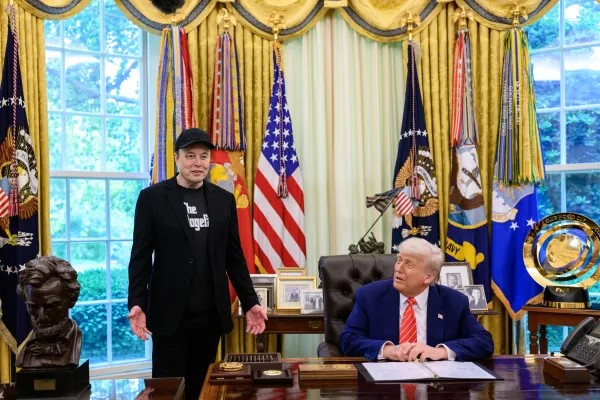
According to a report by FX168 Financial News Agency (Asia-Pacific), in an interview on February 5, billionaire Elon Musk once again emphasized his confidence in technology and his hawkish stance on debt issues, warning that the United States will go “1,000%” bankrupt due to the enormous national burden.
(截图来源:Finbold)
Musk stated in The Dwarkesh Podcast: “Without artificial intelligence (AI) and robotics, as a nation we will be 1,000% bankrupt and fail. No other method can resolve the national debt issue. We just need enough time to develop AI and robotics, ensuring we don’t go bankrupt before then.”
 Specifically, during discussions about the creation and role of the ‘Government Efficiency Department’—a controversial agency marred by chaos in the early days of President Trump’s second term—Musk focused on the issue of rising interest payments.
Musk said, “I am actually very concerned… Without AI and robotics, we are completely doomed because the national debt is accumulating wildly. The interest payments on the national debt exceed the military budget, which is $1 trillion. So we are spending over $1 trillion just on interest payments.”
Musk reveals why he helped establish the ‘Government Efficiency Department.’
The billionaire made it clear that his primary goal is to slow down the accumulation of debt so that the U.S. has a chance to develop AI and advanced robotics—technologies he believes might save the nation.
Musk’s view of technology as a savior aligns with his previous predictions. He estimated that advanced robotics represents a $10 trillion industry, while AI is expected to generate between $1.8 trillion and $15 trillion in revenue by 2030.
However, the actual relationship between these technological advancements and resolving the national debt remains unclear.
How AI and robotics could save the U.S. from a debt crisis.
The main argument supporting the rationale for deficit economics stems from the idea that as long as annual growth exceeds the annual burden, a country can avoid the potential pitfalls of this approach.
In this context, it seems obvious that technology-driven GDP growth can stabilize the situation. However, a key value proposition of artificial intelligence and robotics is large-scale automation—a result that could lead to an unprecedented employment crisis.
Previously, Elon Musk suggested that ‘universal high income’—an undefined variant of universal basic income (UBI), potentially with higher payouts—might address this issue. So far, pilot tests of UBI have shown positive results in improving beneficiaries’ mental and physical health without undermining economic foundations, making ‘free money’ a promising approach.
Nevertheless, significant opposition remains. Right-wing critics repeatedly raise the question of how a country can afford UBI, unwilling to accept the notion of ordinary people receiving payments akin to past bread handouts.
Left-wing critics worry that universal basic income could further weaken the power of the working class, as they would become entirely dependent on the government and large corporations.