
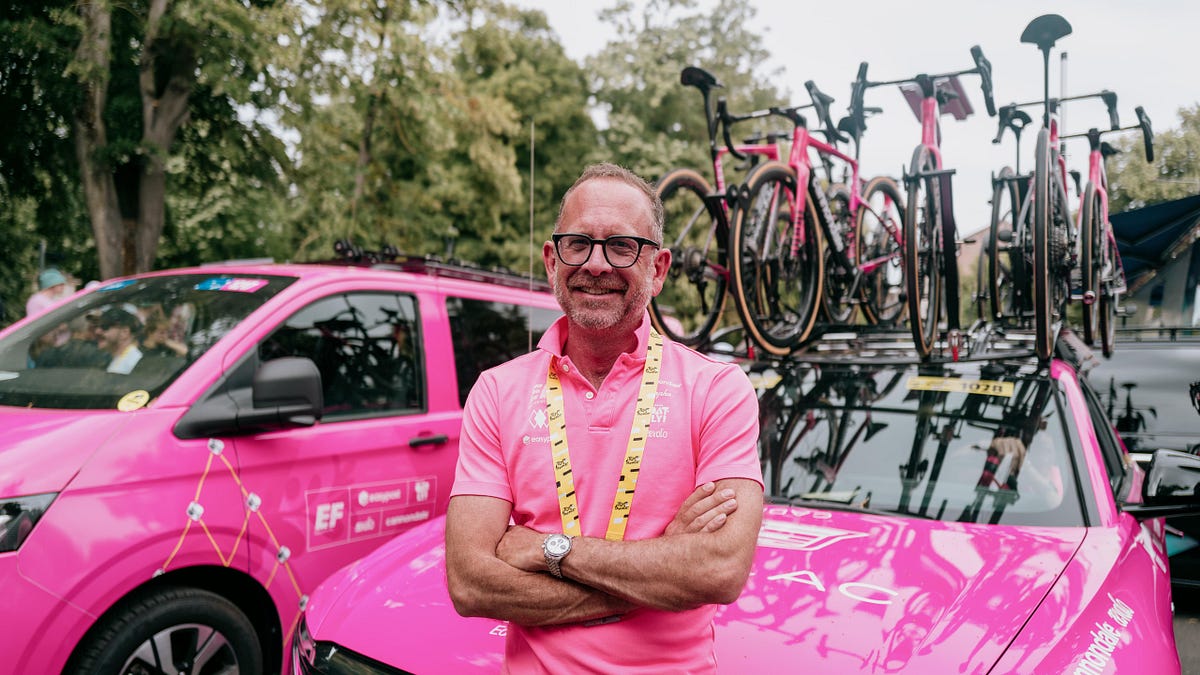
 Pretty in pink. Jonathan Vaughters runs the longest-standing and only American WorldTour team in men’s cycling. Photo courtesy of Keir Plaice.
Hi Subscribers,
At the start of January, when I first began this series of interviews with team bosses about their transfer strategy, I didn’t know if it would work, be well received, or if teams would shut up shop after the first piece with Jurgen Foré of Soudal Quick-Step.
Following our interview with the Belgian, we had Fabian Cancellara from Tudor Pro Cycling Team in the hotseat, and this time it’s Jonathan Vaughters from EF Education-EasyPost. I’ve been covering Vaughters and his team since 2008, from their Garmin days, right through to their current incarnation and the expansion of the organisation to include a women’s WorldTour team and a U23 set-up.
Cycling transfers: Inside Tudor Pro Cycling’s recruitment strategy🇨🇭
Cycling transfers: Inside Soudal Quick-Step’s recruitment strategy 🇧🇪
Follow me on: Twitter 🟢 — Instagram 🔴 — Bluesky 🔵
Being honest, I think this is the most in-depth interview in the series so far, with Vaughters providing insight into how he operates on the transfer market, how relationships matter with rider agents, how talent is scouted, how the books are balanced after a big contract extension with Ben Healy, and how the squad competes against the super rich squads such as Ineos and UAE Team Emirates. The story is 3,000 words, which is a lot, but I discovered loads from the interview, and I’ve been on the transfer beat for some time.
I really hope you enjoy the interview, and please share your feedback in the comments and let me know which team boss you’d like to hear from next.
Daniel 🫶
Daniel Benson: So I always start by asking the team boss to provide some background on their team’s overall recruitment strategy. Can we start with that?
Jonathan Vaughters: We can do that. It’ll be a little difficult to describe, but let’s give it a shot. It’s a complex matrix of physical talent, whether the rider will fit in from a personality standpoint, actual race results and then perceived upside. You have to look at all those different things, and we’re obviously trying to identify talent before anyone else does, then make a fairly quick decision on whether to bring them on board. It’s not always as clear-cut as you might think because you might have a kid who has incredible test scores, incredible power numbers, and their TrainingPeaks looks unbelievable, and ultimately, they just lack a certain number of racing skills and can never make good on that.
On the other side is someone who doesn’t have particularly impressive numbers, and yet they manage to produce great results on the road. Then there are guys who produce great results on the road in the U23 ranks but don’t have much room for improvement or upside. All of those things are really hard to put together. A lot of times, we’ll see these junior world champions or these phenoms at juniors with these incredibly high VO2 max numbers, and they fail in the WorldTour ranks. That happens because their bodies aren’t robust enough to adapt to the workload of more race days and to the greater intensity of racing and training. So even though they might have a large engine, they’re unable to make good on that talent because they can’t handle the strain. So for us, it’s about finding out who has the engine to begin with, can they handle the workload, and do they have the bike skills and race intelligence to make good on that talent. On a psychological level, are they willing and able to fit in with the team? Can they deal with the hardships of professional cycling? What’s their family life like?