
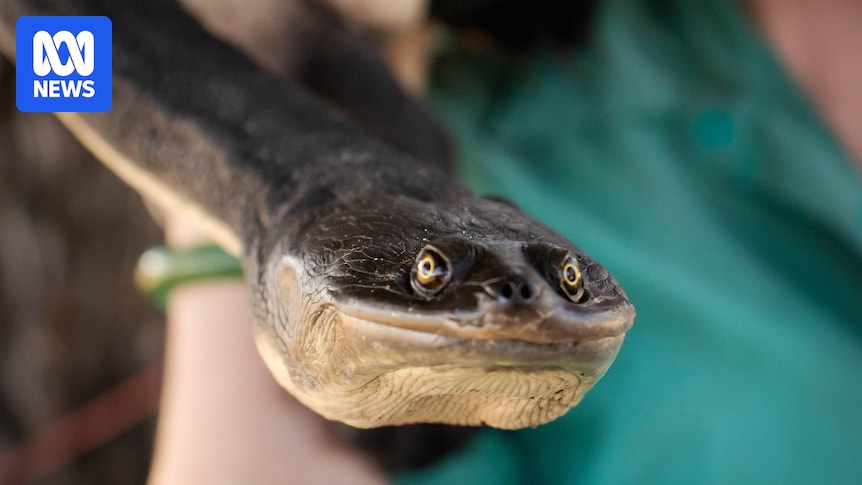
The unexpected discovery of four turtle species at Dumaresq Dam, near Armidale in northern NSW, has researchers perplexed and concerned about the fate of an endangered species.
The discovery has come as a surprise, as native turtles generally prefer running water.
But things changed when researchers from the University of New England (UNE) noticed posts online reporting endangered Bell’s turtles in the water.
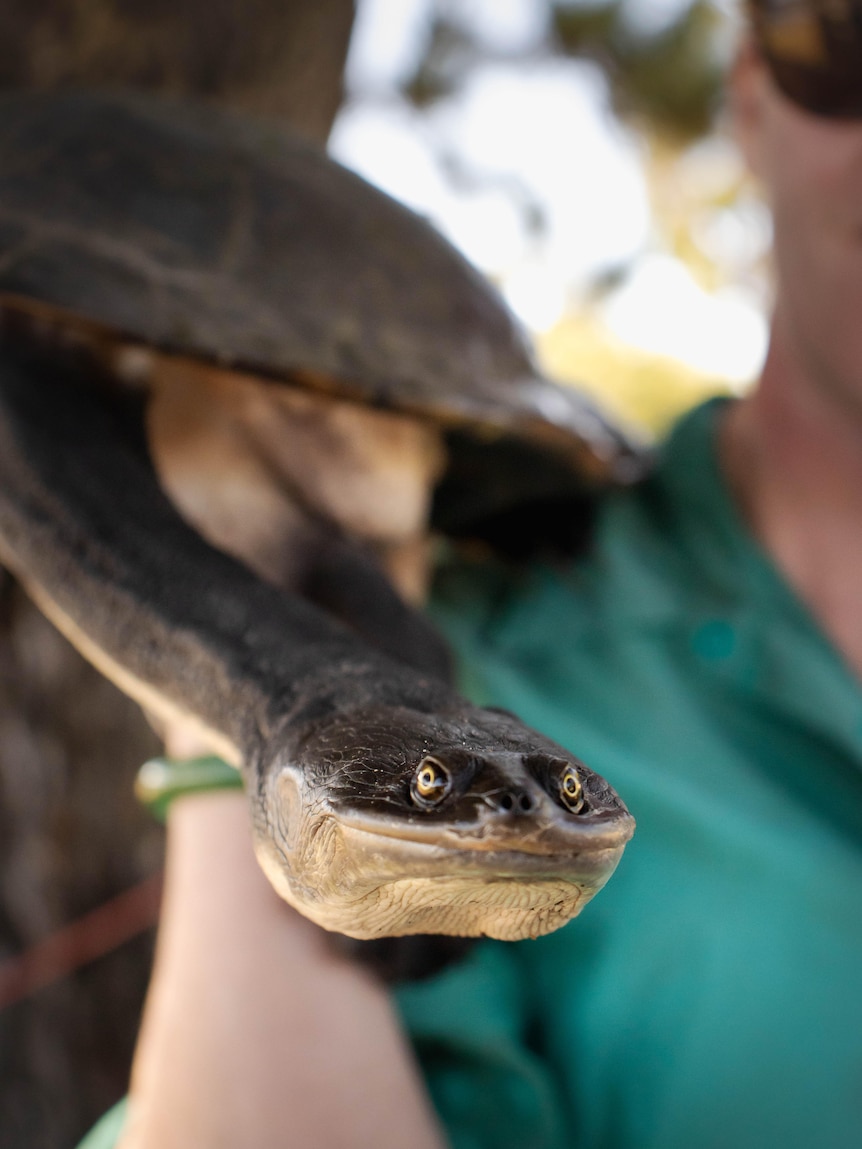
A lone broad-shelled turtle was found during the survey. (Supplied: UNE)
A UNE team conducted the first turtle survey at the site over January 19-22, recording not only Bell’s turtles but also the eastern long-necked turtle, Murray River turtles and a single large broad-shelled turtle.
Deborah Bower, associate professor in zoology and ecology at UNE, said they did not know where the turtles came from.
“It’s quite rare in Australia to have so many turtles in the same place … usually three is the maximum you’d get in one place [in southern Australia],” she said.
“We’ve been taking genetic samples from those animals to understand if they’ve got there naturally from the Gwydir catchment.”
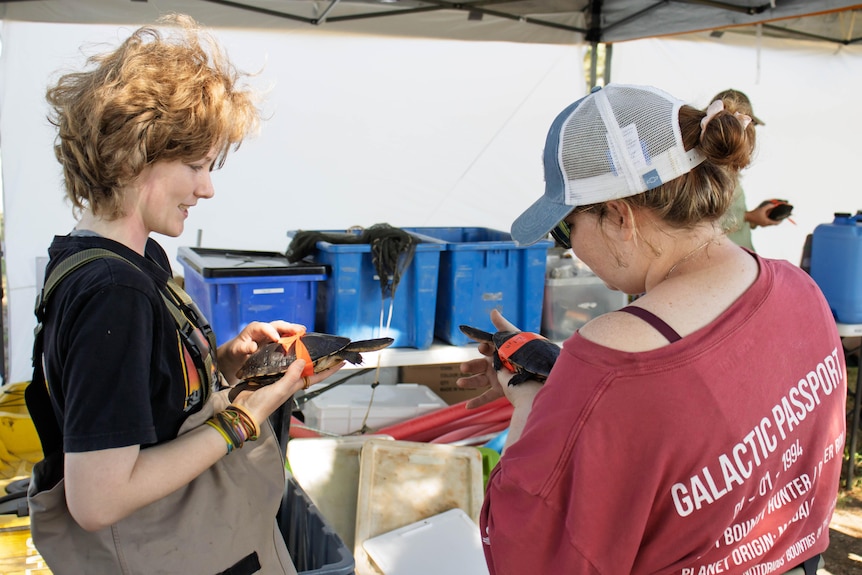
Genetic testing on the turtles could show if they arrived in Dumaresq Dam naturally. (Supplied: UNE)
Pet peeve
Only the eastern long-necked turtle is considered to be native to the area, and the presence of a single broad-shelled turtle has left researchers wondering if some of the reptiles were once pets.
Dr Bower said they often found turtles in strange places after people dumped pets that had grown larger than expected.
“[Owners] think they are doing the right thing, releasing them back into rivers and dams, but those turtles don’t naturally occur there,” she said
“In some cases they can hybridise with species that are already there and reduce their genetic purity, or they could cause competition or introduce disease.”
In 2015 several Macquarie turtles, thought to be abandoned pets, were scooped up from a golf course in Alice Springs, while in 2010 a flat-shelled turtle was found south of Perth hundreds of kilometres from its natural environment.
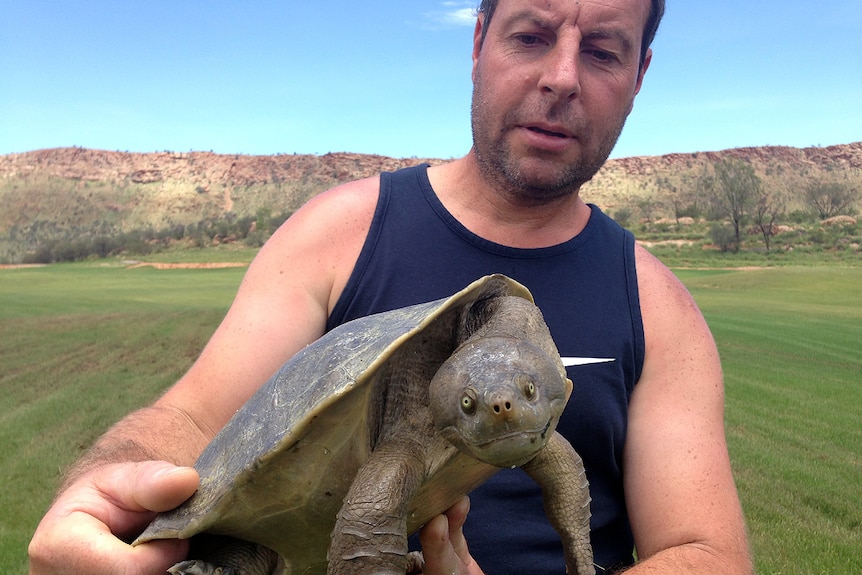
Large Macquarie turtles found living in the Alice Springs Golf Course in 2015 were suspected to be dumped pets. (ABC News: Rob Herrick)
In NSW it is illegal to release an unwanted pet turtle into the wild — they must by law either be given to a licensed handler or euthanased.
Data from the Wildlife Information, Rescue and Education Service (WIRES) showed there were 1,500 turtle rescues across 2024–25 with similar numbers reported the previous year.
Those cases included turtles hit by cars, found in inappropriate places, and mass rescue events when water sources dried up.
According to WIRES, “pet” turtles can carry diseases such as salmonella and parasites, which can lead to death and illness among native populations.
Common pet turtle species such as red-eared sliders are considered a biosecurity risk for this reason.
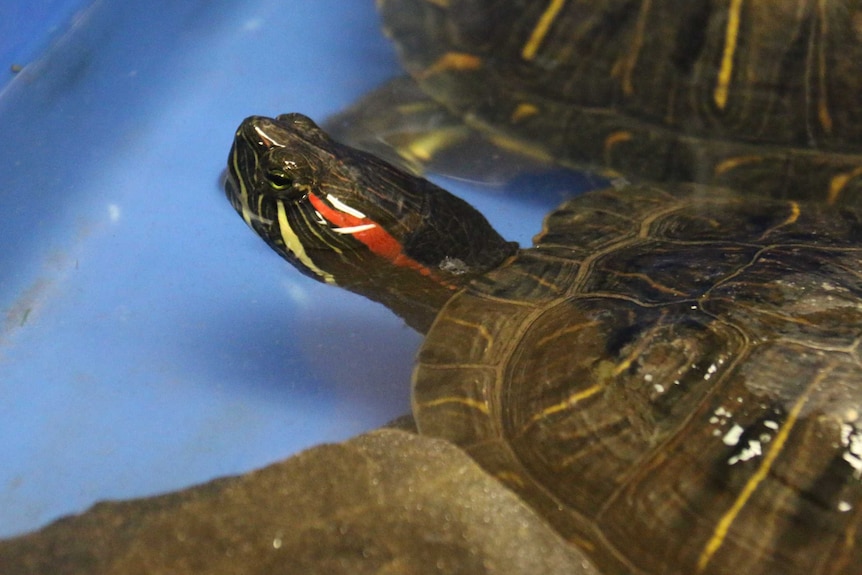
Red-eared slider turtles are one of the most invasive species in the world. (ABC News: Isabel Dayman)
Native to the Midwestern states of the USA and north-eastern Mexico, red-eared sliders are listed by the International Union for Conservation of Nature as one of world’s most invasive species, with an ability to breed quickly and adapt to various environments.
Cautious optimism
Dr Bower said time and research would reveal if the four turtle species found in Dumaresq Dam could co-exist in the small ecosystem.
She said there were concerns for the endangered Bell’s turtle, which was already dealing with about 90 per cent of nests being predated on in the wild.
“We’re looking at declining populations, we’re seeing at least in the border rivers catchment not a lot of juveniles coming into the population and also hybridisation with the Murray River turtle,” Dr Bower said.
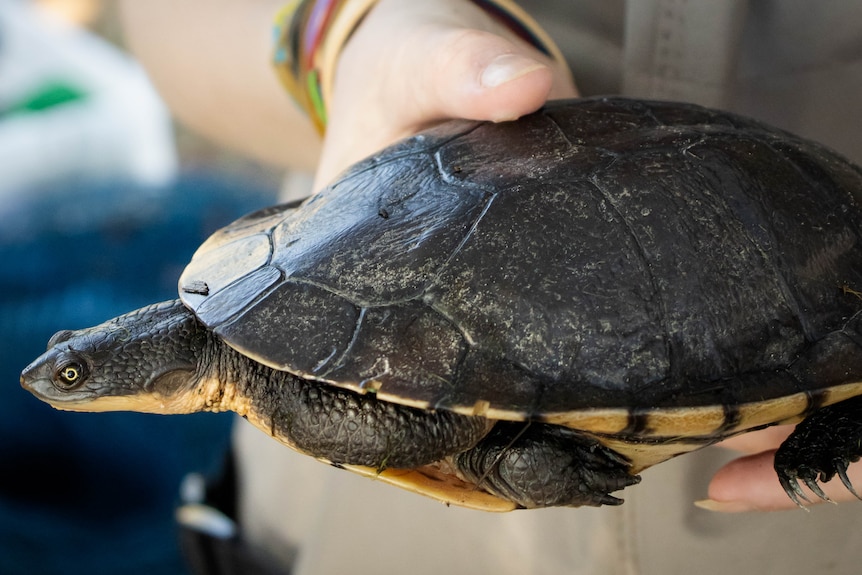
While both are natives, Murray River turtles (shown) have been known to hybridise with Bell’s turtles. (Supplied: UNE)
“We’ve got a program where we’re working with local land services … releasing thousands of turtles back into the wild.”
Dr Bower said the discovery of Bell’s turtles in Dumaresq Dam was positive for the species and conservation.
“It’s really exciting finding another catchment where they are separated from the other [known populations] and if they do go extinct in other catchments, they might survive in this one.”