
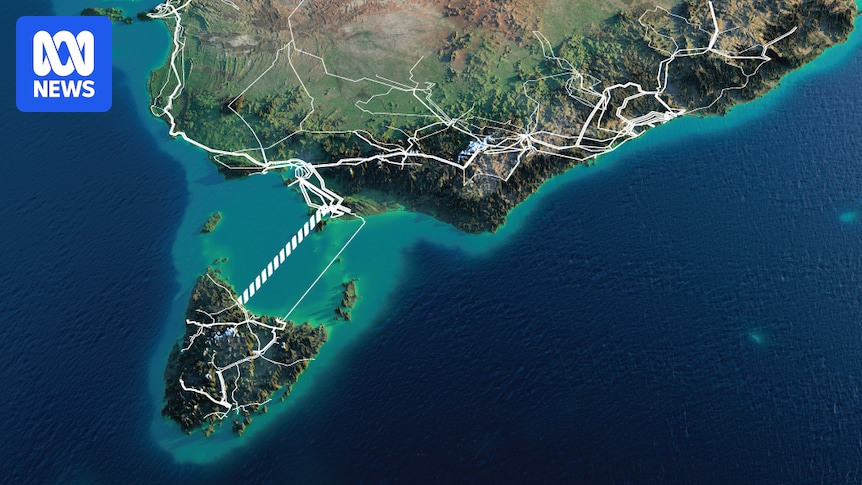
The Australian Energy Regulator (AER) has approved the first stage of an electricity link between Tasmania and Victoria, and the associated transmission line, despite not knowing the full impact they will have on Tasmanians’ electricity bills.
The Marinus Project consists of two components — the North West Transmission Developments (NWTD) project and Marinus Link.
The NWTD project includes a proposal for 240 kilometres of new or upgraded powerlines and other energy infrastructure.
The transmission line would stretch from Palmerston near Cressy in the Northern Midlands to Burnie in the north-west, and loop back to Sheffield, south of Devonport.
It would connect and support the proposed multi-billion-dollar underwater Marinus Link cable, linking Tasmania to Victoria.
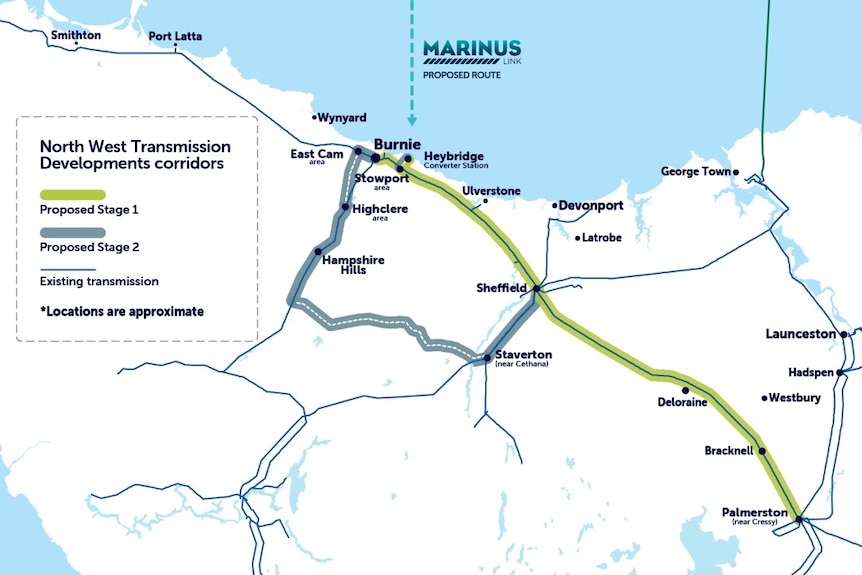
The North West Transmission Developments corridor, which will connect and support the Marinus Link cable. (Supplied: TasNetworks)
The first stage of the NWTD project will focus on the infrastructure between Palmerston and Burnie, about 60 per cent of the entire project.
That stage has now been given the green light by the country’s energy regulator, as has the first stage of the Marinus Link cable.
The AER has determined the construction cost of the cable will be $3.47 billion, while the first stage of the NWTD is expected to cost $922 million.
The cost of both projects will be recovered through electricity bills, which the Tasmanian government is looking to offset by using a federal loan and grant.
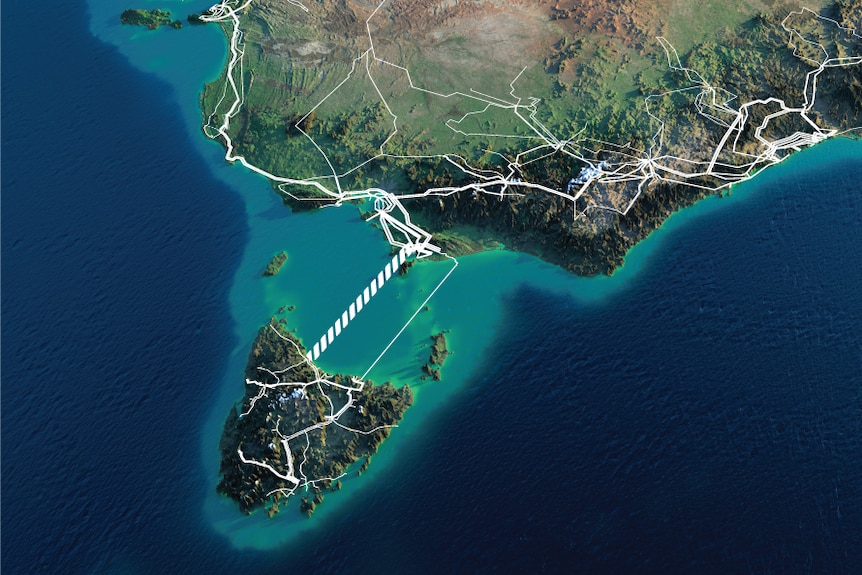
The cost of Marinus Link will be borne by Tasmanians and Victorians, while the cost of the transmission line in north and north-west Tasmania will be borne by Tasmanians. (Supplied: TasNetworks)
The cost of the NWTD will be shouldered by Tasmanians, while Marinus Link will be split between Victorians and Tasmanians.
In its decision, the AER estimated the cost of building the transmission lines would add about $15.50 to the transmission costs of their electricity bills each year from 2026.
From 2029, when the lines are operational, that amount increases to $49 per year for a typical residential customer.
The price increase will be offset by several things, including a $346 million federal government grant.
However, the regulator was not provided with a breakdown of savings per customer from the grant alone.
“We note that [electricity transmission and distribution company] TasNetworks did not include the impact of the grant on transmission charges in its application as the details of how the benefit from this grant would be passed through to Tasmanian customers were still being determined at the time,” the regulator wrote.
It’s not clear how the Marinus Project will affect Tasmanians’ power bills. (ABC News: Daniel Mercer)
Based on its current information, the regulator estimated the grant would reduce a residential customer’s electricity bill by 1 per cent per year.
The main offset to increased prices comes from a low-cost loan, known as concessional finance, from the Clean Energy Finance Corporation (CEFC).
But as the negotiation with the CEFC is ongoing, the AER could not account for the savings in its decision.
TasNetworks estimates it will reduce the impact of the project on customer bills by 60 to 90 per cent.
Energy Minister Nick Duigan said the grant and loan would result in savings for consumers.
“The $346 million grant will be applied against TasNetworks’ regulated asset base, so that is a direct saving to consumers, and that’s a $15 million saving year on year on year,” he said.
Nick Duigan says “energy prices in Tasmania will be lower with Marinus than without Marinus”. (ABC News: Owain Stia James)
The report on Marinus Link does not go into what it will mean for customers’ electricity bills.
CEFC has already agreed to provide $3.8 billion of concessional loans for Marinus Link, which it says will reduce the impact of transmission costs by 45 per cent.
The Tasmanian government maintains the Marinus Project will result in lower power bills for Tasmanians.
“It’s really important that we don’t take any numbers out of isolation,” Mr Duigan said.
“We know that energy prices in Tasmania will be lower with Marinus than without Marinus.”
A 2025 FTI Consulting report commissioned by Marinus Link estimated power bills would drop by $113 per year, arguing more wind and hydro in the grid would push down prices.
But a 2024 Deloitte report commissioned by Treasury found prices would increase for Tasmanians because the state would be more closely linked to the national energy market.

Ruth Forrest says consumers will end up paying more. (ABC News: Mackenzie Heard)
Independent MLC Ruth Forrest said it was still unclear how the Tasmanian government planned to ensure consumer power prices were lower once Marinus Link was constructed.
“It will go up, there’s no two ways about that,” Ms Forrest said.
“Once you spend millions and billions of dollars on energy infrastructure, it has to be recouped somewhere, and when it’s a regulated asset, it’s the consumers who pay.”
Construction is expected to begin this year.