
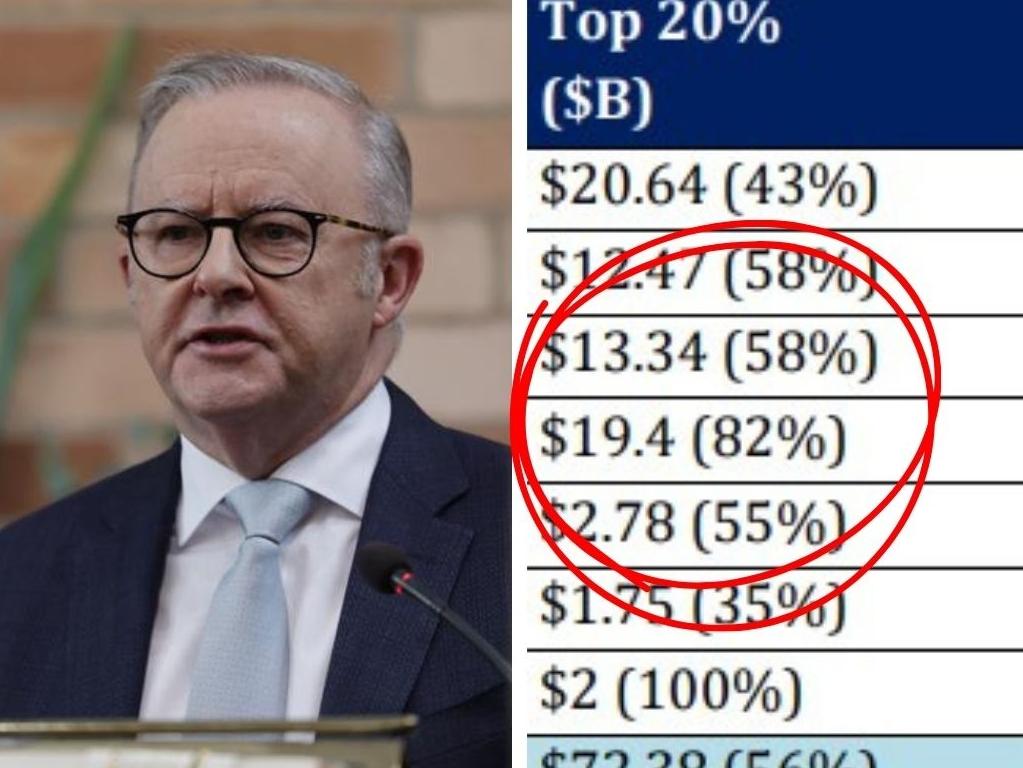

Prime Minister Anthony Albanese is seeing growing support to remove CGT discounts on housing which are helping distort the market. Picture: Hilary Wardhaugh/Getty Images.
The PM is under pressure as new housing data reveals 80 per cent of a $24bn tax benefit goes to wealthy Aussies while renters struggle with affordability.
This after an Anglicare Australia report – out Tuesday – found more than 80 per cent of the benefit of the capital gain tax discount for investors flows to the top 20 per cent of households, while two per cent flows to the bottom 20 per cent.
Anglicare Australia executive director Kasy Chambers said “now is the right time to take this issue on. There’s never been more public support for action, and housing costs – both rents and house prices – have never been higher. This is exactly the moment to tackle it head on.”
MORE: Aussies warned: Billions in tax perks to be cut
Albo’s gamble: Unions behind groundbreaking housing tax reform
This table shows the benefits received from government in billions of dollars by income quintile 2022-23. Source: Anglicare Australia.
“Rents have been rising sharply since the CGT discount was introduced. This is borne out by the surge in weekly asking rents over the past 25 years, and by Anglicare Australia’s own Rental Affordability Snapshot, which shows that affordability has worsened year after year,” Ms Chambers said. “If the argument is that these tax breaks keep rents down, the evidence shows that approach has been failing for decades.”
The Anglicare report found the capital gains tax discount, particularly when combined with negative gearing, had turned housing into an investment game, driving up house prices and rents while delivering the overwhelming majority of benefits to people who already own property.
It showed the capital gains tax discount alone cost the federal budget $23.7 billion in 2022–23, with more than 80 per cent of that flowing to the wealthiest 20 per cent of households.
Its analysis for 2022–23 data saw the wealthiest 20 per cent of households receive the lion’s share of housing-related tax concessions – more than $19 billion from the capital gains tax discount and $20.64 billion from the principal place of residence exemption.
By contrast, the bottom 20 per cent of households received just $0.47 billion from the CGT discount and $3.36 billion from the principal place exemption
Ms Chambers said “the impact of the CGT discount cannot be understood in isolation. Its most powerful effects emerge when it operates alongside negative gearing.”
“Together, these policies create a strong incentive to invest in property not primarily for rental income, but for capital growth.”
She said investors are encouraged to bid up house prices, confident that any losses incurred along the way can be written off against their income, and that eventual gains will be lightly taxed.
MORE: NRL star set for huge side hustle payday
Axed: Albo orders $3bn ADF sell off of 64 sites
Anglicare Australia Executive Director Kasy Chambers
“This dynamic advantages investors over owner-occupiers, particularly first-home buyers. Investors who can leverage tax concessions are able to outbid people seeking a home to live in, pushing prices higher and locking more people out of home ownership altogether.”
Ms Chambers said the policies concentrate housing wealth among those who already hold assets.
“Households that already own property are better positioned to acquire additional properties, benefiting from rising prices and compounding gains. Those who rent are left exposed to higher rents, greater insecurity, and no opportunity to build housing wealth.”
The report said that tax concessions which primarily benefit high-income households now cost far more in taxpayer funds than income support payments for people on low incomes.
In 2022–23, major tax concessions including the capital gains tax discount, negative gearing, and superannuation tax breaks cost an estimated $128 billion, compared with about $76 billion spent on the Age Pension and working-age welfare payments combined.
“Housing should be treated as essential infrastructure, not a tax-advantaged asset,” Ms Chambers said.
Anglicare called for the capital gains tax discount to be reformed alongside other housing tax settings, with revenue redirected into public and community housing to increase supply and ease pressure on the private rental market. “We are encouraged to hear that the government is looking at tax changes in the next Budget,” Ms Chambers said.
Anglicare supports phasing out CGT discounts fully over time.