
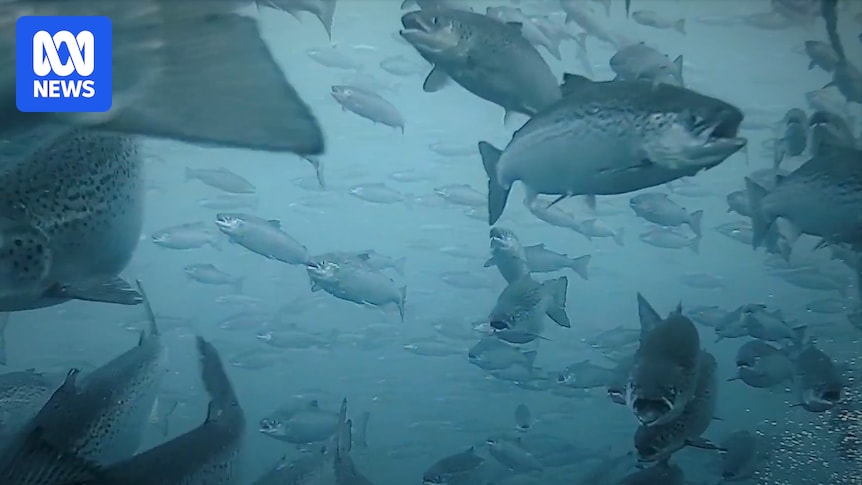
There are calls for the public to be made aware of antibiotic use in Tasmania’s freshwater hatcheries after Huon Aquaculture recently used oxytetracycline to treat diseased salmon.
There are no disclosure requirements regarding the use of antibiotics in freshwater facilities, despite more stringent rules applying to the antibiotic florfenicol in coastal marine fish farms.
Details of Huon Aquaculture’s use of antibiotics at its Meadowbank hatchery on the River Derwent were only made public after a report by the Tasmanian Inquirer.
On Tuesday, Huon Aquaculture told ABC Mornings it deployed antibiotics as a “last line of defence” after an increase in mortality at the hatchery.
The issue was caused by an intestinal infection, rather than the bacterial disease that led to a mass die-off event in coastal waterways in the state’s south-east last summer.
“Back in mid-January, we saw a spike in water temperature,” the company’s general manager of aquaculture, Depha Miedecke, said.
“Things got quite warm and subsequently we saw an increase in mortality and this was caused by intestinal bacterial infection that can sometimes affect salmon and other fish.”
Ms Miedecke said the medication was given to two cohorts of fish over a 20-day period under veterinary advice.
The Meadowbank hatchery is about 20 kilometres upstream from TasWater’s Bryn Estyn water treatment plant, which is the primary source of drinking water for Greater Hobart.
The township of New Norfolk is several kilometres further along the River Derwent.

The antibiotics were used about 40 kilometres upstream from the Bryn Estyn water treatment plant. (ABC News: Tony King)
While downstream users were not notified, Ms Miedecke said the company chose to be “proactive” and “transparent” by making a voluntary disclosure to the Environment Protection Authority (EPA).
“The use of antibiotics in freshwater is very rare, so it’s certainly not something we do regularly at all,” she said.
“We, in this case, decided to voluntarily speak with the EPA about it.”
In a statement, the EPA said antibiotic residue monitoring had been put in place following the disclosure.
“The use of antibiotics at Meadowbank Hatchery was self-reported by Huon Aquaculture, noting there is no current regulatory requirement to do so,” the statement reads.
“Accordingly, the EPA has put appropriate environmental conditions in place, including antibiotic residue monitoring at Meadowbank Hatchery.
“These regulatory requirements will apply across all freshwater hatcheries across the state, strengthening the EPA’s regulatory framework.
“Consistent with EPA practice, monitoring results will be published on the EPA website.”MLC criticises ‘murky lack of transparency’
Oxytetracycline is commonly used to treat diseases in agricultural and aquacultural settings, as well as for human health.
The World Health Organisation has categorised it as a “highly important antimicrobial”.
But the WHO also notes that “antimicrobial resistance”, caused by their “misuse and overuse”, is “one of the top global public health and development threats”.

Meg Webb says there is a “murky lack of transparency” surrounding the use of antibiotics in salmon farms. (ABC News: Maren Preuss)
Independent upper house member Meg Webb said the public should not have to rely on voluntary disclosures from salmon companies about the use of antibiotics in freshwater.
‘Full investigation’ launched after live salmon put into bins
“We’ve got here a really unfortunate murky lack of transparency,” she told ABC Mornings.
“This is why we need full transparency about this.
“We need to have people who are experts looking at this, we need the community to know that full information is being provided and assessed.
“And that’s really part of building public confidence and a social licence for this industry.”
‘Real-time updates’ in place for florfenicol
Oxytetracycline was used during the mass mortality event in coastal salmon pens early last year, but Huon Aquaculture had complained it had been “largely ineffective”.
The industry was granted approval in November to use a different antibiotic, florfenicol, in south-eastern waters, and has since applied it in pens in the D’Entrecasteaux Channel and off the north-west coast of Bruny Island.
Antibiotic approved for Tasmania’s salmon industry
“Real-time updates” showing when and where florfenicol is used are listed on the salmon companies’ websites.
A monitoring system was brought in for baseline and regular testing at various intervals, including the water column and wild fish.
When approval was granted, director of public health Mark Veitch advised the public that if they wished to avoid antibiotic residue, they could avoid consuming fish caught within three kilometres for 21 days.
During the application process, the industry argued that florfenicol had a range of advantages over oxytetracycline because it required lower dosages, lower levels were excreted by fish and it had lower toxicity for aquatic organisms.

Huon is a subsidiary of Brazil’s JBS Foods, which acquired the Tasmanian company in 2021. (Supplied)
Industry ‘heavily regulated’: Health Minister
The Greens called on the government to mandate real-time disclosures for all antibiotic use in Tasmanian waters.
“Instead of allowing Tasmanian waterways to be pumped with antibiotics, and leaving the community in the dark about it, the Liberal government should immediately require companies to report real-time antibiotic use and to destock diseased salmon farms,” Greens MP Tabatha Badger said.

Bridget Archer says she has no concerns about public health risks due to antibiotic use in salmon farms. (ABC News: Jonny McNee)
Health Minister Bridget Archer said antibiotic use was “heavily regulated” in Tasmania’s agricultural and aquacultural industries.
She said she had no concerns about public health risks relating to the use of antibiotics.
“Antibiotics, whether they are in veterinary use or in industry use in the salmon industry, are heavily regulated.
“And they are regulated with regard to their public health use as well. And we would expect those regulations would be adhered to.”