
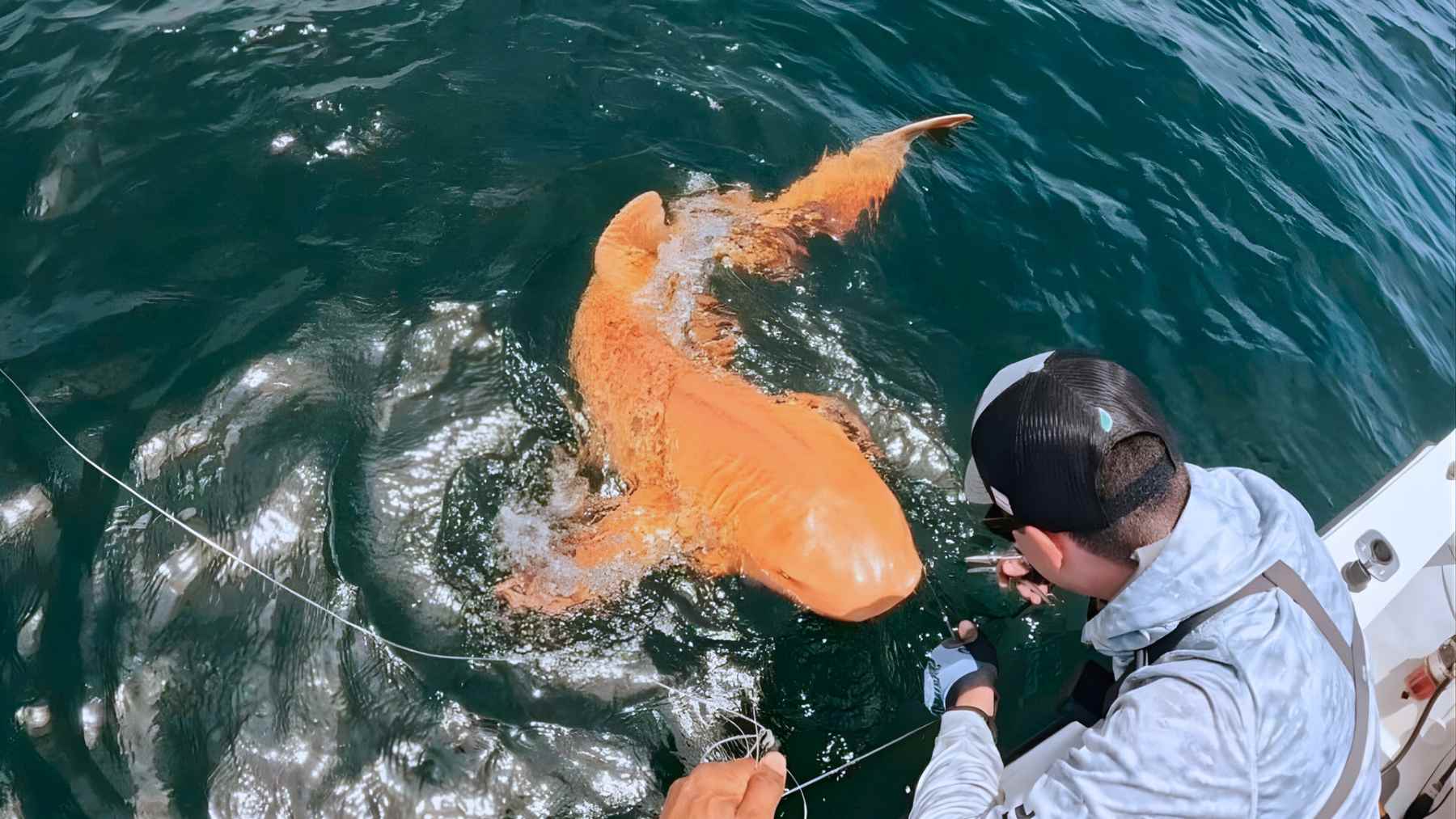
A group of sport fishers off Costa Rica’s Caribbean coast thought they had hooked a normal nurse shark. Then sunlight hit the animal’s skin and it looked almost neon orange. White eyes only made the moment stranger.
Scientists now say this catch, photographed and released in 2024, appears to be the first clearly documented case of a nurse shark with xanthism, a rare pigment change that boosts yellow color. The same shark also showed signs of albinism, which removes dark pigment and can leave eyes unusually pale.
A chance catch turns into a scientific record
The shark was caught near Tortuguero National Park at a depth of about 120 feet, roughly the height of a 10 story building. Garvin Watson, who runs the Parismina Domus Dei hotel in the village of Parismina, said the crew immediately knew it was unusual and took photos before removing the hook and releasing the animal.
Those images traveled fast. After reviewing them and speaking with Watson, researchers determined the shark’s color was not just “a weird lighting thing,” but a real pigment pattern that had not been formally recorded in this species before.
What xanthism and albinism mean in plain language
Xanthism, sometimes called xanthochroism, is basically a body-color shift where yellow pigment becomes unusually strong. In many animals, it can make normal patterns look washed out and push skin, scales, or feathers toward gold or orange.
Albinism is different. It happens when an animal has little to no melanin, the dark pigment that colors skin and eyes and helps block harsh sunlight. In this shark, the lack of the usual dark eye color was one of the clues that albinism may be part of the story.
Why an orange nurse shark is such a puzzle
Nurse sharks are typically yellowish tan to dark brown, a look that helps them blend in near reefs and sandy bottoms. They are often described as bottom dwellers, the kind of animal that benefits from not standing out. That is why a bright orange adult raises eyebrows.
So how did this one make it to adulthood? Researchers point out that color is tied to survival, since camouflage can mean the difference between being ignored and being noticed. Still, this shark appears to have grown to around 6 and a half feet long, suggesting it managed to feed, avoid threats, and live long enough to mature.
Clues, theories, and what comes next
Most evidence so far points to genetics as the main driver of these pigment changes. But scientists also mention that environmental stress, unusually warm water, and hormone shifts can sometimes influence pigmentation, even if the exact pathways are not nailed down yet.
The lead author, Marioxis Macías-Cuyare, a doctoral researcher in biological oceanography at the Federal University of Rio Grande, said more work is needed before anyone can say which factors mattered most here. For now, the photos are a starting point, not a final answer.
There is also a useful comparison from earlier research. A 2018 report on a ray from the Irish Sea described a similar pairing of pigment issues, showing that “double-rare” color cases can occur in related ocean animals, even if they are extremely uncommon.
The study was published on the Marine Biodiversity website.
Image credit: Parismina Domus Dei.