
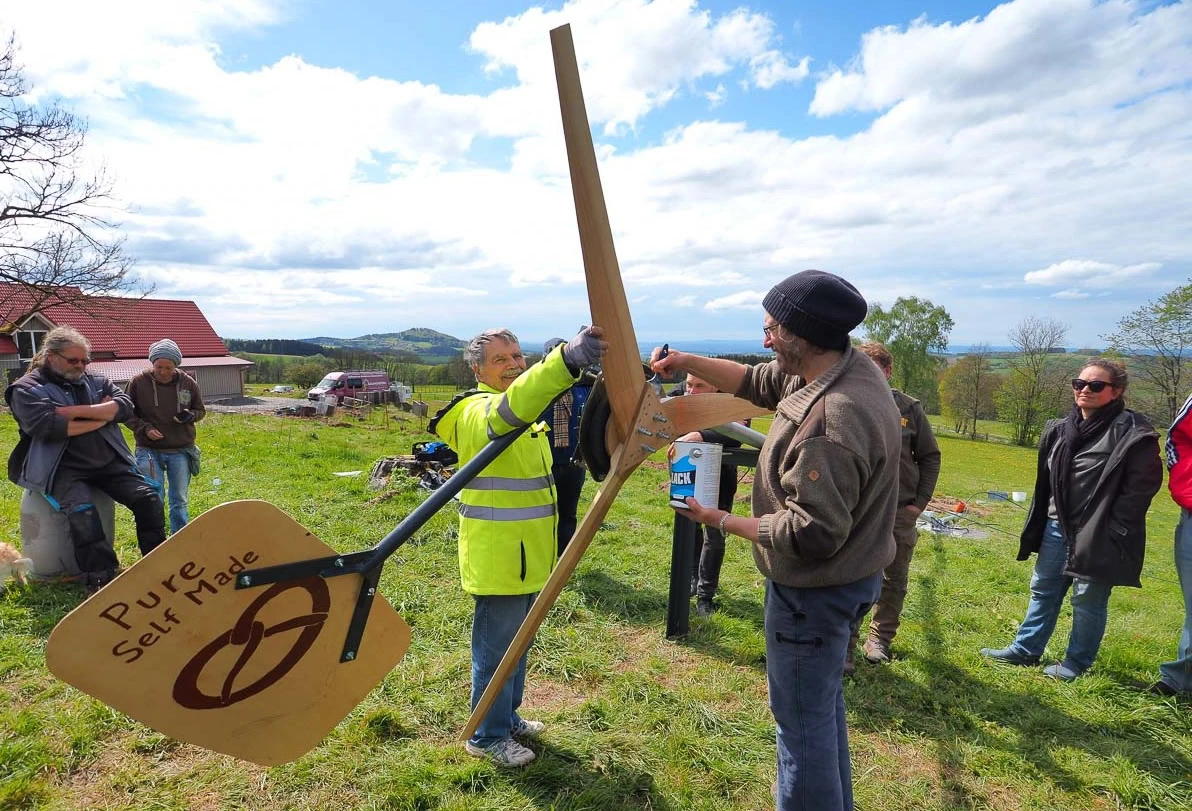
Last summer, Michel, a 65-year-old who lives in Sweden, attended one of the courses in northern Germany, driving there by motorbike. A former electronics technician, he was keen to explore the possibility of building a turbine at his home, where his solar panels are often hindered by a lack of sun or, indeed, snow covering them.
“The experience was absolutely amazing,” says Michel, who was one of about 20 attendees from several European countries at the four-day course.
“It’s very interesting. The costs are low. It’s hand made. You don’t need to buy from a foreign company. I hope to build one in the future.”
To reach an even wider public, PureSelfMade is developing a how-to book that will feature designs for turbines from 600W to about 3kW.
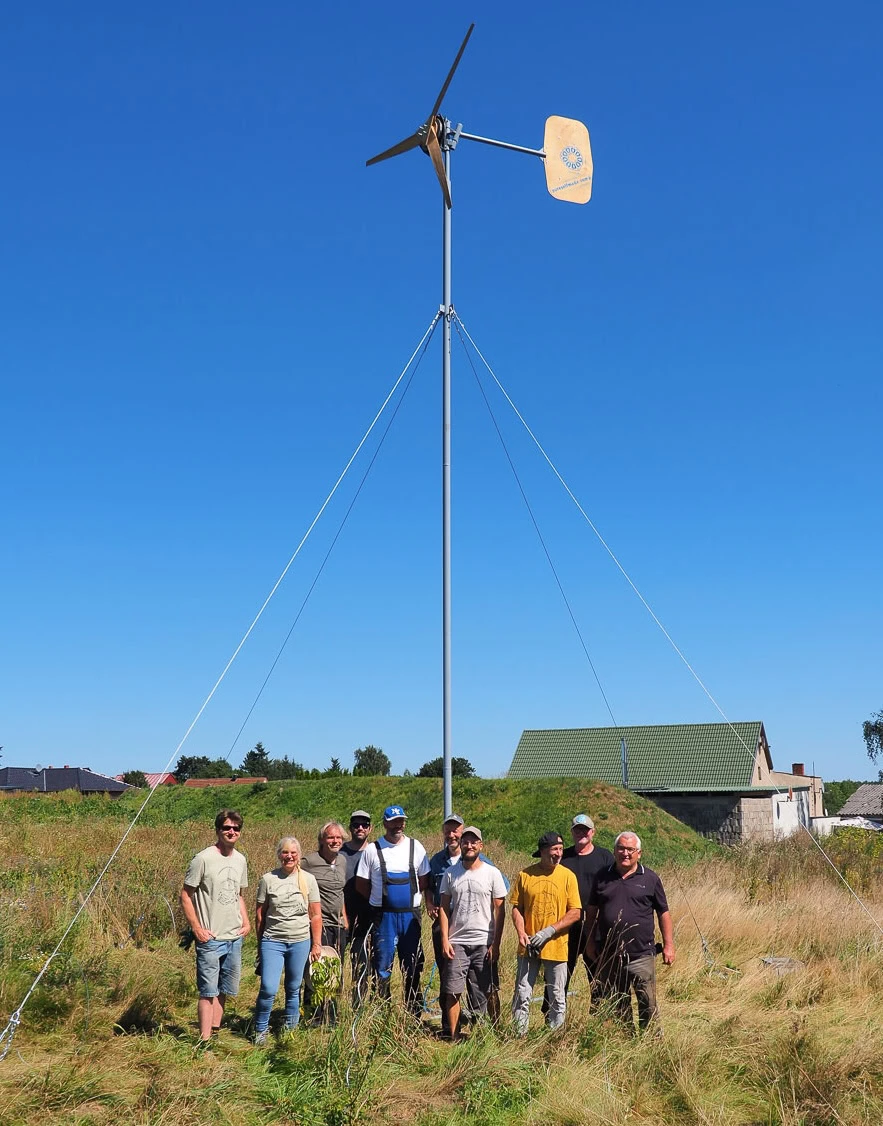 PureSelfMade says one of the main challenges is just convincing people that they will actually be able to make a small turbine. Credit: PureSelfMade
It has also begun selling some pre-manufactured parts for an easy build, with the eventual goal of providing everything needed. While the energy transition has been plagued with issues over sourcing components, with the EV industry causing social and environmental issues across the world, the supply chain for these turbines is as transparent as it gets. Most parts can be bought at a hardware store. And the turbine rotor blades are made from wood, which can be grown locally.
“It’s admirable what they are doing, quite frankly,” says Visser. “Especially using local parts, to avoid all the overheads. Wood, it’s a renewable resource, it decomposes naturally. I think it’s wonderful on a whole bunch of levels.”

Wait, you’re not a member yet?
Join the Reasons to be Cheerful community by supporting our nonprofit publication and giving what you can.
Wind can also work in conjunction with solar, he adds. The sun doesn’t shine at night, but the wind does blow. And in winter the sun is lower in the sky, reducing yields. The two can work together in the right circumstances.
Yet Visser, who ran his own small turbine company between 2015 and 2025 until it went bust, warns that reducing cost is the major challenge. His design had a unique concept using ducted blades — wrapping a duct around the rotor to increase the performance. But there weren’t enough sales to keep the company afloat.
“The capital investment is huge for an individual,” he says. “How can we make small wind turbines affordable?”
At the time Visser was developing his product, a turbine for an average home in the U.S. cost around $80,000, he says. His team managed to reduce that to around $15,000-$17,000 for a 3.5KW turbine.
But PureSelfMade’s models are significantly cheaper. A 2.2 meter-diameter turbine with an output of 700-1,000W, for example, costs around €1,500 ($1,740), including all materials required.
Over the years, Schreiber has improved the generator, magnets, turbine sizes and geometries. And he says there’s still “room for improvement” to make it easier and quicker. In time, grid converters for small wind turbines will develop just like solar.