
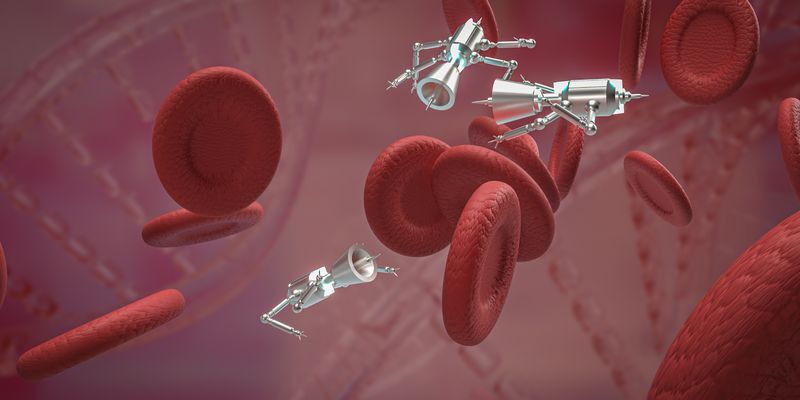
Tiny robots steer drugs through the body with precision.
credit: istock.com/niphon
Moved by magnets or ultrasound waves, these tiny robots make delivering drugs more accurate and effective.
Getting a drug to where the body needs it is a delicate balance. Too little compound can reduce therapeutic impact. Too high a dose can cause dangerous systemic side effects. A new generation of drug delivery devices is showing how to achieve this delicate equilibrium.
These systems are minuscule in size, controlled remotely, and can autonomously respond to changes in their environment. These robots face challenges in fabrication, form, and function, but are redefining precision medicine.
Magnets, metals, and models
The human circulatory system’s winding canals are significant challenges for accurate drug delivery. But that hasn’t stopped the robot designed by Bradley Nelson and his colleagues at ETH Zürich. The device itself looks like a nondescript, two-millimeter black orb, but this inauspicious exterior hides complex inner workings.
There are four main components to the device, Nelson told DDN. The robot contains iron oxide, which is magnetic. “That allows us to make it move,” said Nelson. In a recent Science paper, Nelson and his colleagues showed how the device could be steered through a pig’s body remotely using magnets, like a cross between Operation and Marble Run.
To enhance its visibility to scanners, the device includes the contrast agent tantalum. These materials are encased in a biodegradable gelatin matrix alongside the drug payload. Nelson’s team showed that their device could deliver tissue plasminogen activator, an anticoagulant.
If you’ve ever played with magnets, you see how they click together so quickly; that’s a very dynamic and hard-to-control process.
—Bradley Nelson, ETH Zürich
The device’s movement was difficult to master. “If you’ve ever played with magnets, you see how they click together so quickly; that’s a very dynamic and hard-to-control process,” said Nelson. The device had to reckon with the speed of blood in the body’s circulation. The team designed a navigation system that let the device move with blood flow, but with slight guiding deflections from external magnets.
Continue reading below…

The team first tested their robot in a model of the human vasculature, and then in sheep and pig models. In all cases, the drug, with its clot-busting cargo, could be directed carefully into targeted arteries.
Ultrasound pulses help move minuscule robots
Magnets aren’t the only technology powering modern drug delivery systems. Julia Greer, a materials scientist at Caltech, co-designed a robot that moves using ultrasound pulses. These devices, just a few dozen microns in size, have a hollow cavity in their center. This cavity’s presence means that blasting the robot with ultrasound waves sends it spiraling in controllable arcs.
Both Greer and Nelson’s systems are inspired by nature, but other systems go a step further. Biohybrid microswimmer robots are fusions of machine and microbe. These micro-cyborgs exploit the propulsion systems of bacteria or algae to move and then deliver drugs to targeted locations.
Fixed implants use inflation to beat the foreign body response
Other innovations in drug delivery robotics don’t even require movement. But implants that release drugs from fixed locations face a major hurdle: the body’s foreign body response. When the immune system recognizes an implant as foreign, it can trigger chronic inflammation and form a fibrous capsule around the device, isolating it from surrounding tissue.
These capsules can be disrupted with drugs, but their systemic use can damage major organs. A soft robot designed by a team at Massachusetts Institute of Technology (MIT) instead disrupts the fibrotic capsule by inflating and deflating itself. The robot can sense the capsule’s formation and respond accordingly. Ellen Roche, a mechanical engineer at MIT and co-author on the paper, said that although the device has not been trialed in humans, a potential use case could be in insulin pumps.
Normally, these pumps must be removed every three days as the capsule reduces their effectiveness. “We showed with this implantable reservoir that we can extend the therapeutic lifespan out to eight weeks,” said Roche.
Outstanding challenges for microrobots
A challenge in developing these robotic systems is fabrication. Greer’s robots are printed using complex lithography, which is key to their tiny size. However, the technique is material-specific. “It only prints in polymers,” said Greer. “Figuring out how to convince these polymer resins to contain metal ions or to contain some other functionality that you can then magically transform into a metal or into a metal oxide is very non-trivial.”
Nelson said that his team’s approach to fabrication, using microfluidic droplets, should enable mass production. He added that the robot is nearly ready for testing. “It’s not unreasonable to think we might have something in humans in three to five years,” he concluded.