
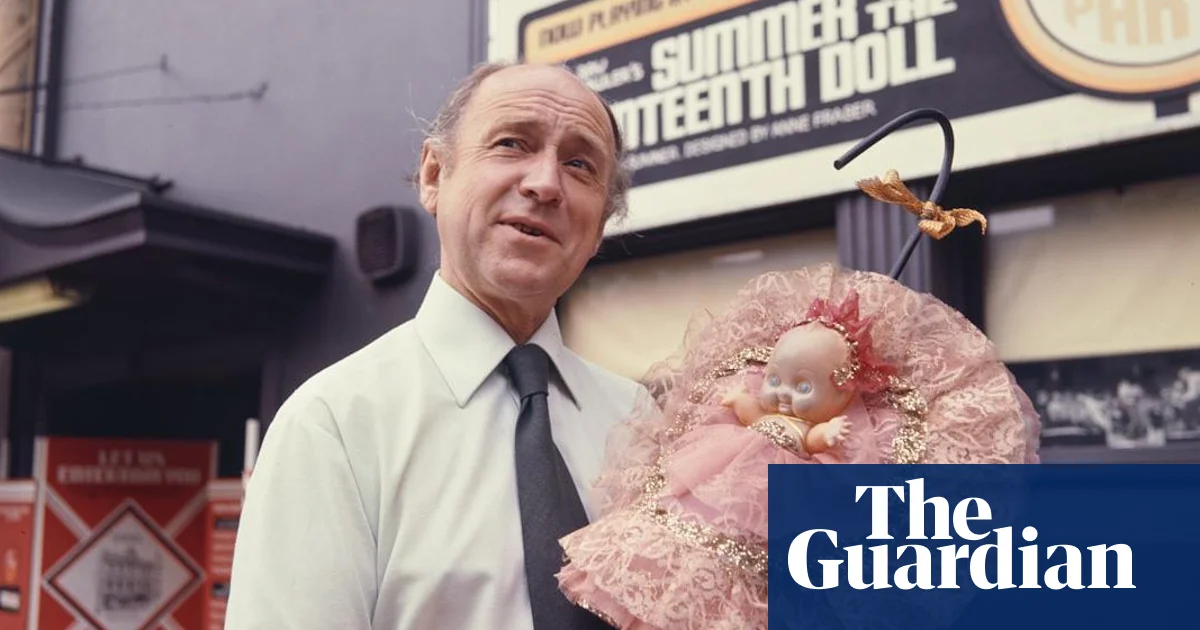
Classic plays often accrue unhelpful or misleading associations that can weigh them down in the public imagination. Ray Lawler’s Summer of the Seventeenth Doll is a case in point: arguably the great Australian play, it’s justifiably credited with having changed theatre in Australia forever by presenting a vision of authentic working-class life on stage. So many claims have carbuncled themselves on to the work since its debut in 1955 that it can be difficult to see it as anything but a museum piece, worthy and impossibly dated.
But when the St Kilda-based theatre company Red Stitch programmed its forthcoming revival of Lawler’s play and the two others that make up the Doll Trilogy – Kid Stakes and Other Times – they found a series of works that crackled with life and resonance.
“Historically, there’s been a lot of grandiose language about [these plays] being about the transformation of a nation,” says the director, Ella Caldwell. “It’s not actually about that. It’s about this specific family in a single lounge room, going through their big and little struggles in a specific time in Australia’s history.”
Inside rehearsals for Summer of the Seventeenth Doll in Melbourne.
Set in a boarding house in the inner-Melbourne suburb of Carlton in 1953, Summer of the Seventeenth Doll opens with barmaids Olive (Ngaire Dawn Fair) and Pearl (Emily Goddard) awaiting the arrival of Queensland canecutters Roo and Barney (Ben Prendergast and John Leary), who have spent the previous 17 years coming south for the layoff. It’s the continuation of an annual tradition, with Olive’s beau, Roo, bringing her a new Kewpie doll for Christmas each year – this year being the 17th, and (it turns out) the last.
With a simple conceit but crackling characterisations and powerful emotional undercurrents, the play was an unprecedented success when it premiered at the Union Theatre (now Melbourne Theatre Company). It toured nationally for two years before opening to great acclaim in London’s New Theatre, presented by Laurence Olivier. The subsequent New York premiere was far less successful, and the Hollywood film that followed suffered from strange casting (Angela Lansbury, Anne Baxter and Ernest Borgnine) and inconsistent accents. Even that couldn’t dent the play’s reputation and it has been remounted in Australia every decade since.
A scene from the 1959 screen adaptation. Photograph: RGR Collection/Alamy
Two decades later Lawler followed up with two prequels set in the same Carlton boarding house: Kid Stakes, set during the original layoff in 1937; and Other Times, set immediately after the second world war. Decidedly more optimistic than the tragic Summer, the first two parts of the trilogy work in subtle ways to complicate and sharpen that play’s central dilemma: how do you set up a way of life in direct opposition to society’s expectations? And how do you maintain it in the face of your own failings and insecurities? If self-delusion is a guiding principle in the Doll, then the earlier-set plays show how that delusion takes root.
Lawler’s world may be a recondite one for younger theatregoers, his accents and idiomatic speech patterns quaint and old-fashioned, but it has seeped immeasurably into our culture. The plays are also far more subversive and critical of the national character than older audiences might remember.
For a start, the key characters aren’t the conservative middle class of the Menzies era; they’re vibrant and mercurial working-class Melburnians living highly unconventional lives as barmaids and itinerants, thumbing their noses at societal expectation for as long as they can get away with it. Lawler’s view of the war is also painfully clear-eyed and unromantic. Newcomers to the Doll might be surprised to find it’s a matriarchal world too, presided over by the flinty single mother Emma, played here by the superb Caroline Lee.
Red Stitch’s revival will give audiences the rare chance to see all three plays consecutively in marathon sessions on Saturdays throughout February and March, immersing themselves in the trilogy’s milieu and deepening the original play’s concerns. As the actor and former Sydney Theatre Company director Robyn Nevin – who played Emma in Neil Armfield’s stunning Belvoir production in 2011 – told ABC RN in 2024: “To see the three of them in one day is something you’ll never forget.”
Robyn Nevin in Belvoir’s 2011 production of Summer of the Seventeenth Doll. Photograph: Heidrun Lohr
The female characters especially shine in this deeper immersion, Caldwell says. “You grow to know and love Nancy, who is a kind of ghostly figure in the Doll. You better understand the resilience of Olive and Emma. The strength of vision and fight in all of the women.”
Audiences can also see the plays individually during the week, in any configuration. Some might choose to start with the lost dream of the Doll and work backwards, in the mode of Stephen Sondheim’s Merrily We Roll Along, the heart-wrenching sadness of the later play making the optimism of the earlier plays feel tragically misplaced. Others might choose to see one play only.
‘Hearing that vernacular coming out of the mouths of younger people is quite special’: Ben Prendergast, who plays canecutter Roo in Summer of the Seventeenth Doll. Photograph: Red Stitch
Caldwell says Other Times is her favourite. Originally considered the “problem play”, it was reworked by Lawler and is a moving reminder of all the war took from people, an optimism and sense of freedom they’d never get back. Its tragedies may be granular but they have an awful cumulative power about them, preparing the way for the ruin to come.
Caldwell says the trilogy “feels like a gift”, while Prendergast calls it “binge theatre. These are generations that are disappearing, so hearing that vernacular coming out of the mouths of younger people is quite special. It’s a beautiful advocacy for a world that’s lost to us.”
The Doll trilogy runs until 11 April at Red Stitch theatre in Melbourne, then Theatre Royal, Hobart (28-31 May) and Her Majesty’s Theatre, Ballarat (20 June).