
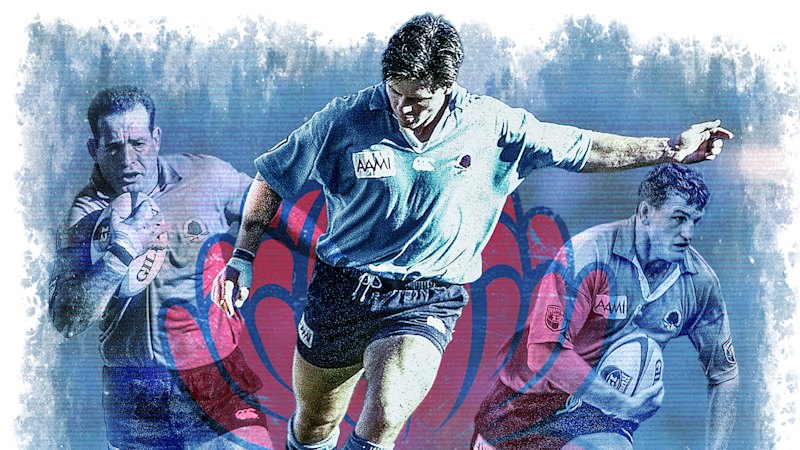
“We were training with the Waratahs from six in the morning until six at night, and I’ve never been so tired,” Burke said. “I’d also never been more bruised on my elbows.
“You were so tired that you missed the door frames and you’d hit your elbow against them. You’d have a pool session around four times a week, but it was also incredible. I played a hobby for a living and got paid for it.”
The second-rower who crossed the Nullarbor
Two years before Super Rugby was born, John Welborn had driven from his home in Perth to Sydney to pursue his dream of playing rugby at the highest level.
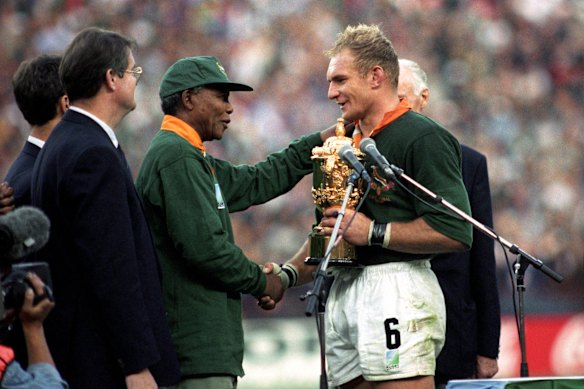
South Africa captain Francois Pienaar receives the William Webb Ellis Trophy from Nelson Mandela.Credit: Getty
He set himself the initial goal of making first grade at Eastern Suburbs.
The physical second-rower went on to become a regular for his adopted state and started in that first match against Transvaal.
The Waratahs won 32-11, thanks to two tries from Burke. But Welborn’s abiding memory isn’t the result – it was the speed of the game, which was on another level to what he had been used to.
“It [Super Rugby] captured the imagination and I think it was the fact that there was really competitive scoring,” Welborn said. “There was a lot happening.
“The rules had developed after that 1995 World Cup, the lineouts were more competitive and the balls seemed to move a lot more. Instead of training just twice a week, the training had increased and the backlines had developed more sophistication.
“We’d all worked a lot on our attack, but we hadn’t yet done a lot of work on defence, which came later into Super Rugby. So we had a professional attack, but amateur defence.”
Welborn has carved out a highly successful career in the mining industry since his playing days. But before Super Rugby, the switch to playing professionally for the qualified accountant wasn’t automatic.
“It was a huge risk [moving to professional rugby], but I’d gone to Sydney to see how good I was and I hadn’t answered the question yet,” Welborn said. “So, it was pretty easy for me to say, ‘OK, let’s see if I’m good enough to play at this level. I’ll find out pretty quickly’.
“It was a ruthless meritocracy … if I was bad in that first game and the second game, I would have been back asking for a job three weeks later.
“I wasn’t saying ‘For the next 10 years of my life, I’m going to be a professional rugby player’. It was much more ruthless and I think that’s why we were so competitive in those days … the uncertainty made it a real challenge, it really brought us all together in a way that is possibly unique.”
The generational Waratahs
Mark Bell was the starting NSW hooker against Transvaal and is well qualified to judge how far the organisation has come in the last 30 years.
Bell’s son Angus has become a mainstay for the Waratahs and the Wallabies. But for Mark, standing on the field and looking over at towering opponents who had fully embraced professionalism was petrifying.
“It was intimidating [going into the game],” Bell said. “The South Africans really became professional trainers, and they were just enormous humans.
“I remember, there was a guy called Rudi Visagie that I met the year before in Auckland, and he was the biggest human I’d ever seen [Visagie stood 198cm tall and weighed 139kg]. I shook hands with him, and I felt like I was a kindergarten kid.
“I was with one of the boys, I said, ‘Holy shit, that’s the biggest human I’ve ever seen’. When we played, we played Transvaal, it was just insane.”
Bell acquitted himself well before being a clash of heads forced him from the field 14 minutes into the second half.
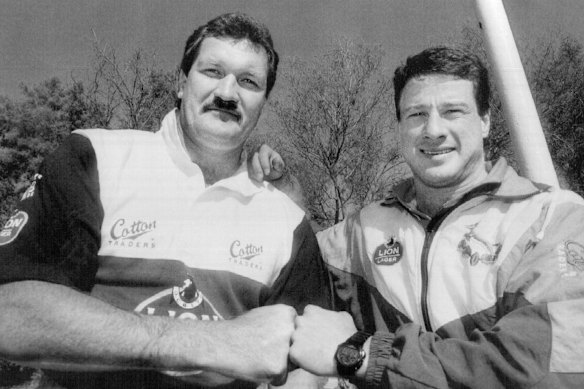
Rudi Visagie (left) training with South Africa in 1993.Credit: Fairfax
He now works as a master mariner after a successful career as a professional rugby coach. He was one of the few players to continue his day job as a policeman while playing for the Waratahs.
“I actually left the police for six months [to focus on rugby], and I hated it,” Bell said. “I didn’t like the full-time footy stuff, it was too much footy for me. I needed to be busy.”
Loading
Bell would wake up at 5am for weights training, go to work, then return home to continue training late. Like most of his Waratahs teammates, Bell would often back up for his club, Warringah, in the Shute Shield the next day.
Burke describes that season of Super Rugby as “Sydney’s hottest ticket in town”. But Bell points out that the new competition didn’t just capture the city – crucially, the fast-running rugby against the best sides in South Africa and New Zealand also captured the bush.
“I was talking to one of my mates out in Moree recently,” Bell said.“They used to get off the tractor on a Friday afternoon, get in the car, and – this is from Moree – drive down [seven hours to Sydney]. They’d make stops on the way, pick people up and be in Sydney for the game, then they’d drive back.
“You just had to be in Sydney for the game.”