
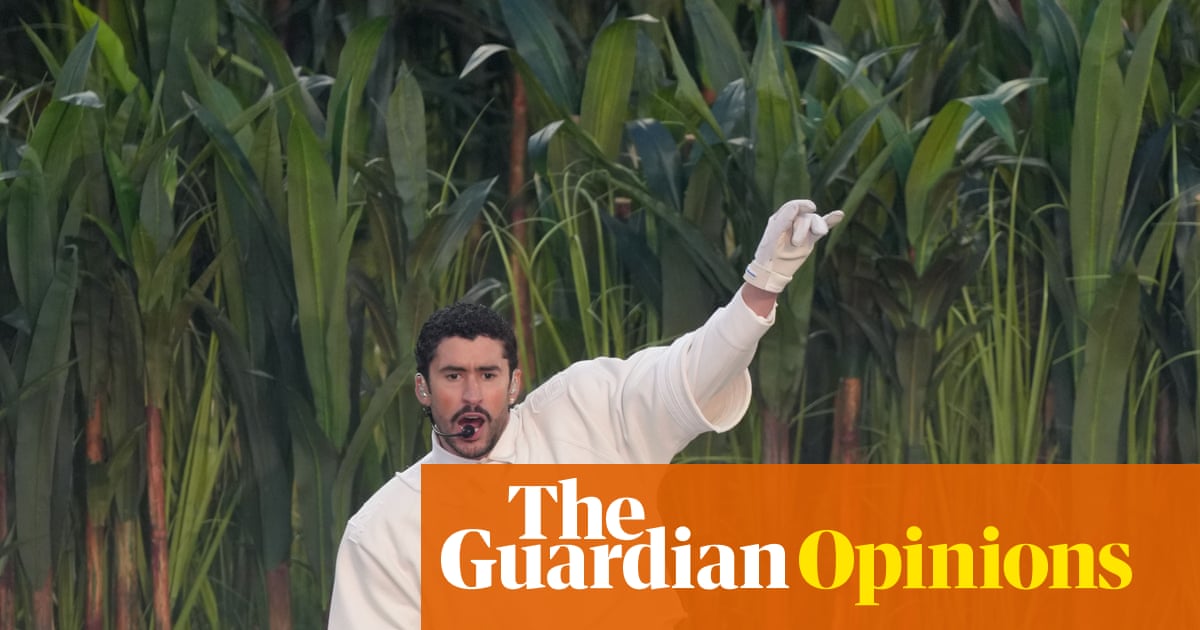
By now, many of us have a favorite part of Bad Bunny’s Super Bowl half-time performance. It’s a dense, rich set that invites rewatching to take in every thoughtful, exuberant detail – even though it’s barely 14 minutes long.
My most beloved part occurs a little more than nine minutes into the homage, when the cuatro puertorriqueño appears. The stringed instrument has its own moment in the spotlight, shown in the talented hands of the cuatrista José Eduardo Santana just before Ricky Martin performs.
I spent months last year reporting an episode of the podcast La Brega about our champion instrument and why it inspires such pride in Puerto Ricans. Yet seeing the cuatro have its moment at the Super Bowl was not on my bingo card for this lifetime. The cuatro’s presence in that arena invites deeper questions: what does it mean that a colony has a national instrument? Could it mean that Puerto Rico is actually a country?
For Bad Bunny, who proudly advocates for Puerto Rico’s independence and flies a light blue Puerto Rican flag associated with that stance, there is no doubt that the answer is yes. Puerto Rico is an American country in the broadest sense of that weighted word: it is part of a bigger family, one that doesn’t revolve around the US.
It’s clear that Bad Bunny has been thinking of Puerto Rico’s place in the Americas for some time, and of what real American citizenship means. There’s a clue in his defiant banger La Mudanza, the last track on his album DeBÍ TiRAR MáS FOToS, when he name-checks the Puerto Rican educator and intellectual Eugenio Maria de Hostos.
Hostos died in the Dominican Republic in 1903, and famously said he’d want to be buried in an independent Puerto Rico. When the day comes for Hostos’ remains to be finally put to rest in a free Puerto Rico, Bad Bunny, named Benito Antonio Martínez Ocasio, tells us in La Mudanza that he wants one of his songs to be playing. And it’ll be the sky blue Puerto Rican flag that adorns Hostos’ coffin.
Hostos was known as “El Gran Ciudadano de las Américas” – the great citizen of the Americas – who dreamed of unity for the Antilles and for the Americas. Benito didn’t perform La Mudanza on Sunday night, but I couldn’t help but think of Hostos as I watched Bad Bunny say “God Bless América” before listing the countries of this hemisphere – his hemisphere – and leading a parade of flags that included the US on equal footing with its neighbors. He strode through a football game, the most “American” of pastimes, and challenged the very meaning of the word.
Bad Bunny holds the Puerto Rican flag of independence while performing at the NFL Super Bowl LX half-time show. Photograph: Chris Torres/EPA
For many of us who carry Puerto Rico in our hearts, there are certain words that are impossible to swallow. When we read a description of Puerto Rico as a “territory” or “commonwealth”, we know that the speaker is uncomfortable with the reality that Puerto Rico is a colony and that the US is a colonizer. “Mainland” is another giveaway. Main to whom, exactly? The word telegraphs that the United States is the epicenter of the speaker’s world, and Puerto Rico is some faraway place studied through a telescope.
The term “American” is perhaps the worst of these. It applies to every country in the hemisphere, and yet one nation, the US, has long claimed a monopoly on its use. Perhaps you’ve heard a common refrain: that Puerto Ricans deserve dignity and respect because, as US citizens, they are “Our Fellow Americans”.
That was more or less the liberal response (“He’s Puerto Rican, that’s part of America!”) when rightwing critics objected that Bad Bunny isn’t “an American artist” and didn’t deserve the glory of the Super Bowl half-time show. It’s OK, they seemed to say, because Puerto Rico is a US colony, and US colonial subjects can hang out at the Super Bowl.
I admit that it can feel tedious to push back on the arrogance of using “American” only to describe the US. Who wants to be the wet blanket in a US newsroom who reminds everyone that America is an entire hemisphere?
But on Sunday night, Bad Bunny did it with joy. He invited the US to a party where it wasn’t the center of the universe – and showed the empire that’s OK. It can even be fun.
Alana Casanova-Burgess is a New York-based journalist and host of La Brega, a bilingual podcast about the Puerto Rican experience.