
SINGAPORE – While artificial intelligence (AI) has the potential to drive major efficiency and productivity gains, training is needed to ensure AI readiness among the workforce, a pre-Budget panel said.
The roundtable, organised by the Institute of Singapore Chartered Accountants and held on Feb 6, also urged more support for small and medium-sized enterprises (SMEs) as they continue to face day-to-day challenges, such as expanding into overseas markets and digitalisation.
Mr Aslam Sardar, Institute for Human Resource Professionals chief executive, cautioned against the risk of the workforce lagging behind technology and said business leaders need to work with human resource teams to prepare employees in harnessing new technologies.
“Oftentimes, companies implement technologies and realise they are not getting full productivity out of it. The reason is… the workforce is not fully trained, skilled and prepared,” he said.
He said that more companies are starting to form task forces to look into how to reap the benefits of AI.
“Last year was all about adoption. This year is going to be a lot about really implementing it in workflows. We are hearing a lot more programmes being run in collaboration with human resources leaders to upskill the workforce in organisations,” said Mr Sardar.
Mr Ajay Sanganeria, partner and head of tax at KPMG in Singapore, observed that many firms are appointing a head of AI or chief AI officer to help drive efficiency. “While these roles are important, it’s essential to recognise that achieving success with AI requires a coordinated effort across the organisation,” he said.
“Leadership has a critical role to play in understanding the ethical implementation of AI,” he said. “By collaborating with the head of AI, leaders can ensure that solutions are both effective and aligned with the organisation’s broader goals.”
He highlighted a growing skill gap in integrating AI into day-to-day work. “This gap isn’t about building AI models – it’s about developing practical skills, such as how to prompt AI effectively, analyse its outputs and apply sound judgment to the results,” he said.
He added that organisations need to focus on two key areas: enabling enterprises to adopt AI effectively and equipping workers with the skills to use it confidently.
He further noted that different firms are at varying stages of AI adoption, so it will be critical to look at a tiered approach, rather than a singular approach.
OCBC Bank chief economist Selena Ling said that while AI promises productivity and efficiency gains, the technology may quietly replace entry-level roles, internships and graduate training jobs – the kinds of positions where people normally learn the basics.
If young workers do not get those early opportunities now, then five to 10 years later, there would not be enough people with real experience to fill mid-career roles, she said.
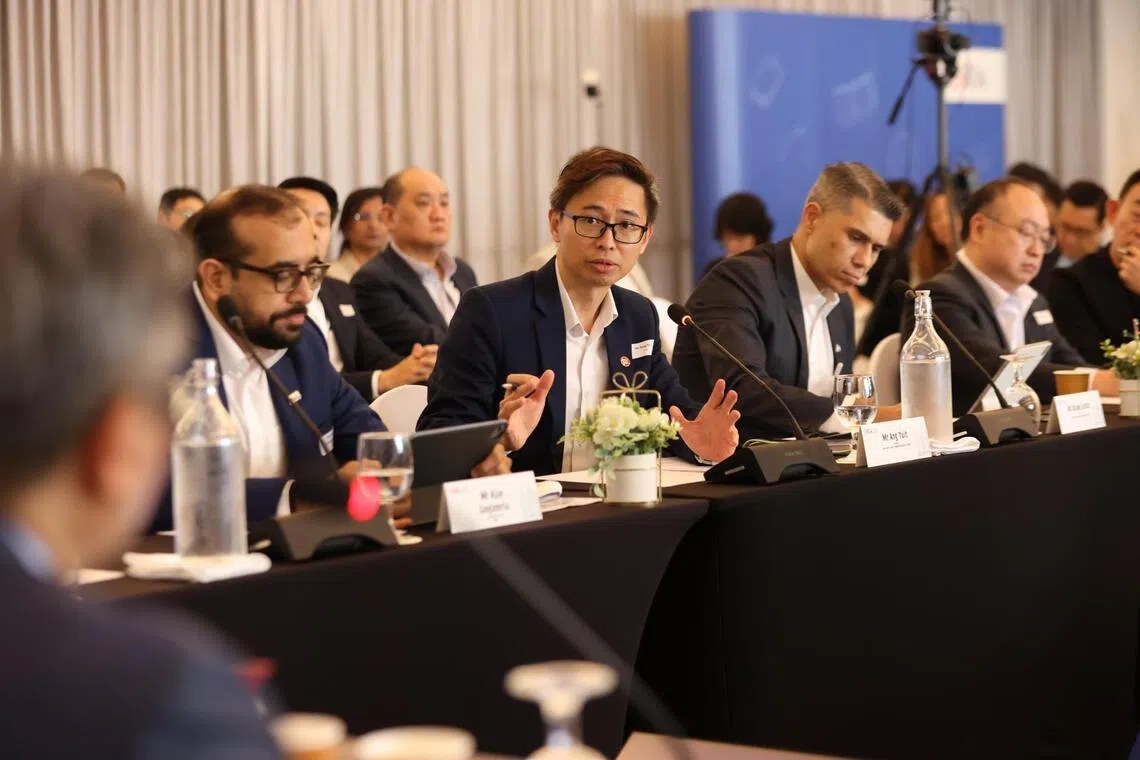
Mr Ang Yuit, president of the Association of Small and Medium Enterprises, also raised the concern over AI and agentic systems – agents that can act autonomously and possess the basic cognitive ability of junior executives, thereby replacing entry-level and junior workers, creating employment challenges.
Ms Ling further noted that there are AI-related courses on SkillsFuture, but such courses need to be more customised rather than generic ones teaching how to use Copilot. She said there could be some scope to consider a special AI SkillsFuture credit.
Ms Lim Bee Kwan, president of Singapore Computer Society, noted that the use of AI has largely been focused on individual productivity and less on organisational productivity.
“We haven’t actually gone up the AI maturity curve to help companies examine how they can use these technologies to change their processes. I think that still needs to continue.”
She added that the Government could help small companies digitalise and look at an ecosystem-type of approach, or create a common platform to smoothen the flow of processes.
The roundtable also discussed persisting challenges that SMEs face and called for more support.
Mr Ang cited rental pressures, wage pressures, financial strain such as credit availability as well as availability of manpower.
He raised the question of whether addressing these challenges required a more structural approach, rather than short-term fixes such as grants, disbursements or a CDC voucher-equivalent for businesses.
“More importantly, we should be looking at it structurally because I think the foundational issues are more structural than temporary,” he said.
He further noted that there is sufficient support for workforce transformation, but less so for enterprise transformation.
“For the micro and small enterprises particularly – which account for almost 50 per cent of headcount hiring (in Singapore) – if they cannot transform, a lot of jobs will be at risk,” he said.
Supporting Singapore companies wanting to diversify overseas was another topic of discussion.
Mr Musa Fazal, chief policy and operating officer for advocacy and policy at Singapore Business Federation, said that firms here are considering diversifying operations and exploring new markets.
He said that as at January, one in three companies here has already started introducing products and services into new markets. ASEAN is often the first foray outside of Singapore for these firms, he added.
He said that while the Government has introduced grants to help companies, there is still significant room for enhancements to some of these schemes.
Mr Musa cited the Market Readiness Assistance grant designed to help firms explore new markets, adding that it has certain caps. For example, the support is capped at $100,000 per company per new market.
“Some of the costs associated with exploration can be a lot higher, and companies will need additional help,” he said.
Mr Ang also urged the Government to help SMEs be more competitive so that they can expand overseas.
“SMEs have less resources, so the kind of help they need when internationalising is different – allowing them to pool resources and grants together would help encourage collaboration and strength as a group,” he said.
Mr Maneesh Tripathi, director and board member at the Singapore Indian Chamber of Commerce and Industry, said tight cash flow is a key factor during times when companies are forced to cease operations.
He urged more leeway in contractual breakouts – often referred to as break clauses or early termination clauses – for tenants. In situations when an SME is hit by troubled market conditions, it may need a mutually agreed “exit clause” to help it either sublet the unit or cut losses, he said.
He praised various Enterprise Singapore initiatives, such as the scheme to share loan default risk with participating financial institutions to support SME financing.
Prime Minister and Minister for Finance Lawrence Wong
will deliver Singapore’s 2026 Budget statement on Feb 12
. He is expected to address issues close to the hearts of Singaporeans, including cost pressures, the uncertain external environment and the impact of technology.