
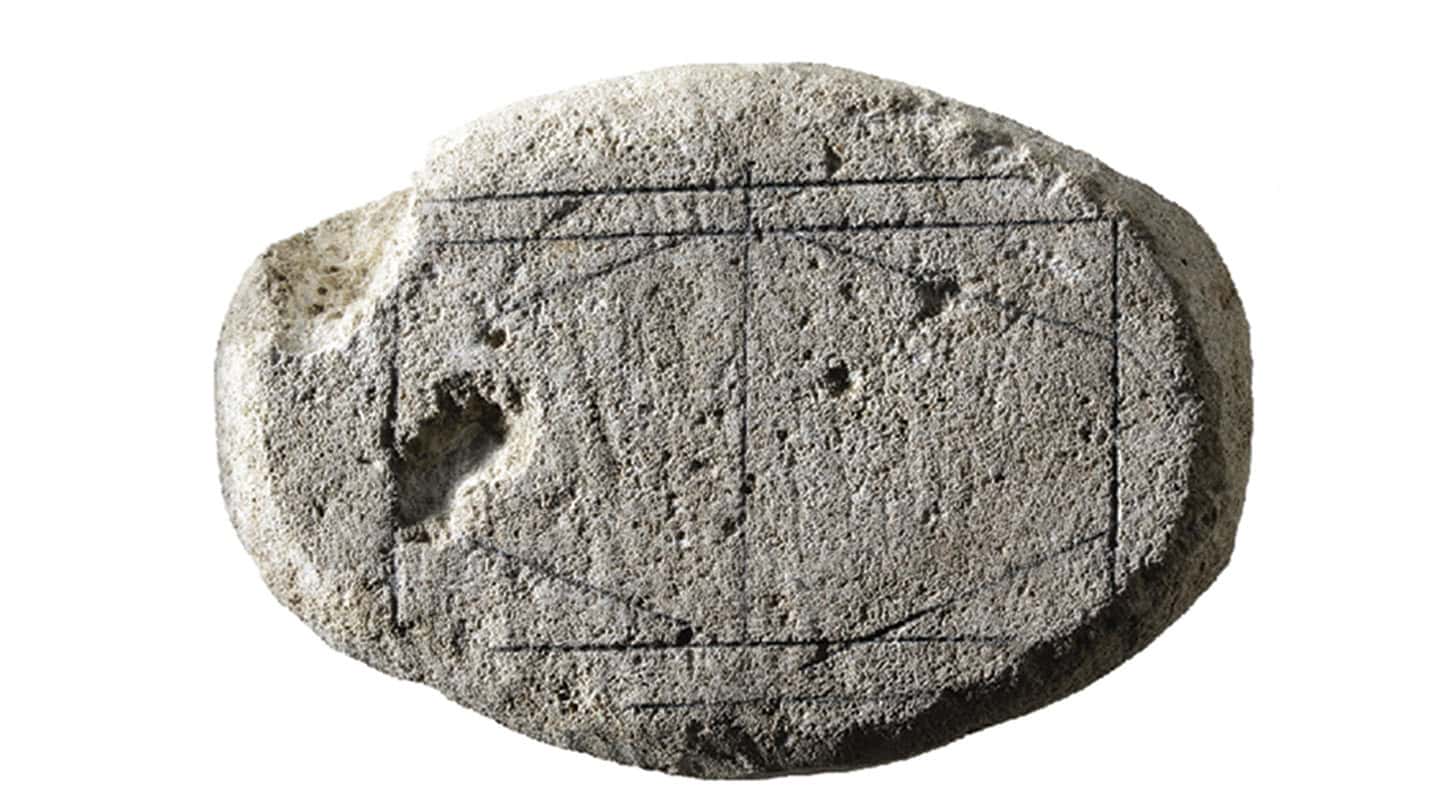
 A potential ancient Roman gameboard with pencil marks highlighting the incised lines. Credit: Walter Crist
During a brief respite from COVID-19 lockdowns in the summer of 2020, archaeologist Walter Crist found himself wandering the halls of Het Romeins Museum in Heerlen, Netherlands. He was killing time, looking at the remnants of Coriovallum, the Roman town that once bustled beneath the modern streets. Then, something odd caught his eye.
Sitting in a display case was a chunk of white Jurassic limestone, roughly eight inches across. It was cataloged as a likely board game, but to Crist — an expert in ancient board games — it looked like nothing he had seen before. The incised lines formed an oblong octagon inside a rectangle, a geometry that didn’t match any known Roman pastime.
“I first found out about the stone when I was visiting the museum during a break in COVID lockdowns, and saw that they had it on display and was initially suspicious since I did not recognize the pattern as belonging to any previously known game,” Crist told ZME Science.
That suspicion ultimately led to a high-tech detective story that would eventually combine microscopic use-wear analysis with artificial intelligence to reverse-engineer a lost piece of Roman culture. According to the results, published today in the journal Antiquity, the stone slab was part of a “blocking game”, where one player has to block another from moving, similar to tic-tac-toe.
The Stone That Didn’t Fit
 Reconstruction of one of the main roads in the city center of Coriovallum, the Roman predecessor of Heerlen. Credit: Mikko Kriek at
BCL Archaeological Support Amsterdam.
The artifact, object 04433, is a hefty piece of Norroy limestone, a material the Romans typically imported from France to build grand columns and monuments. But this stone was small, repurposed from rubble — likely what archaeologists call spolia — and carved with a crude but deliberate grid.
The object sat in limbo for years in the museum collections. It was found in the late 19th or early 20th century, but because it wasn’t dug up during a scientific excavation, its context was lost. Was it a mason’s practice piece? A doodle? Or, as archaeologists would later suspect, some kind of game?
The answer to the questions turned out to be hidden in the microscopic topography of the stone itself.
“We identified the object as a game because of the geometric patten on its upper face and because of evidence that it was deliberately shaped,” Crist said.
×
Thank you! One more thing…
Please check your inbox and confirm your subscription.
When players push game pieces across a stone board, they leave trails. Over years of play, glass or stone counters grind against the limestone, creating smooth “homogeneous zones” where the surface roughness is leveled out. Crist and his team analyzed the stone and found exactly that: localized abrasion.
“Further evidence that it was a game was presented by visible damage on the surface that would be consistent with abrasion caused by sliding Roman-era game pieces on the surface,” Crist noted.
The etches in the stone were concentrated along specific lines, particularly one of the diagonals. This was the clue that would allow an AI to reconstruct the rules of the game.
Forensic Gaming with AI
 Results of the AI simulation showing nine possible game boards. In these games, the player with more pieces attempts to block the player with fewer pieces. Crist et al./Antiquity
To figure out what game could produce those specific scratch marks, the researchers turned to the Digital Ludeme Project and its AI system, Ludii.
The team programmed AI agents to play hundreds of different game variations on a digital version of the Heerlen board. They pulled rulesets from traditional European games that fit the board’s small size — specifically games with around 20 playable spots. These included “alignment games” (like Tic-Tac-Toe or Nine Men’s Morris) and “blocking games,” where the goal is to trap your opponent.
Then, they let the algorithms loose. The AI agents played 1,000 rounds for each ruleset, utilizing Alpha-Beta pruning techniques to simulate competent human players. The goal was to see which set of rules would statistically force pieces to travel along the same lines worn down on the real artifact.
“We tried many different kinds of combinations: three versus two pieces, or four versus two, or two against two … we wanted to test out which ones replicated the wear on the board,” Crist explained to Science News.
The computer churned through the possibilities, eliminating rules that resulted in wear patterns that didn’t match the physical evidence. In the end, the data pointed to a clear winner. The wear wasn’t from a race game or a lining-up game. It was a blocking game.
The Rules of Ludus Coriovalli
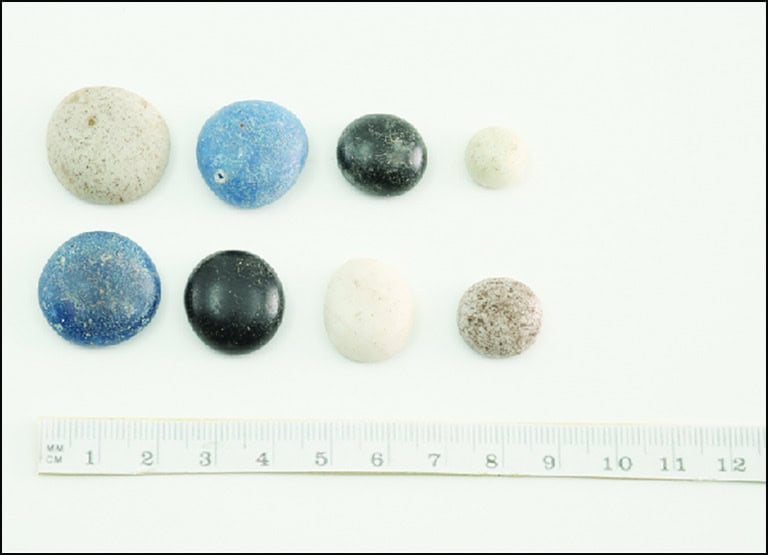 Glass game pieces from Coriovallum. Credit: Het Romeins Museum.
The game the AI reconstructed — now dubbed Ludus Coriovalli (Game of Coriovallum) — is an asymmetric battle of attrition. It is a game of “dogs and hares,” a style of play well-known in medieval Scandinavia but previously undocumented in the Roman Empire.
Based on the simulations that best matched the wear patterns, here is how the Romans likely played it:
One player controls four “dogs,” and the other controls two “hares.”
“The dogs start on the four leftmost points, the hares start on the inner two points on the rightmost side,” Crist told ZME Science.
Players take turns moving a piece to an adjacent empty spot along the lines.
“The dogs attempt to block the hares while the hares try to stay unblocked for as long as they can,” Crist explained. “The player who lasts the longest as the hares wins”.
You can actually try your hand at the reconstructed game online here.
A Missing Link in the History of Play
Until now, historians believed blocking games didn’t arrive in Europe until the Middle Ages, appearing in records of Viking games like Haretavl or the medieval Fox and Geese.
“This study . . . provides evidence that blocking games were played in Roman times, extending the history of this game type by several hundred years in Europe,” Crist said.
The findings bridge a massive gap in the archaeological record. While Romans were famous for Latrunculi (a strategy game similar to chess or checkers) and Duodecim Scripta (a precursor to Backgammon), Ludus Coriovalli suggests a folk tradition of “hunt” games existed alongside them, largely invisible to us because they were played on dirt or wood that rotted away.
The study validates a new method for archaeology: using AI not just to analyze data, but to simulate human behavior to interpret physical objects.
“The greatest challenge was coming up with the methodology; research on games in archaeology is relatively rare, and nobody had tried using AI to try to identify play that would replicate use-wear before,” Crist told ZME Science.
As for the Romans of Coriovallum, their leisure time is now a little less abstract. We can imagine them sitting at a table, sliding glass beads across the limestone, stressing over the movement of an imaginary hare, trying to outsmart a friend.
“Understanding how ancient games might’ve been played,” Crist told Scientific American, “can lead us to new insights on how people in the past enjoyed their lives”. And in the end, whether it’s on a limestone slab or a smartphone screen, the urge to play remains exactly the same.