
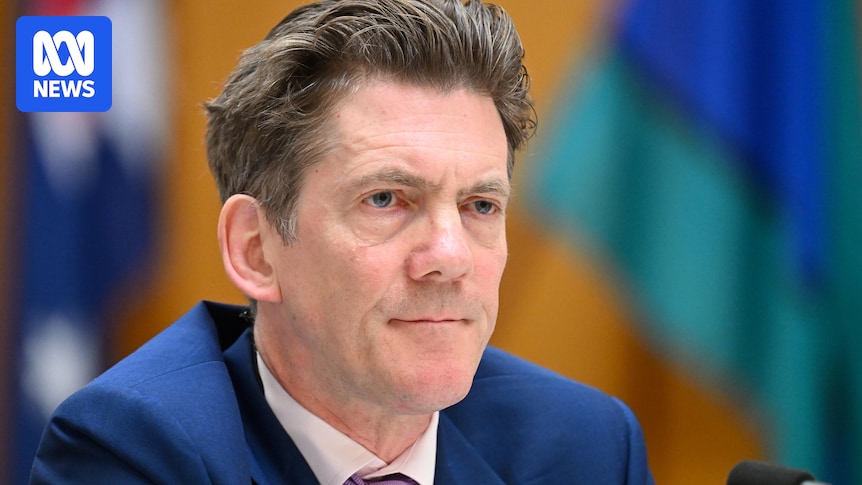
Reserve Bank deputy governor Andrew Hauser has defended the RBA’s unwillingness to criticise the spending choices of the Albanese government, saying it is not the job of “unelected officials” to do that.
Speaking in Sydney, Mr Hauser made an impassioned defence of what role central bankers should play in debates about public policy.
He said criticising the normal spending choices of governments was not one of them.
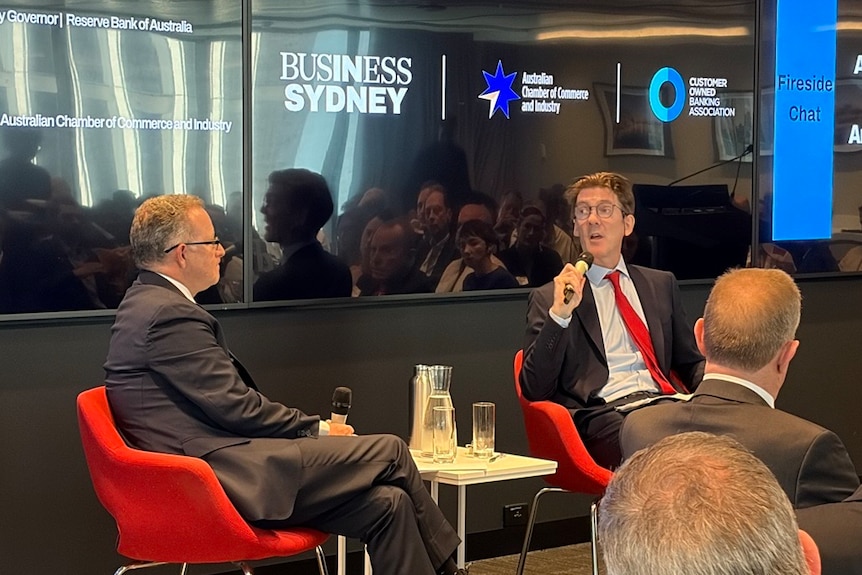
Andrew Hauser speaks at the Australian Chamber of Commerce and Industry (ACCI) Business Leaders’ Series on Wednesday. (ABC News: David Chau)
“There’s been a lot of criticism of the central bank in the past week or two of not speaking out,” he said.
“[But] we are an equal opportunity monetary policy maker. A dollar of demand that comes from the public sector, a dollar of demand that comes from the private sector, should be counted exactly the same in terms of its impact on inflation.
“The composition of total demand is for the government to determine and the public will determine whether they agree or disagree with that in the normal way.
“Australia has an extremely robust electoral system.”
Mr Hauser said he was also sceptical of the idea that the Reserve Bank should be more vocal about its views, especially if it meant “attacking” the government’s position.
“I always think it’s worth asking then: What if we were coming in and taking the opposite view to you?” he said.
“Unelected officials, some of them from other countries, making a comment about the decisions of a publicly elected government.”
Political debate about inflation
Mr Hauser’s comments come days after RBA governor Michele Bullock refused to blame the Albanese government’s spending for causing inflation to jump higher, saying the spending would have contributed, but it was not the only source of inflation.
Speaking to a parliamentary committee on Friday, Ms Bullock said there were many reasons why inflation had increased in Australia recently.
RBA governor grilled over rising inflation
She listed low unemployment, rising real incomes, falling interest rates, tax cuts, and government spending among the many contributors to the pick-up in inflation in the back half of 2025.
She also reminded federal MPs that the RBA had pursued a different strategy to reduce inflation in recent years, compared to other central banks, because it wanted to maintain low levels of unemployment coming out of the COVID lockdowns.
“The position we’re in, although everyone’s talking about it quite negatively, it’s actually quite positive,” Ms Bullock said.
“The reason we’re in this position is because the labour market is still doing really well, and it’s stabilised at a relatively low unemployment rate.
“This is good news, and I think people sort of forget that,” she said.
Since Australia’s economy is so finely balanced, is it more prone to inflation?
Mr Hauser reiterated some of those comments on Wednesday, saying the RBA’s strategy for dragging inflation down had left Australia’s economy very finely balanced and perhaps more susceptible to demand shocks.
“We had a different policy strategy to other countries,” he said.
“We didn’t raise interest rates as far up during the COVID inflation boom, and that meant we were slower to bring them down as well.
Capacity constraints explained
“The consequence of that, and I think it’s fair to say, is this economy is closer to balance than many of the other economies you might have in mind.
“New Zealand is obviously very close. It’s had a big negative output gap opening up their economy, it went into recession.
“Canada has obviously had its own massive challenges.
“With the US, Europe has its own structural growth challenges. So most of those other countries are nowhere near as close to balance as the Australian economy.
“In a way, the backside of that success, of keeping the economy close to balance, is that even relatively small demand shocks of the kind we had last year can lift inflation a bit and cause [monetary] policy to need to respond,” he said.
Mr Hauser said the inflation-fighting strategy the RBA has pursued in recent years had put Australia in an interesting position.
“Now we don’t know whether this pick-up in inflation is going to be wholly temporary, wholly permanent, or somewhere in between. That’s the big debate amongst all the economists in the room,” he said.
“We’ll look at the data, and we’ll take our view.
“But I think it’s fair to say that it’s a consequence of that, hubris is a dangerous thing, ‘relative success’ of holding the economy close to balance that we are now facing the inflationary challenges of that pick-up in demand we’re seeing globally a little bit earlier than others.
“We clearly have learned things about the domestic economy as well. Let’s see: Are we the first mover in a number of countries beginning to tighten policy over the next year or two? Or are we a complete idiosyncratic case with its own domestic issues?
“It’s an interesting question and I’m not sure which way it goes.”
The RBA lifted rates in February because ‘the facts changed’
Mr Hauser also said that the RBA lifted rates in February because “three key facts” changed in recent months.
The first fact to change was “the world”.
He said nobody thought we would be in this position at the start of 2026, with the global economy powering ahead.
He pointed to Taiwan’s export statistics and how they were linked to the insatiable demand for chips and servers for the AI and tech boom. He said nobody expected such solid growth at the global level.
Chalmers on May federal budget
The second fact to change was the RBA’s “stance of policy”.
He said the RBA’s stance on monetary policy did not just refer to the level of the cash rate.
He said it was also the level of credit growth in Australia, and the “exceptionally low risk premium in international markets,” all of which helped to boost demand.
“And possibly, hands up, we [at the RBA] underestimated the extent to which those financial conditions might imply a somewhat less restrictive path for policy than we thought,” he said.
The third fact to change was the surge in private demand relative to supply.
“In fact we, and I particularly, were expecting that pick-up to happen earlier and it didn’t, and our models … kept saying ‘private demand should be stronger’ and there were, you know, poor confidence issues, and tone and Trump and all the rest of it that were maybe holding things back that models struggle to take seriously,” he said.
“And again, the models were right, they were just right at the wrong time.
“So I think models are an important input. We treat them sceptically. But we don’t ignore them. And actually, one of the lessons I take from the past year is that ignoring them completely might be a bit of a mistake.”