
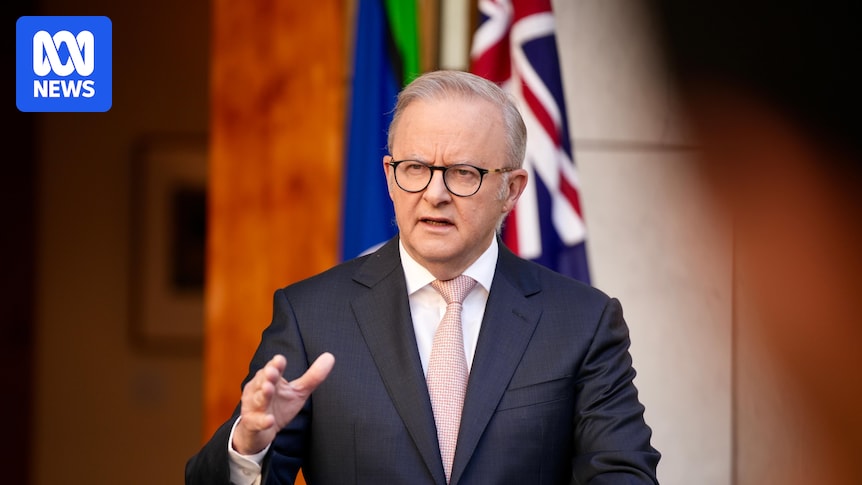
The prime minister “is not contemplating failure” on closing the gap between Indigenous and non-Indigenous people despite the deadline being just five years away, he will tell parliament on Thursday.
“We must … guard against talk of failure, because talk of failure dismisses the aspirations and achievements of Indigenous Australians,” Anthony Albanese will say.
“It ignores the leaders and communities who are changing lives. Failure is a word for those who have stopped trying — or given up listening.”
Mr Albanese will hand down his annual report card on progress under the National Agreement on Closing the Gap, a partnership with the Coalition of Peaks and state and territory governments.
“I make this clear today: I am not contemplating failure. Our government is not contemplating failure.
“We are determined to succeed.”
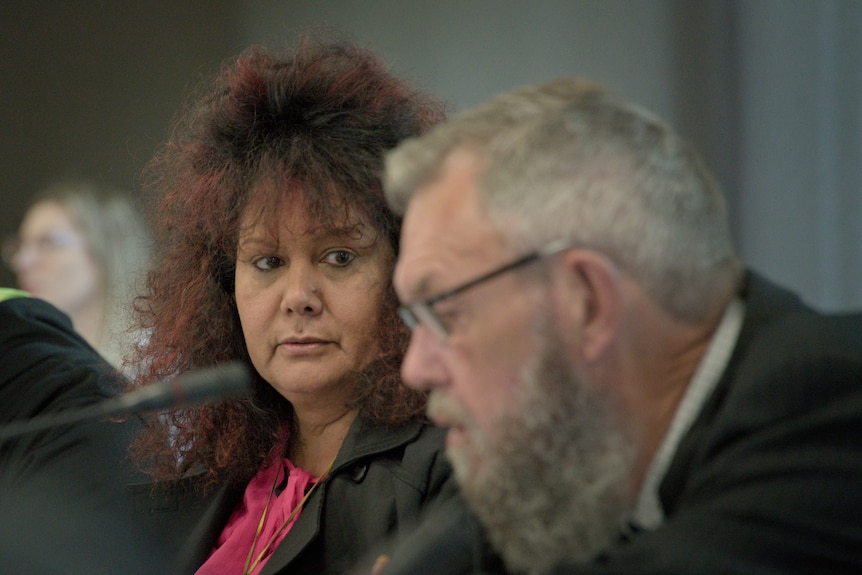
Malarndirri McCarthy and Scott Wilson discussing progress on the national agreement last year. (ABC: Owain Stia-James)
The latest data shows just four out of 19 targets are on track to be met by 2031.
But the prime minister will highlight that six targets are improving and the target of 95 per cent of children enrolled in pre-school is expected be achieved when the data is updated later this year.
“Different states and territories are performing better on different outcomes, even in some of the more challenging areas,” he will say.
This includes progress by New South Wales, the ACT and the Northern Territory in reducing the rates of children in out-of-home care, despite the target worsening nationally.
And Western Australia, Victoria and South Australia are making “significant progress” in reducing youth detention, Mr Albanese will say, although the national trend shows no change from the baseline in 2016-17.
The annual progress report is a commitment made since 2008, when then-prime minister Kevin Rudd first vowed to reduce the disparities between Australians within a generation.
New commitments announced Thursday include:
A further $299 million to double the number of jobs in remote communities under the RJED scheme, to 6,000 by 2030;$144.1 million to upgrade and repair community-controlled health clinics and buildings;$27.4 million to expand the number of stores eligible for subsidies on 30 essential grocery items;$32.7 million towards food storage to help 75 more remote stores cope with extreme weather events;$44.4 million towards Birthing on Country maternal care programs; and$48.3 million for short-term hostel accommodation.
The government also revealed the $25 billion funding deal struck with states and territories last month will include $450 million for Indigenous health — $250 million from the Commonwealth and $200 million from the states.
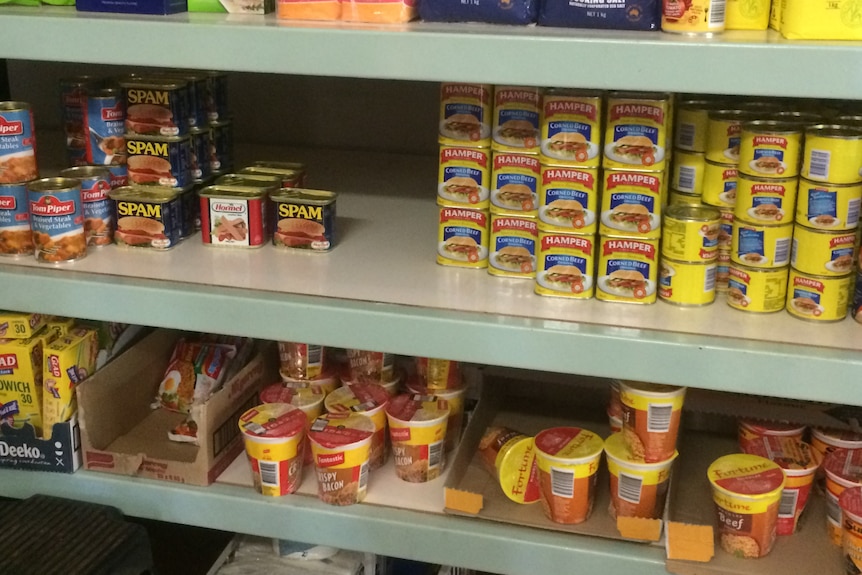
The remote store subsidy scheme aims to keep essential items affordable. (Supplied: Melissa Stoneham)
Mental health support service 13YARN will also receive $13.9 million to extend its hours and establish a text message service, something they have long been calling for to help youth and people experiencing violence.
On Tuesday, First Nations organisations and the federal government launched the first standalone national plan to end violence against Aboriginal and Torres Strait Islander women and children, accompanied by $220 million federal funding over four years.
In a statement, deputy lead convenor of the Coalition of Peaks, Scott Wilson, said closing the gap meant giving Aboriginal and Torres Strait Islander people and organisations the power and resources to lead solutions.
“We’ve seen it happen and we know it works,” he said.
“Our people and organisations have the knowledge and trust of their communities, and that is exactly what’s needed to drive real, lasting change.”
‘We stand with you’
The prime minister’s progress report comes just over a fortnight after the alleged terrorist attack on the Invasion Day rally in Boorloo/Perth.
“We see you. We stand with you,” Mr Albanese will say, addressing First Nations people.
“The danger of that alleged attack was real — and so was the racism and hatred behind it, motivated by a white supremacy ideology.
“Aboriginal and Torres Strait Islander people have the right to gather and express their views, without fear of violence.
“More than that, you have the right to a full and equal place in our nation and our future. Unburdened by discrimination or disadvantage. Empowered by opportunity and security.
“That is the test — and the purpose — of Closing the Gap.”
What does the latest data show?
Data released last year shows the four targets on track to meet the deadline are increasing land rights, sea rights, the rates of adults employed and the rates of children enrolled in early childhood education.
Four targets are going backwards, with rates of suicide, children in out-of-home care, adult incarceration, and early childhood development all worsening.
Is the gap closing for Indigenous kids?
For some other targets, including domestic violence rates, there is no updated data to measure progress.
“Closing the Gap targets continue to worsen under the Albanese Labor government and the indicator for family violence remains void of data on which to assess progress,” opposition spokeswoman for Indigenous Australians, Kerrynne Liddle, told the ABC on Tuesday.
“These are matters that Labor should be prioritising.”
The 2020 Closing the Gap agreement was signed in partnership with the Coalition of Peaks, representing more than 80 community-controlled organisations (ACCOs).
Under the agreement, all parties agreed that ACCOs are better for Aboriginal and Torres Strait Islander people and achieve better results, and governments committed to increasing their funding.
But a damning review by the Productivity Commission in 2024 found state and federal governments’ engagement with Indigenous communities had been “tokenistic” and most had carried on a “business-as-usual” approach.
Last year, an independent First Nations-led review by Jumbunna Institute found ACCOs were “doing the heavy lifting while at the same time being under-resourced in comparison with government.”