
There are those who like to point out that we know more about space than the ocean , stoking a feeling of existential dread that we inhabit the same planet as one of the greatest unknowable entities around.
Still, that’s not to say space isn’t full of mysteries. Like these weird signals that’ve had scientists scratching their heads for decades.
Daily Galaxy reports how an insanely strong signal blasting toward Earth has been drawing the attention astrophysicists from all over. Specifically the fact it’s last over seven hours, the most intense duration any signal of its kind has last.
NASA Goddard Space Flight Center researcher, Eliza Neights, explained to BBC Sky at Night Magazine that these signals are what’re known as gamma-ray bursts (GRBs), a form of radiation that initially baffled the scientific community.
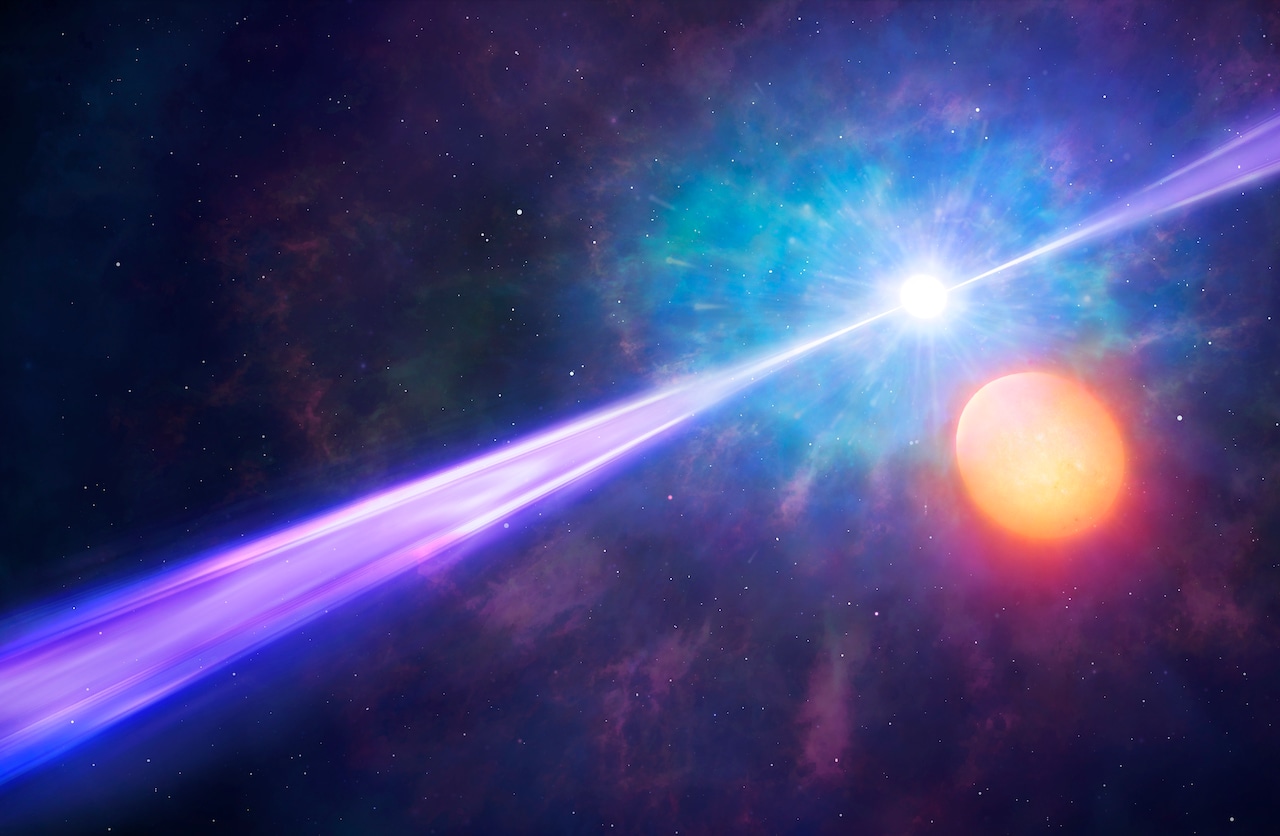
“There are two processes that are known to lead to GRBs,” Neights explained. “Most originate from the collapse of a rapidly rotating, massive star.
“These stars collapse into compact objects, probably black holes, which form powerful jets.”
These bursts can also be formed “when two neutron stars — very dense stellar remnants — are orbiting each other and then merge,” Neights continued. This also produces that compact, jet-producing object.
Neights states that this long-lasting GRB — now called “GRB 250702B” — was so notably exceptional because previously-detect GRBs weren’t known to last more than just a few minutes.
“GRB 250702B’s duration cannot be explained by the known origins of GRBs — it needs a novel physical explanation,” she said.
As for what the alternative explanations may be, well, the answer might lay in black holes. Neights confirmed that more research — as gleaned by a gamma-ray telescope that should be launched next year – is needed for more concrete conclusions to be drawn.