
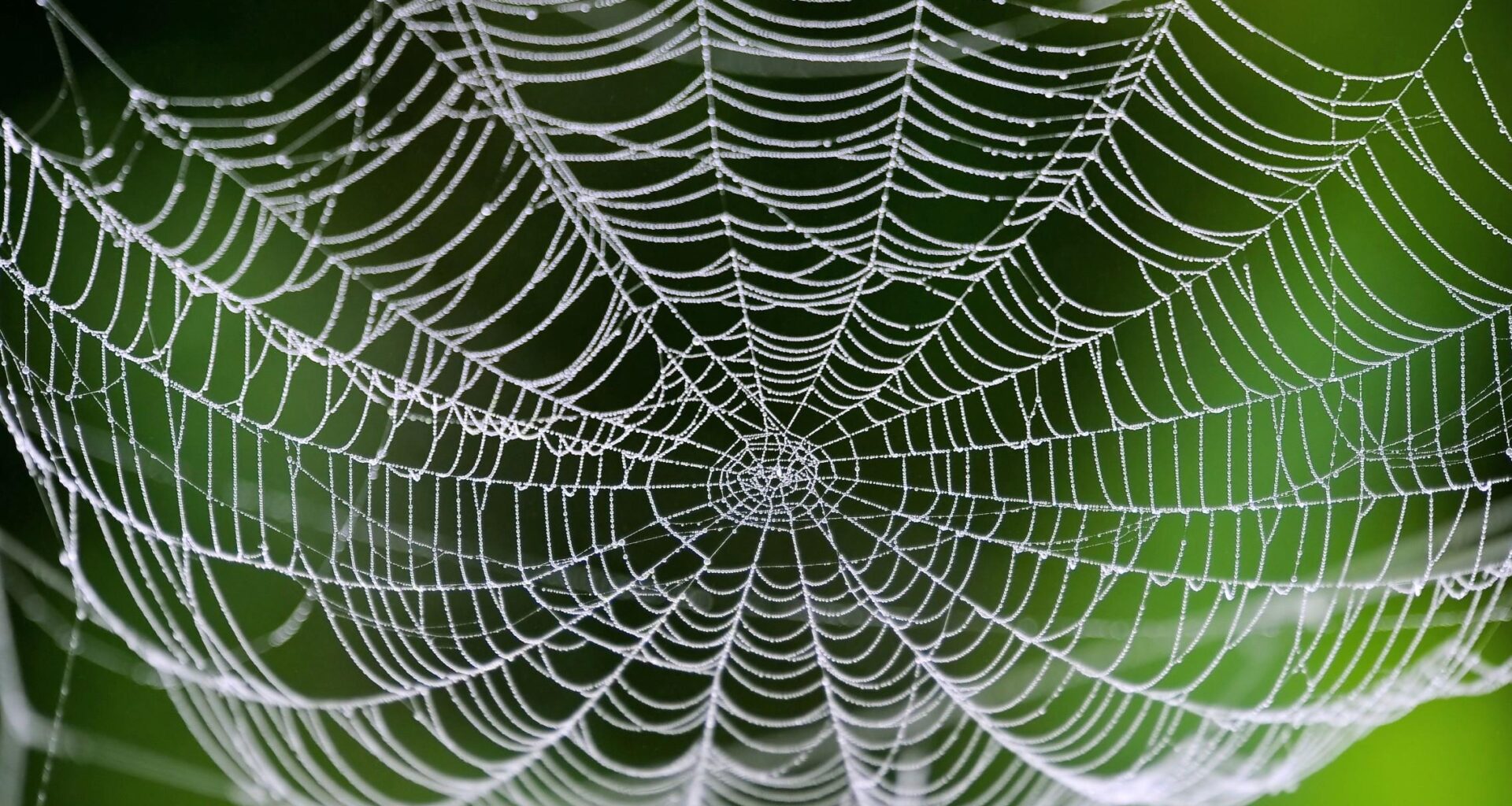
Spider silk is famous for combining strength and flexibility in a way few materials can match, yet scientists have long struggled to explain exactly how spiders turn liquid proteins into such durable threads.
A new study now points to a surprisingly simple answer: one stubborn chemical attraction that keeps protein chains linked at the critical moment when silk begins to solidify.

Researchers at King’s College London traced this tiny molecular connection as silk proteins move from liquid droplets to finished fiber, showing that the same interaction helps guide the structure of the final thread.
By identifying this key link, the work offers engineers a clearer roadmap for designing next-generation synthetic fibers for protective gear, medical materials, and other advanced uses.
Protein links start spider silk
Deep within the silk protein chain, two amino acids – arginine and tyrosine – repeatedly find each other and form a key connection.
Arginine carries a positive charge, while tyrosine provides a flat carbon ring that the charge naturally prefers, creating what chemists call a cation-pi interaction.
This attraction appears again and again along the protein, helping hold neighboring chains close together at the earliest stages of silk formation. Inside the spider’s gland, these proteins are stored as “silk dope,” a thick liquid that remains stable until spinning begins.
When the chemical conditions shift – especially in the presence of certain salts – the mixture separates into dense protein droplets surrounded by clearer fluid.
Phosphate ions help push arginine toward tyrosine, strengthening their attraction and encouraging droplets to form.
Once these droplets appear, they create an initial template that guides the proteins as the fiber later tightens and dries into a finished thread.
Droplets become tough fiber
During spinning, the spider draws those droplets into a strand, and the proteins began lining up as water moved out.
Instead of breaking, the arginine-tyrosine pull kept linking nearby chains, so the forming thread carried the same connections forward.
Loose regions stayed flexible, but the repeated links helped the material organize into tougher zones as the strand narrowed.
“This study provides an atomistic-level explanation of how disordered proteins assemble into highly ordered, high-performance structures,” said study co-author Christian Lorenz, the head of the Department of Engineering from King’s College London.
Simulations map silk structure
Once the strand formed, parts of the silk protein packed tightly while other stretches remained springy, giving the material its rare mix of strength and flexibility.
In the dense regions, beta sheets – flat stacked folds that lock protein chains together – created the backbone of the thread.
At the edges of these sheets, arginine sometimes joined the ordered layers, while tyrosine often bent the chain into turns, helping shape the surrounding structure.
Weight for weight, this arrangement allows spider dragline silk to rival steel in strength while still surpassing Kevlar in toughness.
Because silk forms so quickly and at scales too small to observe directly, researchers also turned to computer simulations for clues.
The King’s College London team found that phosphate ions pushed water aside, increasing how often arginine and tyrosine met and formed their key attraction. AI-based structural models then placed these amino acids near the borders of the ordered regions, closely matching laboratory measurements.
Even with this strong agreement, the researchers note that simulations cannot capture every force inside a living silk gland, meaning real spinning conditions still play an important role.
Building better synthetic fibers
Material engineers want fibers that stay tough, feel light, and break down safely after use. Using silk’s pattern, they can place a few stubborn chemical links in the chain and let the rest move freely.
Past attempts to spin lab-made spider silk often fell short, and one review explains why the process is so sensitive.
“The potential applications are vast – lightweight protective clothing, airplane components, biodegradable medical implants, and even soft robotics could benefit from fibers engineered using these natural principles,” said Lorenz.
Why brains get mentioned
In humans, some proteins also separate into droplets, and evidence links that behavior to neurodegeneration, the loss of nerve cells over time.
During several diseases, including Alzheimer’s disease, proteins that first mix like liquid can later harden into beta-sheet-rich clumps that harm cells.
Studying spider silk lets scientists watch that change without the messy complexity of a human brain, then search for control points.
Still, medical relevance will depend on careful follow-up, because silk evolved for spinning strength, not for signaling between neurons.
Inspiration for engineered materials
Even this detailed work from King’s College London covered only one slice of silk making, focusing on the chemistry that starts clustering.
In living organisms, real spinning ducts also squeeze, stretch, and acidify the liquid, and these forces may further reshape the same molecular contacts.
Future experiments can test other charged and ring-shaped amino acids and examine whether newly engineered fibers retain their strength after heat exposure or long-term wear.
For industry, the findings offer a design rule that can be replicated, although scaling production will still require patience.
By tying a specific chemical attraction to both droplet formation and the finished thread, the study clarifies how silk balances structural order with molecular motion.
Applying this rule to manufactured proteins could improve recyclable fibers and medical materials, while also helping scientists learn how to better regulate protein phase behavior.
The study is published in Proceedings of the National Academy of Sciences.
—–
Like what you read? Subscribe to our newsletter for engaging articles, exclusive content, and the latest updates.
Check us out on EarthSnap, a free app brought to you by Eric Ralls and Earth.com.
—–