
Signs of growing division in Australia aren’t hard to find lately.
Fifteen Jewish Australians killed in the worst terrorist attack on Australian soil. Violent clashes between police and pro-Palestine supporters. The rise and rise of support for One Nation. The conservative side of politics torn over which direction to pursue.
Now, new research has confirmed the obvious. Australians are increasingly of the view we’re a sharply divided lot. For a nation that’s long prided itself on strong social cohesion and being far from global conflicts, the numbers are telling a different story.
Loading…A divided Australia
Eighteen months ago, only 27 per cent of Australians surveyed by JWS Research agreed Australian society was either “extremely” or “very” divided.
This month, a new JWS survey found that number had jumped to 41 per cent. A further 45 per cent agreed Australia was “somewhat” divided.
It’s a remarkable, if unsurprising, escalation. Australians are feeling more divided than they have been for years.
To be clear, JWS Research was asking respondents about division on key “political, economic and social issues”. The economic divide between the haves and have-nots is a factor here that shouldn’t be ignored.
But it’s the social and political divisions that have markedly deepened in Australia after the Hamas attack on Israel, Israel’s retaliation in Gaza, the Bondi atrocity in December, and this week’s visit of Israeli President Isaac Herzog.
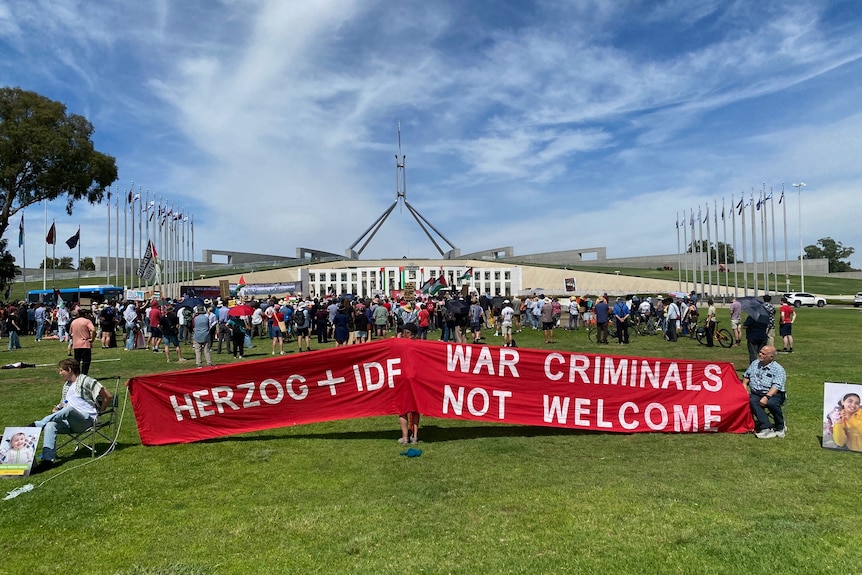
A sign at a protest outside Parliament House against the Israeli president’s visit. (ABC News: Monte Bovill)
Pleading for unity
The prime minister, through all this, has been urging calm and pleading for unity. He’s tried to keep the fractures from widening. Not always successfully and not without political cost.
Most significantly, Anthony Albanese was marked down for his response to the Bondi attack and blamed by some in the Jewish community (and his political opponents) for allowing antisemitism in Australia to reach this point.
This week, however, the loudest attacks on the prime minister were coming from the other side. The pro-Palestine movement and the political left are outraged at Albanese’s decision to invite the Israeli president to Australia.
“Your invitation has fundamentally undermined unity and social cohesion in this country,” suggested Greens MP Elizabeth Watson-Brown, who asked the PM on Tuesday if he would condemn the police treatment of protesters and “send President Herzog home”.
After being hammered throughout January by the Coalition over his response to Bondi and letting antisemitism reach such levels, here was the PM now being accused by the Greens of undermining unity and social cohesion by inviting the Israeli president to comfort Jewish Australians.
Albanese knew a question like this would come after the troubling scenes from the streets of Sydney the night before, which shocked many Australians. They included violent clashes and videos of protesters being punched by police.
Albanese didn’t defend all the police actions, but made no apology for inviting Herzog, and used the moment to deliver a powerful and repeated plea for all sides to “turn the temperature down”.
Loading’That does not advance peace’
Bondi and its aftermath clearly took a toll on the prime minister. He spent weeks copping criticism, both public and in private, from Jewish community members.
In parliament on Tuesday, when accused by the Greens of going too far by inviting Herzog to Australia, Albanese’s anger and emotion were plain to see.
“The debate is not advanced by people thinking it’s like a football team where you have to support 100 per cent one side or the other,” Albanese told his critics in both the Greens and the Coalition. “That does not advance peace.”
He raised the government’s decision last year to recognise Palestinian statehood, which drew the ire of Israeli Prime Minister Benjamin Netanyahu and had been rarely mentioned by Albanese in the wake of Bondi. To highlight this policy shift while the Israeli president was in the country was significant.
The Australian government, Albanese argued, believed “very, very strongly” in a two-state solution and “in order to do that, you need to engage constructively with Israelis and Palestinians”. Australia can have more influence with Israel, in other words, if it’s at least on speaking terms.
Herzog visits Sydney, Israel tightens grip on West Bank
It was the most confident Albanese had sounded on this issue since being rocked by the terrorism at Bondi. Labor MPs were impressed. Political opponents fell silent.
Of course, this plea to “turn the temperature down” doesn’t mean it will happen. The passions on both sides of this debate are strong.
But the prime minister appears to be on strong ground in arguing most Australians don’t want the conflict between Israelis and Palestinians brought here.
The JWS Research poll shows 70 per cent of Australians are “concerned about tensions between different groups” and 67 per cent don’t want “international disputes” impacting on everyone here.
It’s a reminder the bulk of Australians want greater social cohesion, even if they don’t see much of it right now.
Amidst the noise, there’s a strong desire to turn the temperature down.
David Speers is national political lead and host of Insiders, which airs on ABC TV at 9am on Sunday or on iview.