
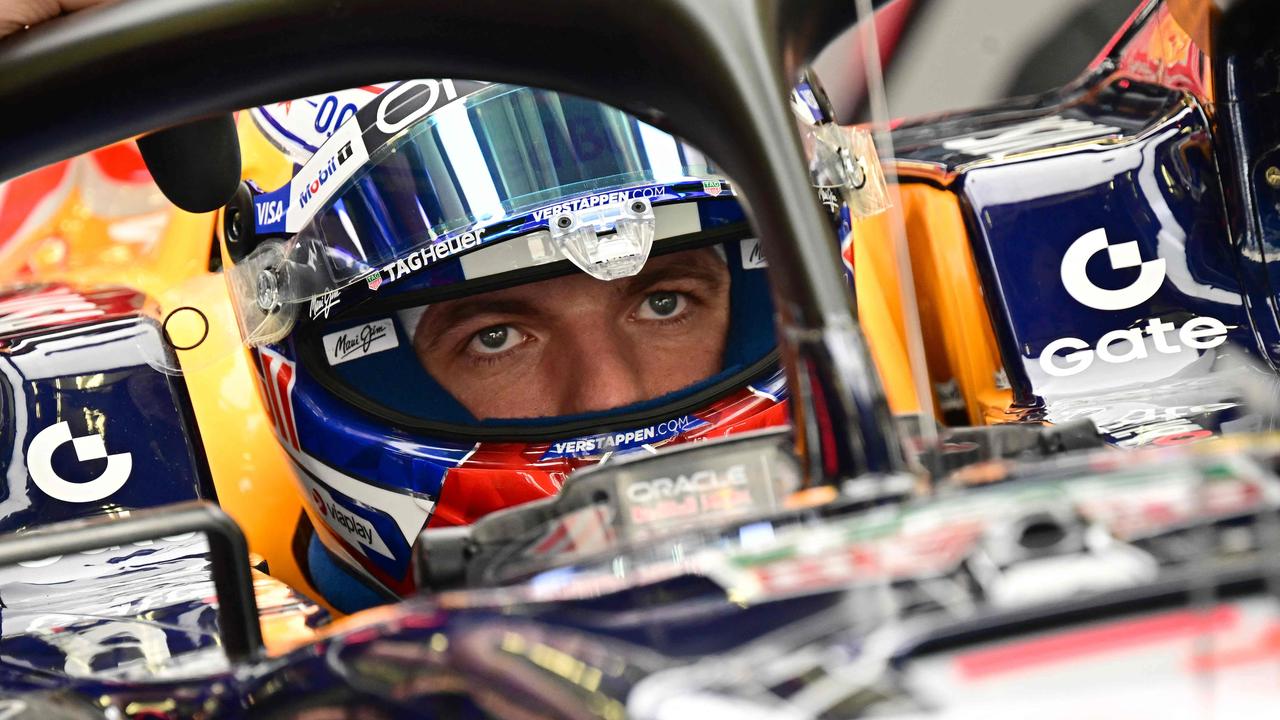
Lando Norris ended the first day of Bahrain pre-season testing with the fastest time on a workmanlike day for the championship-winning team, but Williams, absent from the opening test in Barcelona, completed the most laps.
Norris took control of the McLaren car from teammate Oscar Piastri in the afternoon and capitalised on the better conditions to set the benchmark at 1 minutes 34.669 seconds.
Times this early in testing are largely irrelevant and notoriously difficult to extrapolate into meaningful conclusions. Pole position in Bahrain last year was almost five seconds quicker.

Fox Sports, available on Kayo Sports, is the only place to watch every practice, qualifying session and race in the 2026 FIA Formula One World Championship™ LIVE in 4K. New to Kayo? Join now and get your first month for just $1.
The reigning champion set the fastest time despite McLaren remaining committed to analysis of the new rules rather than experimenting with performance.
“We have approached this week by prioritising our learning and therefore chosen a deliberate run plan to optimise work that ultimately accelerates the development of our package,” chief designer Rob Marshall said.
“You can see from Oscar and Lando’s running that they have both completed heavy aerodynamic testing today in conditions that are very different to the ones we experienced in Barcelona last month.
“With this in mind, we have prioritised data gathering runs over out and out mileage on this first day of the test.
Times by team, day 1
1. McLaren: 1m 34.669s (Lando Norris)
2. Red Bull Racing: +0.129 (Max Verstappen)
3. Ferrari: +0.521 (Charles Leclerc)
4. Haas: +0.909 (Esteban Ocon)
5. Mercedes: +1.439 (George Russell)
6. Alpine: +2.096 (Pierre Gasly)
7. Audi: +2.192 (Nico Hülkenberg)
8. Williams: +2.768 (Alex Albon)
9. Racing Bulls: +3.276 (Arvid Lindblad)
10. Cadillac: +4.159 (Sergio Pérez)
11. Aston Martin: +5.214 (Lance Stroll)
But the story of the day wasn’t to be found on the time sheets but in the data — at least according to Mercedes.
MERCEDES SAYS RED BULL RACING IS THE ‘BENCHMARK’
Mercedes looked serene and in control after the opening test in Barcelona, but it’s taken just one day of testing in Bahrain to add significant turbulence to its cruisy start to the year.
The team itself endured several niggles throughout the day. The car was late out of the garage, and when it was on track, George Russell found it was well outside its operating window — poorly balanced, locking up, bad on traction and generally inconsistent.
Andrea Kimi Antonelli took over after the lunch break, but a suspension problem kept him boxed for several hours, leaving him with just 30 laps and unable to better his teammate’s time despite running in the more favourable afternoon conditions.
But the real blow came not from within but externally — from what Mercedes believes it saw from Red Bull Racing.
“I was hoping that they were worse than they are, because they’ve done a very good job,” Mercedes boss Toto Wolff said, per Racer. “The car, the power unit, are the benchmark at the moment, I would say.
“Look at the energy deployment today. They are able to deploy far more energy on the straights than everybody else — I mean, speaking of a second per lap over consecutive laps.
“On a single lap we’ve seen it before, but now we’ve seen it on 10 consecutive laps with the same kind of straight-line deployment.
“As per today, on the first official day of [Bahrain] testing — which is always the caveat of that — they’ve set the benchmark today.”
Mileage by power unit, day 1
1. Mercedes: 420 laps (2273.0 kilometres) (four teams)
2. Ferrari: 353 laps (1910.4 kilometres) (three teams)
3. Red Bull Powertrains: 211 laps (1141.9 kilometres) (two teams)
4. Audi: 122 laps (660.3 kilometres) (one team)
5. Honda: 36 laps (194.8 kilometres) (one team)
The limiting factor for engine performance this year is how much electrical energy the cars can regenerate over a lap. The electrical motor contributes around 350 kilowatts to the total 750-kilowatt power unit, so any time the battery is empty, the car is operating at roughly half power.
Wolff said GPS data suggested Verstappen was deploying electrical power for longer down the straights without being slower elsewhere around the lap. That means he was able to regenerate more energy in the first place — more, Mercedes says, than it’s currently able to.
Verstappen used that apparent advantage to set the day’s most competitive long race stint simulations without any sign of needing to back to recharge the battery.
It’s doubly impressive considering this is the first power unit built by Red Bull Powertrains. It wasn’t expected to be immediately competing among the established manufacturers.
It’s still early in testing, and all results should be viewed cautiously. But it’s certainly an interesting development.
BUT ARE POLITICS AT PLAY?
It’s hard, however, to separate Wolff’s effusive praise for the Red Bull motor from the political machinations of the paddock, which is currently roiled by the engine compression ratio controversy.
Mercedes is believed to be exploiting a loophole on the maximum compression ratio, which would give it more power.
Ferrari, Audi and Honda have all been lobbying the FIA to close the loophole but haven’t had the numbers to try to force a rule change.
Red Bull Powertrains — which was thought to be exploiting the same loophole — has reportedly switched camps and is now open to changing the rules.
If the group of four engine builders can convince both the FIA and F1 to agree, the rules can be changed before the season-opening Australian Grand Prix.
Given speculation that a higher compression ratio could be worth up to 0.4 seconds per lap — a considerable margin — is it any surprise that Wolff is talking about the Red Bull engine having as much as a second per lap advantage?
The Austrian boss admitted that the consequences of a rule change would be dire for every team running one of his motors.
“Then you’re screwed,” he said, per Autosport.
“You develop an engine over a long time, and you have lead times, and if you were told you can’t operate the engine in the way you have developed it, that could be quite damaging for the performance.”
Williams boss James Vowles, his team a Mercedes customer, was stronger in his rejection of the case for change.
“This is a meritocracy where the best engineering outcome effectively gets rewarded, not punished as a result,” he said, per The Race.
“I’m sure other teams are pissed off they weren’t able to achieve what Mercedes did, but we also need to take care.
“My hope is that sense prevails and that we as a sport recognise that we are here to be a meritocracy, [where the] best engineering solution wins as the result of it.”
The next engine meeting is set down for next week.
3-Peat?! – McLaren unveil 2026 livery | 00:38
WILLIAMS ‘MOOD HAS LIFTED’ AFTER TESTING DEBUT
Vowles, though, was in an otherwise upbeat mood after the first day of Bahrain testing.
After having missed the entirety of testing in Barcelona, the new Williams car burst from blocks in fine form in Bahrain to complete an untroubled and highly productive day in the desert.
Missing the first test was embarrassing for the British team. It has a recent history of missing testing deadlines and then turning up with cars that aren’t up to scratch. This case was particularly painful given Vowles talked extensively last year about switching focus to 2026 very early to maximise performance, only for snowballing production delays to cost it a third of its pre-season.
But a day-high 145 laps — the third-highest total for any team on their first track day this year — has changed the vibe.
Mileage by team, day 1
1. Williams: 145 laps (784.7 kilometres)
2. Red Bull Racing: 136 laps (736.0 kilometres)
3. Ferrari: 131 laps (709.0 kilometres)
4. Audi: 122 laps (660.3 kilometres)
5. Haas: 115 laps (622.4 kilometres)
6. McLaren: 112 laps (606.1 kilometres)
7. Cadillac: 107 laps (579.1 kilometres)
8. Mercedes: 86 laps (465.4 kilometres)
9. Alpine: 77 laps (416.7 kilometres)
10. Racing Bulls: 75 laps (405.9 kilometres)
11. Aston Martin: 36 laps (194.8 kilometres)
“It was a tough winter, there’s no doubt about it,” Vowles said.
“But what’s great is … the car ran faultlessly just from start to finish, and actually [there were] no major vices, which is what we’re hoping for here, good correlation.
“Absolutely the mood has lifted.”
The team hasn’t denied that the car is overweight, and likely by more than other teams, though rumours of it being several tens of kilograms above the limit are wide of the mark.
There was also nothing to interpret from the team’s lap times given performance is far from the minds of engineers at the team at the moment, who are still analysing the basics of the car’s performance.
There’s a lot of catching up to do, but with surely considerable relief at Grove, the task has begun.
Cadillac F1 reveal 1st Livery for 2026 | 00:39
ASTON MARTIN’S MOOD CAN’T BE GOOD
Aston Martin appeared to be downplaying expectations considerably at the team’s season launch earlier this week. It was a good call based on the results of the first day in Bahrain.
The team completed just 33 laps before lunch and only three laps after before calling it a day.
Even remembering that the team got really only one day of tentative testing under its belt in Barcelona, that’s still a poor return. Williams, after just one day of testing, has already racked up more laps for the total pre-season period.
The trouble was caused by Honda’s power unit, with engineers garaging the car for analysis ahead of the second day of testing.
Its critical for both chassis and engine. Aston Martin isn’t just the Honda works team, it’s the only team Honda supplies with engines. If the car isn’t on track, no-one else is accumulating the data.
Compare that, again, to Williams, which at least knew the Mercedes engine wasn’t going to be a problem when it finally made it to testing this week, and its program is off to a strong start as a result.
Identifying problems is what testing is for. Aston Martin might keep in mind Red Bull Racing’s dreadful start to 2014 pre-season testing and it getting Daniel Ricciardo onto the podium at the season-opening Australian Grand Prix just weeks later, albeit he was disqualified afterwards.
But for a team that clearly already saw itself as behind the curve, more troubled days like this one will only pile on the pain.
Mercedes confident in new W17 Challenger | 01:30
AUDI FIRES OPENING SHOT IN DEVELOPMENT RACE
The first day of Bahrain saw the first major upgrade of the year — and it came from Audi.
The rebranded Sauber team was one of the first to undertake a private test before pre-season testing began. It explained that its plan was to have a very premature car running in January to allow it to focus on basic reliability and in particular on its brand-new power unit, the first ever designed for Formula 1 by the German marque.
The upgrade it brought to Bahrain demonstrates just how basic that model was — and how fast we should expect development to move this season.
There are changes all over the car, but you’ll most notice the new sidepods and engine cover. Gone is the basic boxy shape of last fortnight; in comes something vaguely resembling the ill-fated Mercedes zero-pod concept of 2022, with its tight, vertical radiator inlets and aggressively downwards-sloping bulges.
Of course Mercedes has poor memories of that version of its car, but it’s important to remember that the 2022 regulations were completely different to those in force this year. Mercedes also said the sidepods weren’t really the problem — the floor was the most influential performance part of the previous rules.
This year, though, the bodywork counts for much more. It’s unsurprising, then, to see the bodywork much more tightly packaged and looking like it serves more of a purpose.
We know, for example, that Ferrari has also talked about having essentially a launch-spec car for now before moving to its first race car before Melbourne. Others are also in a similar boat. It’ll be fascinating to see how the cars grow more different over the next two weeks.
Audi completed a thoroughly decent 122 laps for the day, suggesting its reliability upturn late in Barcelona might be sustainable.