
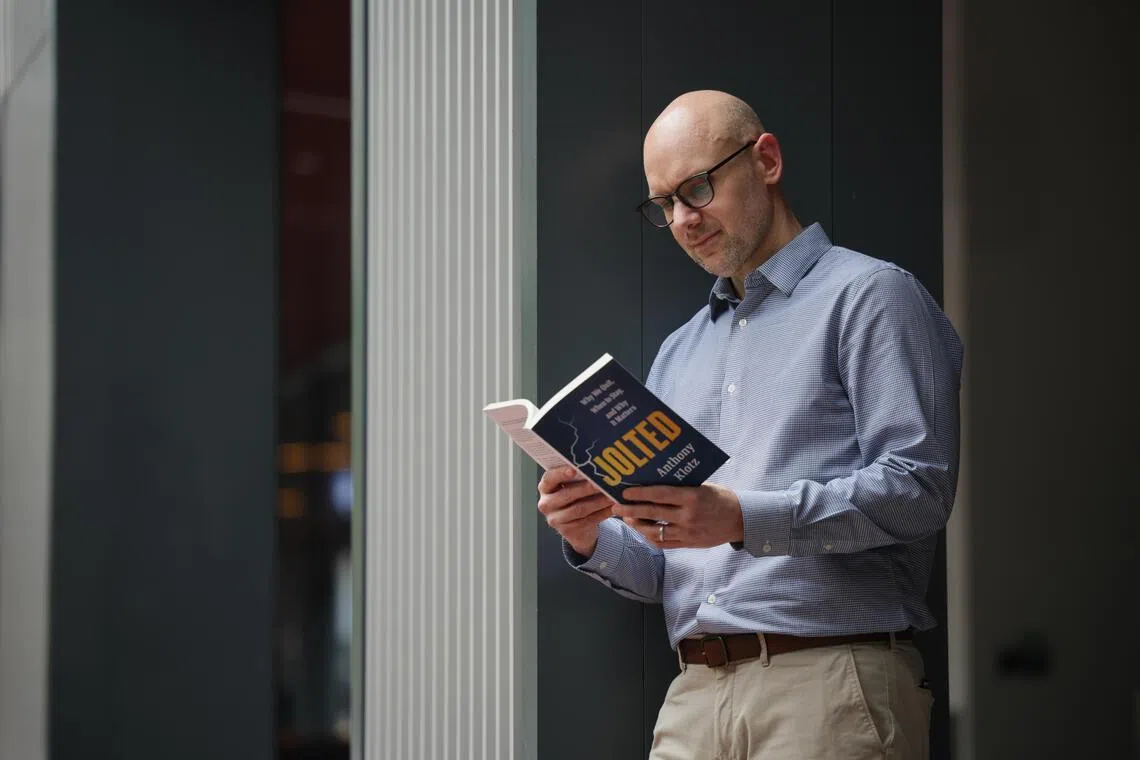
SINGAPORE – Singapore’s white-collar workers could be heading into a fresh wave of “AI jolts”, said Dr Anthony Klotz, the organisational psychologist who gave a name to the Great Resignation.
Singapore impresses him with its
mechanisms such as SkillsFuture
strong higher-education system
, but with almost two-thirds of its four million workers in white-collar roles, workers here risk entering a period of uncertainty and disenfranchisement.
Until robotics is good enough to replace manual jobs, office workers will be hit first by advanced artificial intelligence (AI), said the 46-year-old professor at University College London School of Management.
Speaking to The Straits Times during an exchange visit with the NUS Business School, Dr Klotz said: “You have a pretty anxious white-collar workforce in the world right now, and that workforce knows that major changes are coming. I call them AI jolts.”
He projects that within five years, AI tools and robotics might replace 20 per cent of what workers do today. How that pans out is the question, he said.
“We can do even more so go faster, faster. Or we could say, why don’t we all work a little bit less?
“We could spend more time with family, leisure and hobbies. A lot of people would spend more time on side hustles like entrepreneurial ventures, which would unlock more economic potential.”
Fast-greying countries like Singapore, where one in four citizens will be aged 65 and above by 2030, will face this difficult challenge.
“The question these countries are asking themselves is – can we maintain growth, but also do it in a way that maintains people’s well-being,” he said.
Since coining the term the “Great Resignation” in a media interview in 2021, Dr Klotz has become a go-to commentator whenever there are questions on why people would suddenly walk away from their jobs.
“The nice thing about me going viral for coining this term is it gives me a bigger platform to share the research that we’re doing with workers and leaders,” he said.
He had turned down suggestions to trademark the label, but is putting out his first book on March 19, titled Jolted: Why We Quit, When To Stay, And Why It Matters.
It is on a pet topic of his: resignation.
Drawing on his research, he wrote that careers are shaped less by smooth planning than by sharp inflection points.
“We can be very content employees and all of a sudden, one event happens, and it makes us rethink our relationship with work,” he says.
Dr Klotz describes in his book an academic conference in Chicago where, in a single day, he discovered that three close colleagues from his department were quietly interviewing for roles at other universities.
The trio, who he thought were happy in a department he “loved”, ended up staying.
He, however, was jolted into thinking he was “a fool not to at least think about doing the same”. It led him to entertain an offer he had earlier declined. He left.
Dr Klotz added that resignations can be contagious, and sometimes, filled with regret.
“Because when you experience one of these jolting events, it can often be confusing or a little bit emotional.”
He hopes his tips can help workers avoid such remorse, but concedes that most workers cannot just up and leave.
“So we often find ourselves in the situation of what’s been called ‘reluctant stayers’.”
What workers could do then depends on the stage of their careers, Dr Klotz said.
Younger workers are better off resetting expectations and broadening their prospects beyond their day job.
“There’s only so much you can do to speed up your career progress,” he said.
He added: “Realise that you’re not alone and yeah, it is very normal to feel impatient and disenfranchised early in your career because you’re at the lowest-paying, least-powerful moment of your career.”
He urges these workers to build on their hobbies, relationships, family and, where possible, find small creative side projects, which AI tools are making easier to start.
When it is time to leave, Dr Klotz said “grateful goodbyes” are always better, though blasting up bridges could also be forgiven in exceptions, such as when it leads to improvements for colleagues who stay.
Older workers with influence and security may carry a bigger duty to speak up, he said.
“You may feel like ‘I need to bring up this clear problem in a way that will get the company’s attention. The company will address it, and it will benefit those whom I leave behind’.”
For the one speaking truth to power, it might also bring a sense of relief. “In general, when we act in accordance with our values and beliefs, we feel better about ourselves.”