
Born in Belfast 100 years ago this week, the footballer Danny Blanchflower (1926-1993) would not live long enough to see the era of reality television.
Nor, probably, would he have considered that a big loss. Even so, unlike most of its publicity-hungry participants, he would have agreed with the sentiment in the second half of one TV show title: I’m a Celebrity … Get Me Out of Here!
For most of Blanchflower’s playing career, the pinnacle of television fame was an appearance on This Is Your Life, presented on BBC and later ITV by Dubliner Eamonn Andrews.
Central to that show’s weekly drama was the moment when Andrews ambushed his latest target, with the big red book and eponymous catchline, before whisking guests in a fast car to the studio theatre where their friends and family awaited.
The risk of the surprise format, always, was that a guest might refuse to play along. Blanchflower, the most famous footballer in Britain at the time but fiercely defensive of his privacy, was the first ever to do so, and the only one not to change his mind.
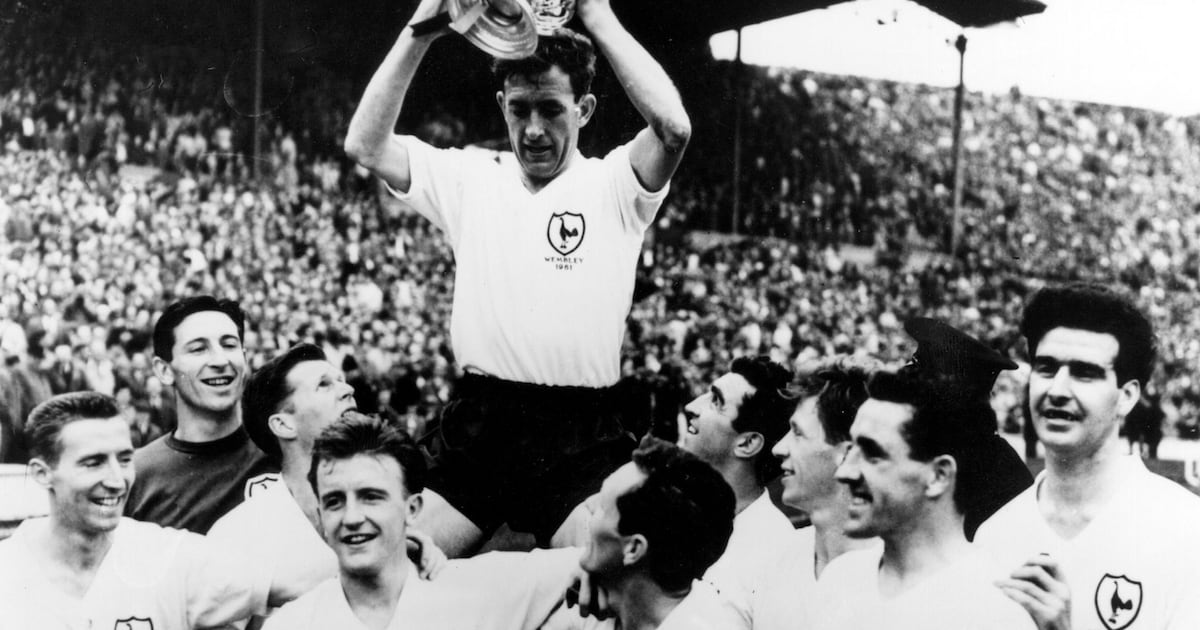
It happened shortly before the 1961 FA Cup final, in which he would captain Tottenham Hotspur to England’s first league-and-cup double of the century.
Andrews and his production team had as usual gone to great lengths to keep preparations secret from the guest. In this case, that included inviting Blanchflower to a pretend news broadcast, on the issue of players’ wages, elsewhere in London.
The ambush was to be furtively recorded there, then broadcast as live, with the rest of the show. But on this occasion, the careful planning came to naught. As a rueful Andrews recalled in his autobiography, he got only as far as producing the book and saying, “Danny Blanchflower, this is your …” At that, Blanchflower fled “like a greyhound from a trap”.
An attendant BBC editor caught hold of the retreating footballer’s coat but Blanchflower wriggled free of it, shouting: “Let me out. Let me out.” Andrews then chased him through a doorway and down a flight of stone steps, desperate to save the show while also worried about the cup final. “I had this dreadful vision of him slipping and breaking a leg.”
[ An Irishman’s Diary on football legend Danny BlanchflowerOpens in new window ]
He caught Blanchflower at the end of a corridor with a locked door, but then met a Belfast brick wall when telling him about the theatre full of friends already assembled. “That was our concern, he said. He hadn’t invited them.”
With weeks of work and a fortune in audience travel expenses invested, however, Andrews wasn’t ready to give up. Fifteen minutes before the show’s scheduled start, he caught Blanchflower again in the BBC club. “Again, I pleaded. Again, Danny refused.”
Resigned now, Andrews mentioned the car still standing by and told Blanchflower he might as well use it to take him home. Perhaps that was intended as a guilt trip, literally. But the guest declined anyway, in case it ended up back at the theatre. “He’d take the tube,” Andrews was told.
Blanchflower later entertained many of the intended audience, including cousins flown in from Detroit, in his own house. And he was sufficiently PR conscious that next day he also called a press conference in which he explained his reaction to being “shanghaied”.
Refusing to apologise, he said he’d do the same again. “He pointed out that he did not work for the publicity it gave him, but felt he had a private life ‘somewhere along the line’,” The Irish Times reported.
Blanchflower was voted Footballer of the Year that season, for the second time. His many career accolades also included being named on the team of the tournament for the 1958 World Cup, when he captained Northern Ireland to the quarter-finals.
In his post-playing career, he had a short-lived role as co-commentator in US soccer, until his forthright views again caused problems. After blaming a goalkeeping error for a goal from a 35-yard shot, he was summoned to a meeting in CBS and accused of being too negative.
When he protested he had only told the truth, CBS suggested there were “two truths”, the other of which would have involved praising the shot instead of criticising the save (or lack of it).
Blanchflower countered that a goal from 35 yards was almost by definition a keeper error. He and CBS then parted ways amicably, although in a subsequent essay for Sports Illustrated, he wrote of his mistake in taking the job, headlined: “One truth for me.”
Hard-headed as he was in the figurative sense of the term, he was vulnerable in the literal. Like many central defenders of his era, Blanchflower suffered long-term effects from years of heading heavy leather footballs.
He retired at 38, but by the time Spurs held a special testimonial game for him in 1990, he was in the early stages of both Alzheimer’s and Parkinson’s disease. He died three years later, aged only 67.