
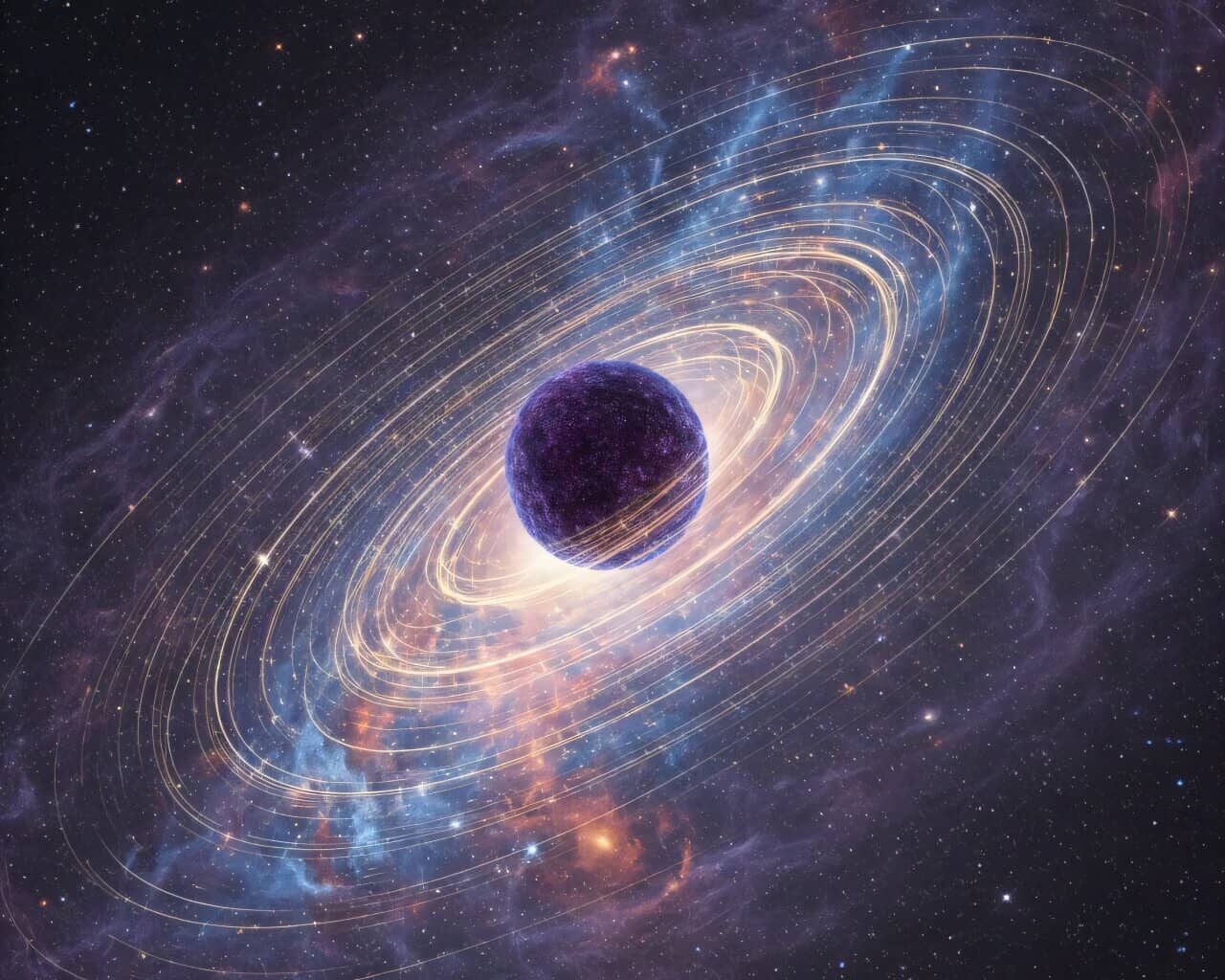
 Artistic representation of the Milky Way, where the innermost stars move at near relativistic speeds around a dense core of dark matter rather than a massive black hole at the center. Credit: Valentina Crespi et al.
Astronomers overwhelmingly agree a supermassive black hole anchors the Milky Way. But a new theoretical analysis explores a far more speculative possibility: not a black hole, but a dense knot of dark matter powerful enough to imitate one.
The proposal, published in Monthly Notices of the Royal Astronomical Society, attempts to explain both the frantic motion of stars near the galactic center and the slower rotation of matter far beyond it using a single structure made of elusive particles.
Previous observations of stars whipping around an unseen mass—especially a bright star called S2—have pointed to an object about four million times the Sun’s mass. The standard interpretation is a black hole known as Sagittarius A*. But the new work asks a simple question: could dark matter alone create the same gravitational pull?
Dark Matter in Disguise
The researchers modeled the dark matter clump as a sea of lightweight particles called fermions. Under gravity, these particles could gather into a compact central core surrounded by a vast halo stretching across the galaxy.
Such a configuration would behave, from a distance, much like a black hole. The dense core could steer nearby stars along the tight, fast orbits astronomers observe, while the extended halo could shape the Milky Way’s overall rotation, which are two phenomena usually explained separately.
“This is the first time a dark matter model has successfully bridged these vastly different scales and various object orbits, including modern rotation curve and central stars data,” said study co-author Carlos Argüelles of the Institute of Astrophysics La Plata.
“We are not just replacing the black hole with a dark object; we are proposing that the supermassive central object and the galaxy’s dark matter halo are two manifestations of the same, continuous substance,” he added in a statement.
To test the idea, the team compared how well different models reproduce the orbits of S-stars and a set of dusty objects known as G-sources near the galactic center. Using statistical techniques, they found the dark-matter scenario can match the observed motions almost as closely as the traditional black-hole model. In many cases, the predicted orbital parameters differed by less than about one percent, well within current observational uncertainties.
×
Thank you! One more thing…
Please check your inbox and confirm your subscription.
The model also connects naturally to data from the European Space Agency’s Gaia mission, which maps how stars move across the Milky Way. Gaia’s measurements reveal a subtle slowing in the galaxy’s outer rotation, a feature the fermionic dark-matter halo can reproduce when combined with ordinary matter in the disk and bulge.
Imitating a Black Hole’s Shadow
 Glowing ring of hot matter around Sagittarius A*. Credit: Wikimedia Commons
Any alternative to a black hole must account for one of astronomy’s most significant observations: the glowing ring around Sagittarius A*, imaged by the Event Horizon Telescope in 2022. Astrophysicists widely interpret the ring as emission from hot plasma lensed around a black hole’s event horizon.
Yet earlier theoretical work showed a dense dark matter core illuminated by an accretion disk could cast a similar shadow. The new study further builds on that possibility.
“This is a pivotal point,” said lead author Valentina Crespi of the Institute of Astrophysics La Plata “Our model not only explains the orbits of stars and the galaxy’s rotation, but is also consistent with the famous ‘black hole shadow’ image. The dense dark matter core can mimic the shadow because it bends light so strongly, creating a central darkness surrounded by a bright ring.”
Even so, the researchers emphasize that current observations cannot decisively choose between the two pictures. Measurements of stellar motions remain consistent with both a black hole and a compact dark matter core.
Future observations may break the tie. Instruments such as the GRAVITY interferometer in Chile could detect subtle relativistic effects in stellar orbits, while future Event Horizon Telescope observations may probe photon-ring structure—features expected around true black holes but absent in the dark-matter scenario.
Evidence for supermassive black holes sits at the center of nearly every large galaxy studied so far, and their growth appears tied to galaxy evolution itself.
Because of that deep connection, replacing the Milky Way’s black hole with dark matter would ripple across astrophysics. It could change how scientists understand galaxy formation, matter under extreme gravity, and the nature of dark matter.
Still, extraordinary claims demand extraordinary evidence. The new work does not definitely show that there is no black hole. Instead, it reveals how much remains uncertain, even in a region studied for decades with the world’s most powerful telescopes.