

Colin UdohFeb 12, 2026, 07:30 PM
CloseItinerant writer. Engineer in a previous incarnation. One time Black Belt. Lover of football, flirter with other sports.
Multiple Authors
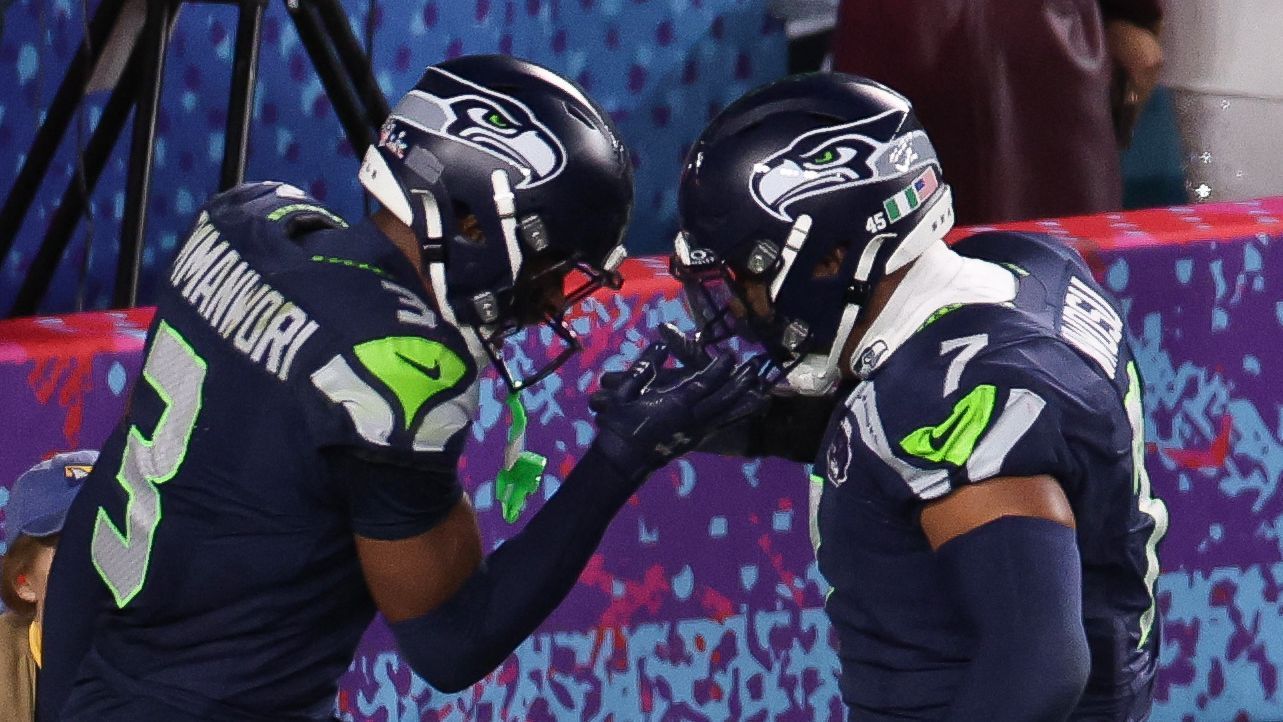
Last Sunday, as confetti rained down on Levi’s Stadium and the Seattle Seahawks celebrated their 29-13 Super Bowl LX victory over the New England Patriots, three of their championship-winning players draped themselves in the green and white of the Nigerian flag.
Linebacker Uchenna Nwosu slung the Nigeria flag across his shoulders. Defensive back Nick Emmanwori and linebacker Boye Mafe each held it aloft.
Together with teammates Jaxon Smith-Njigba (draped in the green, white and blue of Sierra Leone but also of Nigerian background), Olu Oluwatimi and quarterback Jalen Oluwaseun Milroe, they had just written a new chapter in a story that began 34 years ago, with a player whose name most people have never even heard of — Mohammed “Mo” Elewonibi.
Together, all six, as players of Nigerian descent represent the highest number ever to capture the Lombardi Trophy in a single season, breaking the record of five set by the Kansas City Chiefs in 2022.
Nigerian President Bola Tinubu issued a statement congratulating the players, singling out Emmanwori, Nwosu and Mafe for raising the flag.
Editor’s Picks
2 Related
“President Tinubu commends all the players for the pride and honour that they have brought to their country of descent, especially Emmanwori, Nwosu, and Mafe, who raised Nigeria’s flag after winning the Super Bowl with the Seahawks,” a statement from Bayo Onanuga, Special Adviser to the President said.
“These players and their accomplishments affirm Nigerians’ global reputation for excellence and talent,” Tinubu said, also acknowledging Patriots offensive lineman Michael Onwenu, who played for the losing side but earned praise as ‘one of the most dominant offensive linemen’.
For Nigeria, and perhaps the larger African diaspora in the USA, this provides the latest evidence of a pipeline that has grown from a trickle to a now steady stream, starting from when Elewonibi became the first player of African origin to win a Super Bowl with the then-Washington Redskins in 1992.
Born in Lagos and raised in Canada, Mo was selected by the Redskins in the third round of the 1990 NFL Draft and was part of the team that won a third championship for the team from the capital.
That accomplishment did not immediately translate, and looked more like an one-off, as it took over a decade before another player of Nigerian origin followed in Elewonibi’s footsteps.
Mohammed Elewonibi was the first African player to win a Super Bowl title, with the then-Washington Redskins in 1992. Focus on Sport/Getty Images
This time, it was Chicago’s Obafemi Devin Ayanbadejo, a running back who was signed as an undrafted free agent by the Minnesota Vikings in 1997 and spent two years there before being acquired by the Baltimore Ravens, with whom he won Super Bowl XXXV in 2000.
Two years later, San Jose-born wide receiver Onome Ojo followed suit with the Buccaneers. But then, a two-year hiatus followed for players of Nigerian origin, although not for Africa, as Asante Samuel, a player born in Accra, won back to back championships with the New England Patriots before Chukwunweze “Chukky” Okobi and Chidi Iwuoma won again with the Pittsburgh Steelers in 2005.
In the 20 years and Super Bowls that have followed, players of Nigerian origin have missed out on Super Bowl wins on just four occasions. Only the 2001, 2014 and 2016 Patriots, along with the 2008 Steelers and 2020 Buccaneers have not had a player of Nigerian origin in their ranks.
In all, a total of 41 players of Nigerian origin have now won the Super Bowl, the most of any African country. Kansas City leads all teams with eight Nigerian Super Bowl champions across multiple championship runs.
The 2023 Chiefs team holds the overall record for African representation with seven champions of African descent, including Lucas Niang of Ivory Coast descent and Ekow Boye-Doe, who was born in Ghana.
One family even has the unique honour of having earned two wins: brothers Obafemi and Oladele Ayanbadejo both won 12 years apart with the Baltimore Ravens, in 2000 and 2012 respectively.
Of that number, Chiefs Derrick Nnadi has captured the most rings with three, while Osi Umenyiora, Chris Oladokun and Prince Tega Wanogho have each won twice. Oladokun, along with Jalen Milroe are the only two quarterbacks on that 41-man list.
All of this is no accident. Two men have been instrumental in making this happen, especially in recent years. Two-time champion Umenyiora and twice Pro-Bowler Christian Okonkwo.
play
1:20
What was the key to the Seahawks’ defense?
Tedy Bruschi and Dan Orlovsky break down how the Seahawks’ defense was able to have so much success against Drake Maye and the Patriots’ offense.
Former New York Giants defensive end Umenyiora was the first high profile player of Nigerian origin to be a Super Bowl champion and has been instrumental in growing the game in Africa, bringing more players to the NFL with his Uprise camps and workshops on the continent.
Nwosu, who made history as the first player of Nigerian origin to score a touchdown in the Super Bowl when he picked off Drake Maye for a house call to ice the game, did not hesitate to give Umenyiora his flowers after the win.
“Shoutout to Osi, he has been a true mentor and a true leader,” he said. “A true OG and true vet. He’s done great for this league, brought a lot of players in and continues to shine.”
The path all these players, including Umenyiora, walk was cleared by Okoye, who became the first Nigerian-born position player in NFL history when the Kansas City Chiefs drafted him in 1987 as the 35th overall pick.
Known as the Nigerian Nightmare, Okonkwo never won the Super Bowl, but he enjoyed a stellar career, earning First Team All Pro, Second Team All Pro, Two time Pro Bowler honors and NFL rushing yards leader in the 1989 season. He retired as the Chiefs all-time rushing leader before that record was surpassed by Priest Holmes and was enshrined in the team’s Hall of Fame in 2000.
Born in Enugu during Nigeria’s Civil War, Okoye, represented and won gold for Nigeria in the Discus throw at the 1985 African Championships and earned himself a track and field scholarship to Azusa Pacific on the recommendation of Nigeria athletic legend Innocent Egbunike.
But he only turned to American football at the age of 23 after being denied a chance to go to the Olympic Games for Nigeria. Two years later, he was a second-round draft pick. By 1989, he led the NFL in rushing.
“It always feels good to see a Nigerian name in the NFL, for sure,” Okoye said in a 2022 interview. “It’s not a cultural thing for us, but it’s beginning to be.”
Nigeria represent! Seattle Seahawks’ safety Nick Emmanwori and Seattle Seahawks’ linebacker Uchenna Nwosu celebrate Nwosu’s touchdown in the Super Bowl against the New England Patriots. Patrick T. Fallon / AFP via Getty Images
No truer words have been spoken, and the numbers prove it. While a lot of the players of Nigerian and African descent in the NFL were born in the USA, they have been largely influenced by the work and accomplishments of Okoye, Umenyiora and others, who showed that players of African origin can have a place in America’s game and hold their own.
According to Umenyiora, more than 100 players of African heritage now populate NFL rosters, with more to come.
“If you look at the trends, you’ll probably see that maybe 10% of the NFL will be coming from Africa pretty soon,” he said at the NFL’s camp in Ghana in 2022.
That camp did not happen by accident. The NFL was following the lead of Umenyiora and Okoye, both of whom have long advocated for the sport’s growth in Africa. That camp was the league’s first official event on the continent. Players including Nwosu participated.
“There was definitely a course of teaching because there is no football over there, but I was surprised by the amount of athletes that knew how to play,” said the newly-minted Super Bowl champion at the time.
“Those guys keep getting better, and there’s going to be more and more in the future.”
One of the results of that pivot has been the International Player Pathway Program, which has brought several Nigerian-born players directly to NFL rosters, including Chiefs defensive end Kehinde Oginni and Wanogho.
All of the players, whether born in Nigeria or in the diaspora, are unabashedly proud of their roots, turning out in game day fits that reflect the African culture and proudly flying their African flags as helmet decals.
Jaxon Smith-Njigba carried the flag of Sierra Leone after the Seahawks’ Super Bowl win, but he too has roots in Nigeria. Kevin Sabitus/Getty Images
Mafe, who was born in Minnesota to Nigerian parents, but spent his eighth-grade year in a Nigerian boarding school, has visited the country about a dozen times. He wears traditional Ankara-print clothing to casual events and formal Nigerian attire to bigger occasions.
At Minnesota, he and fellow Nigerian defensive end Esezi Otomewo became known as the “Nigerian Nightmares” — a deliberate callback to Christian Okoye’s nickname.
“Representing Nigeria means the world to me,” Mafe said during his draft preparation. “For me, I’ve always wanted to embrace my culture and be able to show that Nigerian players are able to play in the NFL, have a stature and have a place in the NFL.
“Everything that I was taught from my parents to my relatives and everybody in the community, it really shaped and moulded me into who I am today.”
And it is not just in Championship teams that the Nigerian representation shines through. At one point, the Detroit Lions had a posse of players of Nigerian heritage, with brothers Romeo and Julian Okwara hosting the group at their home with Nigerian meals prepared by their mum Melda.
Both times the Seahawks have won the Super Bowl, in 2014 and now in 2026, Nigerians have been on the roster. They had Russell Okung and Benson Mayowa on that first go around.
It is somewhat fortuitous, that just one day before the Super Bowl, the National Sports Commission in Nigeria officially recognized the Nigerian Federation of American Football (NFAF) and inaugurated the board the Wednesday after the Super Bowl.
Okoye, now 64, had long dreamed of bringing the NFL to Africa in a meaningful way. “Man, I was trying, but the NFL wasn’t ready,” he said in 2022. “Now they are ready, and it’s happening. I’m so happy.”