
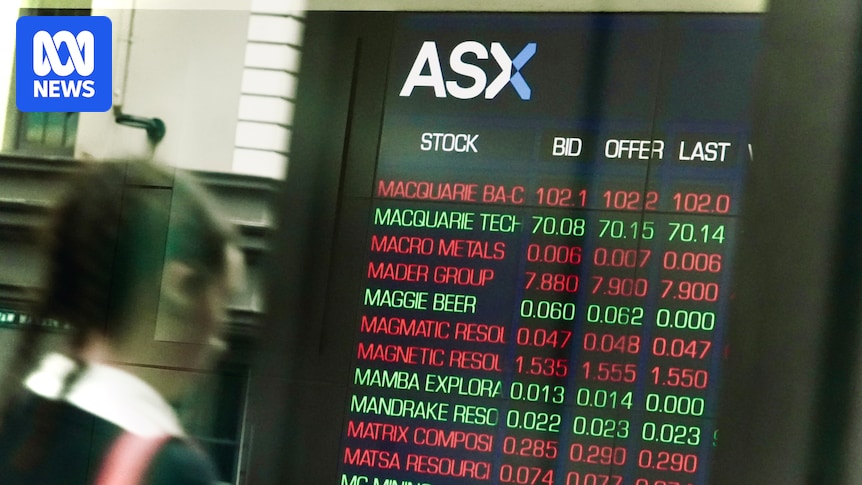
If history is any guide, Helen Lofthouse may well have picked the perfect moment to pull off her Houdini trick at the national stock market operator.
In April, the ASX will “go live” with the first stage of its new automated technology to settle share trades.
It’s been a long time coming.
A decade of technology failures, unplanned outages, management upheaval, irate investors and the torching of hundreds of millions of dollars has left the organisation’s reputation in shreds.
Even Lofthouse’s departure announcement was mired in controversy.
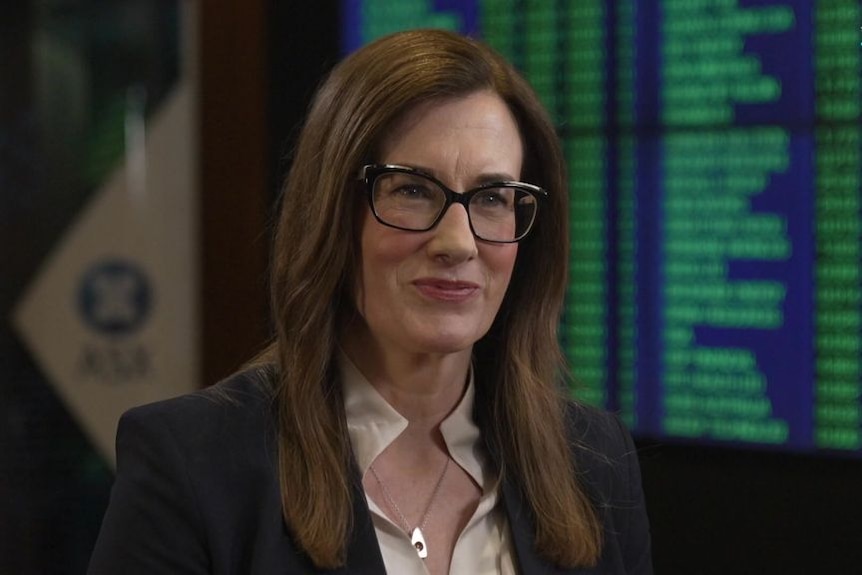
Helen Lofthouse has had to deal with plenty of controversy. (ABC News)
On Tuesday night, heavyweight Australian biotech CSL announced the sudden departure of its chief executive Paul McKenzie.
The notice, lodged immediately after the close of trading, was designed to give investors plenty of time to digest the shock before trading resumed the next day.
Except, there had been an extension to trading times that few knew about. Certainly, CSL executives didn’t. Nor did most fund managers.
CSL shares took an immediate hit as trading resumed 10 minutes after the announcement lobbed, well after normal trading ended on Tuesday.
The falls continued the next day, but there was confusion over the percentage decline, even on the ASX website and on most third-party delivery systems.
Was it 4.6 per cent? Or 11 per cent? It depended on where you thought trading ended the previous session.
By the time Lofthouse leaves ASX in May, the new systems will have been in place for just a few weeks.
Any hiccups will be her replacement’s problem.
Where did it all go wrong?
There was a time when the ASX was a global trailblazer.
In the 1980s, it was a loose amalgamation of state-based exchanges that were owned by the stockbrokers who traded each day.
Eventually, they amalgamated and demutualised, and in the late 1990s ASX was listed on its own stock exchange, the ASX. It was a model that was replicated globally.
Its performance in recent years, however, has prompted a series of formal investigations, regulatory ultimatums and threats to strip the ASX of its monopoly.
The ASX’s TPG bungle adds to a decade of woes
The first real cracks appeared a decade ago, when it became obvious that the ASX’s creaking settlement systems could no longer handle the volume and increasing complexity of trades.
In 2015, it began scouring the globe for a replacement to its ageing CHESS system.
And two years later, ASX set the world abuzz when, in a world first, it announced it would be using blockchain technology, the revolutionary system that powered bitcoin, on an industrial scale to underpin its transactions.
Insiders say the project was a disaster from the beginning.
The three-year timeline was far too ambitious, and there’d been precious little thought about other service providers that supported the ASX.
Fights broke out among information providers over how they would interact with the new system, while myriad groups within the ecosystem — such as share registries and custodians — grew concerned that it would steal their business.
By the time the fifth delay to the rollout time was announced, it was obvious the project was on the rocks. At the end of 2022, it was canned, forcing the ASX to announce a $250 million write-off.
The uproar continued. Brokers and investment houses had spent vast amounts replacing their systems to integrate with the blockchain dream that ultimately turned into a blocked drain.
Lofthouse’s predecessor, Dominic Stevens, who had commissioned the project, had seen the writing on the wall and had departed earlier that year, leaving then-chair Damian Roche to clean up the mess.
Regulators steaming
As a key component of Australia’s financial infrastructure, the exchange is overseen by the Australian Securities and Investments Commission (ASIC) and the Reserve Bank of Australia.
Then-RBA governor Philip Lowe and ASIC’s Joe Longo were both appalled at the ineptitude and made little attempt to disguise their feelings after an independent review of the saga by Accenture was released.
“The independent report has found significant gaps and deficiencies in ASX’s program delivery capabilities and that there are significant challenges in the technology design,” Mr Longo said.
“That these findings can be made at this late stage of a critical replacement program is altogether unsatisfactory.”
Shares in stock exchange operator ASX fall after damning inquiry
Worse was to come.
Stevens may have handed Lofthouse a poisoned chalice, but little seemed to change after she assumed the leadership.
The patched-up 25-year-old CHESS system was long past its use-by date, and the ASX was back to square one on a replacement.
Despite all the talk about using bits and pieces of the abandoned blockchain project, the ancient system suffered repeated outages, leading to a series of embarrassing shutdowns.
Among the worst was the Friday before Christmas 2024, when brokers couldn’t settle trades, leading to this outburst from Mr Longo.
“I am very concerned about it. Very disappointed. And from a regulatory perspective, everything is on the table,” he told the Australian Financial Review.
“We went after the ASX twice last year, and you know what? It’s probably going to happen again this year,” he said.
One mistake too many
Last June, ASIC launched a sweeping investigation, citing “ongoing concerns over ASX’s ability to maintain stable, secure and resilient critical market infrastructure”.
“ASIC’s decision to initiate an Inquiry follows repeated and serious failures at ASX,” Mr Longo said in the announcement.
But the SNAFUs just kept on coming.
As Treasurer Jim Chalmers gathered business leaders in Canberra late last year for his economy roundtable, the ASX blundered into a new controversy when it confused a listed company with a similarly named foreign-owned private equity group that was engaged in a huge takeover.
Loading
The mistake led to TPG Telecom — no relation to TPG Group — being pounded by investors, losing $400 million in market value, even though it had nothing to do with the takeover of an automotive software company.
The mistake was compounded by the ASX’s inability to quickly correct the situation, leaving the company under attack for hours.
Mr Longo, who was in Canberra with the treasurer, then dropped a bombshell.
The regulator, he said, was considering the approval of a rival exchange that would remove ASX’s monopoly.
It had been in talks with CBOE Australia, the local offshoot of the Chicago-based financial trading giant, which already trades ASX-listed securities through its own market.
It was a move designed to ensure the efficiency of our markets, he said, in the face of intensifying global competition for capital.
Lofthouse, who inherited a deeply troubled organisation, apologised for the error.
But the damage was done, and her replacement, who has yet to be named, faces an uphill battle rebuilding confidence in the institution.