
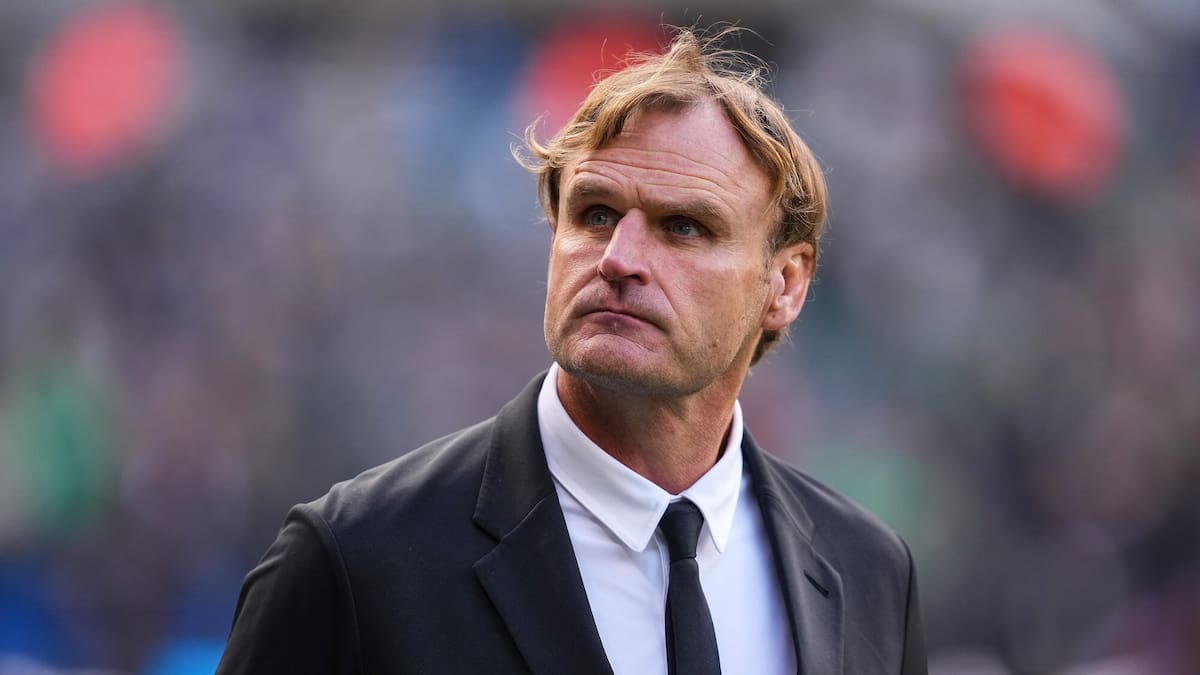
At 51, Robertson has got time to reinvent himself – an opportunity to learn from the mistakes he made with the All Blacks.
But he has restrictions on where he can coach until the end of the year, and with a relatively small number of high-level roles likely to become available in the immediate future, his options are going to be limited.
Scott Robertson stood down as All Blacks coach last month. Photo / Photosport
As part of what was believed to be a circa $1m termination settlement with New Zealand Rugby, Robertson is understood to have agreed a 12-month restraint of trade from coaching top-tier nations.
There is believed to be a potential early break clause where he could join a tier-one team this year after the All Blacks have played that nation – but that may also be at the discretion of NZR who are likely withholding some of Robertson’s termination payment until the end of the restraint period.
NZR has enforced the restraint partly because it is standard practice to protect valuable intellectual property from ending up in the hands of opposition teams, and partly because it is aware that Robertson has a strong desire to be at the 2027 World Cup in some capacity.
Back in mid-2022 when he was overlooked for the All Blacks’ role for a second time, he appeared on a podcast with former Scotland lock Jim Hamilton and revealed that he held a desire to coach two different countries at two different World Cups.
“I want to win a Rugby World Cup, but I want to win it with two different countries,” he said. “I haven’t said it publicly before, but I have now.
“I think that would transcend. I think it would be great to win a World Cup with your own country, and that’s what I want to do, but I’d love to do it with another country.
“I’m not sure in which order – that’s not my decision, that’s for others, but I’d love to win two with different expectations, a different culture.”
It was a statement that some international coaches found presumptuous and one that Wallabies coach Joe Schmidt, who was an assistant with the All Blacks at the time, considered a naked attempt by Robertson to exert pressure on NZR to keep him.
“There was a podcast – with Jim Hamilton and Scott Robertson,” Schmidt said in former All Blacks coach Ian Foster’s autobiography, Leading Under Pressure.
“That’s in the public domain. That was a pressure point and an advertisement that he wanted to win the World Cup with two different teams.”
Wallabies coach Joe Schmidt and All Blacks coach Scott Robertson before a Bledisloe Cup test. Photo / Photosport
Whatever they were at the time, Robertson’s comments on the Big Jim show now serve as some kind of roadmap to where he may end up next.
It’s probable that Robertson still wants to be involved with a team at next year’s World Cup, and there are essentially two distinct paths that could get him there.
The first is to find a gig with a lower-ranked nation such as Chile, Spain, Portugal, Canada – be it as technical director/consultant or some other role where his expertise can be utilised.
Often, these emerging nations have a budget to bring in a heavyweight rugby personality 18 months out from the World Cup, and Robertson would be an ideal candidate.
Scott Robertson faces the media during his time as All Blacks coach. Photo / SmartFrame
Working with a second-tier nation would enable Robertson to get back in the coaching game in a relatively low-profile way, have a major impact in a short space of time and get him to a World Cup.
It would also be a short-term gig, and keep him active and engaged until, inevitably, tier-one head-coaching roles become available after the 2027 tournament.
The alternative path is to hope that a tier-one job becomes available – one that can fit around his restraints.
Following their defeat to Italy, Scotland could be looking for a new head coach after the Six Nations – a job that would no doubt carry high interest for Robertson, but the timing would be problematic as the All Blacks don’t play Scotland until November 8.
Besides, all of Scotland is hankering for current Glasgow coach Franco Smith to take over the national job should incumbent Gregor Townsend be let go.
Other than Scotland, the remainder of rugby’s top international sides are tracking well with their incumbents (Wales are still struggling but have only just appointed a new head coach), so if there is tier-one opportunity for Robertson at next year’s World Cup, it’s probably as an assistant.
And, while this may seem far-fetched, arguably Robertson’s best chance of landing a role is with the Springboks.
Behind enemy lines
As unlikely as that sounds, there are several factors that make it plausible, the first and most compelling of which is that it would be straight out of Springboks head coach Rassie Erasmus’ playbook to hire Robertson later this year to try to spook the All Blacks.
Erasmus is rugby’s most creative and innovative thinker, and he knows that with the Springboks destined to meet the All Blacks in the quarterfinal of next year’s tournament, how unsettling it would be for New Zealand to have a narrative running about their former coach having switched sides.
Having Robertson in the Springboks coaching box would unearth a rich and enduring narrative for Erasmus to play to at the tournament – and have the potential for the new All Blacks coaching crew to start guessing themselves.
On a practical level, Robertson has a super skill in that he can pick apart attack patterns – a quality that would make the Springboks yet stronger if they gave him a tight brief to hyper analyse opponents.
Being part of the high-flying Springboks coaching team would also heighten the probability of Robertson fulfilling his stated goal of winning a World Cup.
But still, Robertson being invited to join the Springboks later this year and agreeing to it, feels the longest of Hollywood long shots.
Or does it, because suspicion is rising that intel about the All Blacks review and process to remove Robertson is being leaked out of Ireland via South Africa.
The working theory is that Erasmus is somehow plugged into the New Zealand network, and is using the strong links he formed with specific Irish media while he was coach of Munster, to work an agenda that destabilises the All Blacks.
The initial story that Robertson’s contract was being terminated broke in the Irish Independent, with the same paper writing a follow-up story that included precise details about the process NZR followed to part company with the head coach.
That same piece contained this line: “One theory is that he was not popular among Auckland Blues power-brokers who hold sway at NZR board level and within the tranche of Blues players in the New Zealand squad”.
For a foreign paper to be so well-informed is unusual and it was also intriguing to hear Erasmus answer questions about the All Blacks put to him by South Africa media last month.
“I was surprised,” he said. “If we get to know the real reasons, we may not be so surprised.”
“Players can definitely not tell you what they want and how they want to win if they don’t know how much work the coaching staff are putting in.
“In some cases player power is a dangerous thing, especially if people don’t fully understand and a player airs his opinion.
“If the process is 100% right and in place, players can have opinions. I’m not saying there was an issue [in the All Black camp], but player power can be a problem.”
The narrative around player power having been at the heart of Robertson’s demise is one of the many red herrings being espoused, alongside the portrayal of Ardie Savea as some kind of orchestrator of this alleged revolt.
But peddling mis-information about player power and then hiring Robertson seems like an excellent way for the Springboks to unsettle the All Blacks.
Gregor Paul is one of New Zealand’s most respected rugby writers and columnists. He has won multiple awards for journalism and written several books about sport.