After losing the Liberal leadership this morning, Sussan Ley has announced she will resign as member for her southern NSW seat of Farrer. Ley has held the seat since 2001 when she took it from the National Party after the retirement of Tim Fischer.
In two-party contests, Ley has held the seat with double digit margins since her first victory in a three-cornered contest in 2001. But that margin has been reduced in contests versus Independents at two of the last three elections, to 10.9% in 2019 and only 6.2% in 2025.
If Ley resigns it will set-up a very messy by-election for new Liberal Leader Angus Taylor.
Under the Coalition agreement, the Nationals did not contest Farrer while Ley was member. With the seat vacant, it is certain that the Nationals will run against the new Liberal candidate.
Given current polling, One Nation would be certain to contest. Two of the last three contests for Farrer have seen Independents reach second place. Labor may contest the by-election, but the party has not reached a quarter of the primary vote since 2007. More likely Labor would sit out the contest and leave the field free for a conservative slugfest.
The last few weeks of Coalition disputes and Liberal leadership rumours could well drag on ahead of a Farrer by-election.
History of the Farrer Electorate
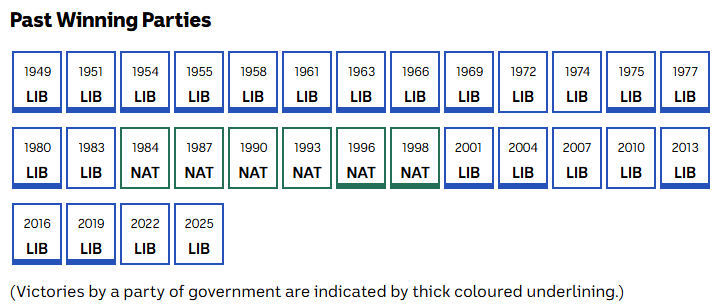
Farrer was first contested in 1949 on the expansion of the parliament. It has always been held by the Coalition with only four members over 76 years since. All have served as Ministers in Coalition governments.
Members for Farrer have been David Fairbairn (Liberal 1949-1975), Wal Fife (Liberal (1975-1984), Tim Fischer (National 1984-2001) and Sussan Ley (Liberal) since 2001.
From 1949 to 1984, Farrer covered the rural areas around the southern NSW regional cities of Albury and Wagga Wagga. In the past both have been cities where the Liberal Party was the dominant Coalition party.
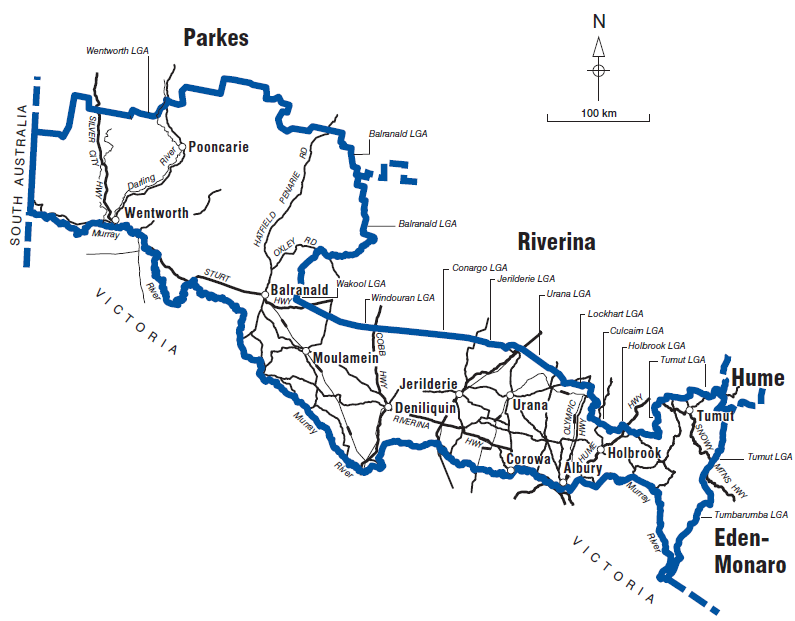
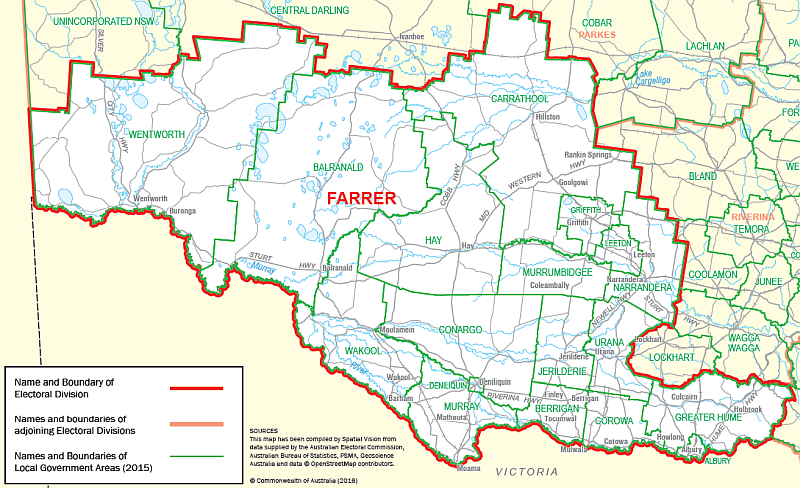
That boundaries radically changed with the expansion of Parliament in 1984. Wagga Wagga was moved into Hume (it is now in Riverina) and Farrer was re-drawn as an elongated seat running along the Murray River from the Snowy Mountains through Albury to the South Australian border. The justification for this elongated electorate was that Farrer received television and other media from Melbourne. The boundaries were expanded slightly ahead of the 1993 election. The 1993-1998 boundaries are shown below.
Farrer 1993-1998
Farrer 2007-2013
NSW lost a seat in a redistribution ahead of the 2001 election. The areas east of Albury were removed, replaced by a vast expansion north to take in Broken Hill and extending to the Queensland Border. The border expanded further in 2007 with Wilcannia and the central Darling included. So the seat covered areas receiving television from Sydney, Melbourne and Adelaide. The western part of the seat was on South Australian time. 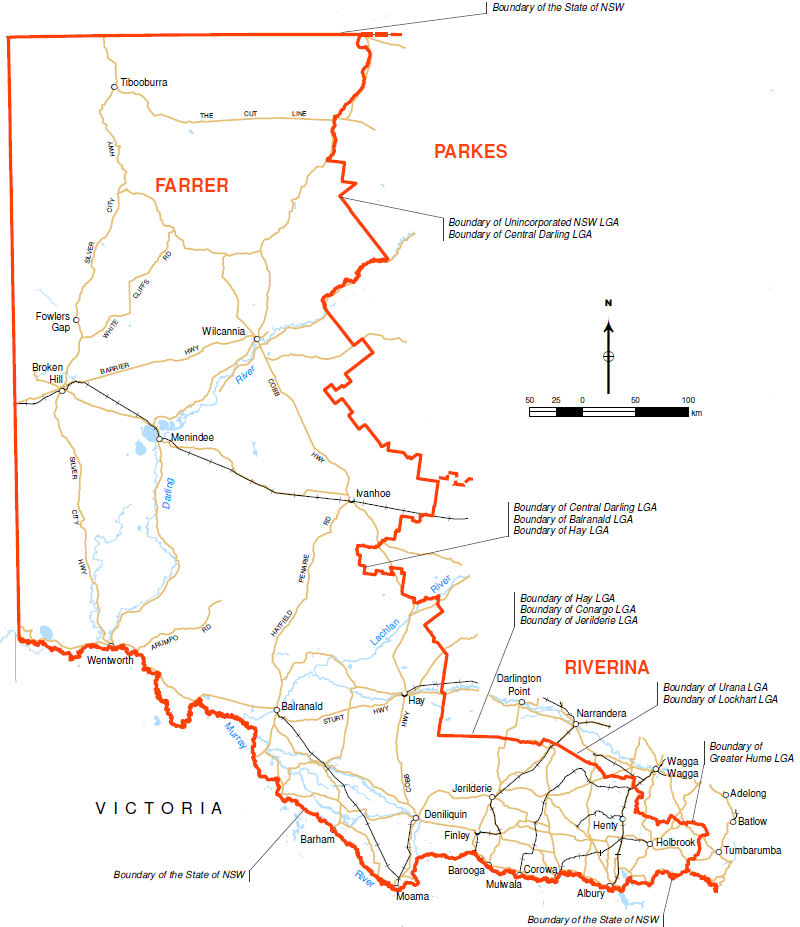
Farrer since 2016
In 2016 there was another major boundary change. Broken Hill and northern areas were removed, Farrer gaining the western Riverina including Griffith, Leeton and Narranderra. Those boundaries remain in place today.
Past Results and Three-Cornered Contests
Through history the Coalition agreement has held up in Farrer. Of the seat’s 28 contests, only four were three-cornered races with both Liberal and National candidates. Two were on the expansion of Parliament in 1949 and 1984. The other two followed the retirement of sitting members in 1975 and 2001.
The 1984 election on re-drawn boundaries was the first to see Farrer leave the Liberal fold. It was won by the National Party’s Tim Fishcher, who had represented the western end of Farrer as a state MP. Fishcer would be re-elected without a Liberal opponent at the next five elections before retiring in 2001. Fischer served as National Party Leader 1990-2001 and Deputy Prime Minister 1996-2001.
Whichever party held the seat, it has always been a very safe seat. The chart below shows Coalition two-party preferred results in Farrer compared to the Coalition two-party preferred percentage vote for New South Wales.
Farrer has recorded two-party results 15-20% above the Coalition’s state-wide two-party result at every election. The majority was for the Nationals 1984-1998, and for the Liberal Party with Sussan Ley since 2001.
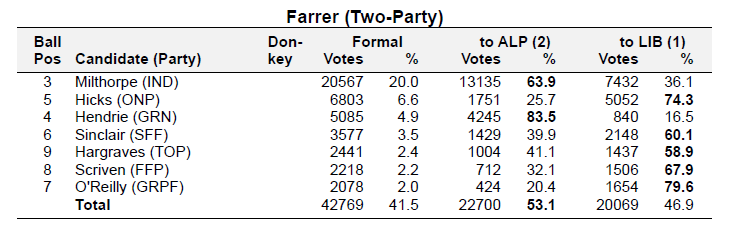
But not all contests have been two-party races. In 2019 and 2025 Labor slipped to third behind an Independent. In 2019 the Liberal margin versus Independent Kevin Mack was reduced to 10.9%, around half its two-party margin. In 2025 the margin was again halved to 6.4% in a contest versus Independent Michelle Milthorpe.
The tightest race came in the 2001 three-cornered contest. The two-party preferred margin was 16.4%, but Labor had slipped to third and the final result was a Liberal victory over the Nationals by just 0.1% or 206 votes.
The chart below shows primary votes at elections since 1984. The Liberal and National primary votes both fell below 50% at the three-cornered contests in 1984 and 2001, though in both cases the combined Coalition vote was above 50%. The 2025 election was the first where support for a single Coalition candidate fell below 50% as Sussan Ley faced an independent and several small right-wing parties.
Labor’s vote has not been above 33% since 1984, or above 25% since 2007. Labor’s vote has been below 20% at the last four elections, at two of which Labor slipped to third behind Independents.
One Nation has contested Farrer five times. Its highest vote was 14.0% at its first election in 1998. It has returned to the contest at the last two elections with 6.3% in 2022 and 6.6% in 2025. Independent Kevin Mack polled 20.5% in 2019 and Michelle Millthorp 20.0% in 2025.
The 2001 Contest
With the retirement of Tim Fischer, Farrer saw a three-cornered contest at the 2001 election. After a pre-selection involving public meetings across the electorate, the Nationals chose 57 year-old Bill Bott. My notes at the time state “When Tim Fischer retired, he pushed for a new type of pre-selection process for his successor. This was implemented, with the candidates for pre-selection attending public meetings in all the major towns of the electorate, meeting, greeting and answering questions from interested constituents. Then the normal National Party pre-selection process took place, choosing 57 year-old farmer Bill Bott from just north of Corowa, a past President of the NSW Shire’s Association. He has served on Corowa Shire Council since 1977.”
The Liberal Party chose Sussan Ley, who according to my notes at the times was a “39 year-old farmers wife from across the Murray at Tallangatta in north-east Victoria. She was defeated for Liberal pre-selection in the Wodonga based seat of Indi, and now crosses the border to try NSW after defeating five other party hopefuls for the opportunity. She works for the tax office in Albury.” She had been defeated for pre-selection in Indi by Sophie Mirabella.
Come the election, the younger female Liberal candidate easily outpolled the older National, 37.7% to 23.4%.
But Labor finished third and recommended preferences to the National. The chart below plots the progressive % vote by count during the distribution of preferences.
Ley continued to easily outpoll Bott through the distribution of preferences. When only three candidates remained, Ley (LIB) was on 43.7%, Bott (NAT) 29.6% with Labor third on 26.6%.
On Labor’s exclusion, 76% of Labor preferences flowed to Bott, bringing him close to victory. As the final line of the above chart shows, Ley won 50.1% to Bott 49.9%, a margin in votes of just 206 votes.
If there is a by-election, with Liberal, National, One Nation, Independent and possibly many other candidates, the contest will be more like 2001 than the coronation contests that Farrer has seen since 1949.
2025 Two-Party Preferred Polling Place Results
(Click on polling place for results)
2025 Two-Candidate Preferred Polling Place Results
(Click on polling place for results)
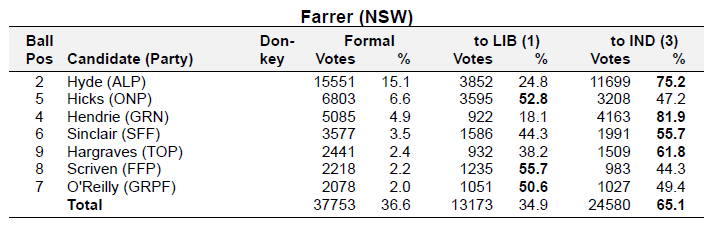
2025 Preference Flow Data – Liberal versus Independent
2025 Preference Flow Data – Liberal versus Labor