
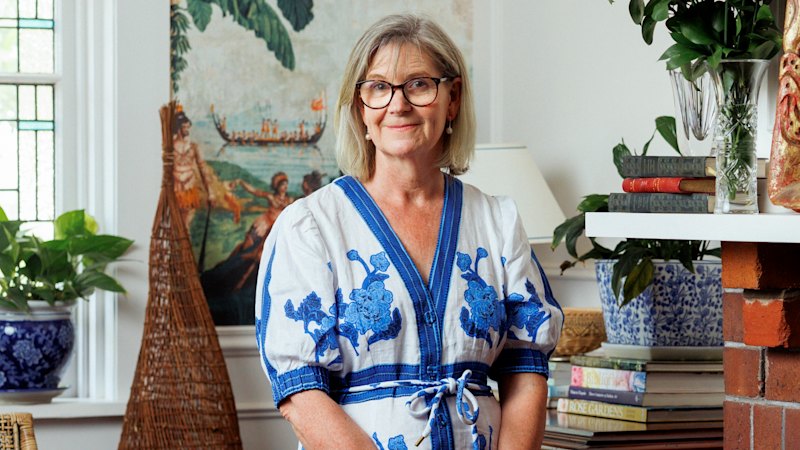
For Proudford, her home provides the “luxury of being able to dip into some technology when … it’s needed”. It also provides escape from particularly rural challenges.
Loading
“It can take you away from those troubles that sometimes exist in farming and droughts and worrying about stock and things,” she said.
Proudford’s room, and overall renovation, picks up on key features of the so-called analogue home. It celebrates craftsmanship and has tactile features like vintage light switches. Books and handmade artworks and garden views are featured.
There are sofas around a fireplace, for “people to catch up”, said Proudford.
Interior designer Elise Croker from Croker Design Studio, the company behind the reimagining of Woodford, said warm, low-level lighting was key to the design, including table lamps and wall sconces.
“Priority number one was their rest and reflection,” said Simon Croker, principal and registered building designer at Croker Design Studio.
Over the past few years Elise has seen “a real interest” from clients wanting spaces for music, yoga studios and pottery rooms.
Parents are seeking home designs encouraging less screen time as attitudes towards tech change, underscored by Australia’s landmark under-16s social media ban which began in December.
The American Society of Interior Designers recently released 2026 Trends Outlook Report said concerns about technology’s impact on children was intensifying, “fuelling renewed demand for screen-free environments, in-person connection, and spaces designed to support mental health and real-world social interaction”.
Trias, in inner Sydney, works with many families, McMaster said, with some trying to be more conscious about screen time.
“We’ve definitely noticed a shift in the way that they’re wanting to plan and organise the home to keep devices out of key spaces,” she said.
“Something we’ve been seeing and talking about a lot with our clients is introducing study spaces that are outside the bedroom.”
People wanting more tech-disconnected homes, McMaster said, was about allowing the home to be a “private and restorative” place with a focus on natural materials and furniture that ages and is “enriched by use”.
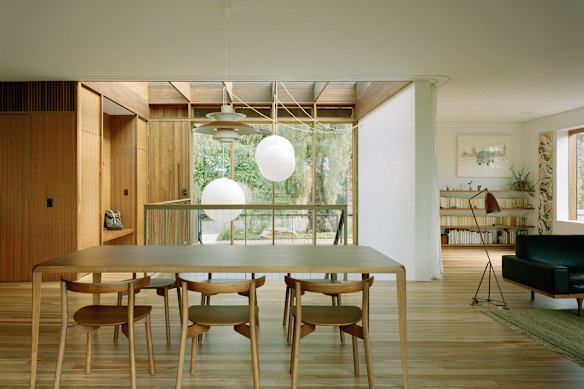
A Trias design. Some families are trying to be more conscious about screen time.Credit: Clinton Weaver
“There’s a space to shed everything and to … leave the detritus of the day behind,” she said.
Loading
“People are yearning for opportunities to just reconnect in really simple ways – so through conversation, through cooking, through enjoying an activity together.”
In Melbourne, the Plus Studio-designed R.Iconic two-tower development reflects changing tastes on a grander scale. The first stage, with about 500 dwellings, was launched in 2020 and included work-from-home spaces.
But for the second tower, R.Evolution, which is under construction, Plus Studio director Ian Briggs said there was “a concerted effort to provide that ability to work nearby, rather than within your apartment”.
Recently, the developer, Melbourne-based R.Corporation, asked Plus to remove study spaces in some apartments and replace them with fireplaces and bars, said Ivona Golubovic, an interior design associate at Plus Studio. There will be a sensory reset room, with soft lighting and sound-absorbing soft furnishings.
At Woodford, reconnection is a daily occurrence. Proudford said everyone at the house breaks at 9.30am.
“We stop and we have some morning tea and we sit around a table and we talk, you know, we joke, we laugh,” she said.
“It’s just a pausing point in the day.”