
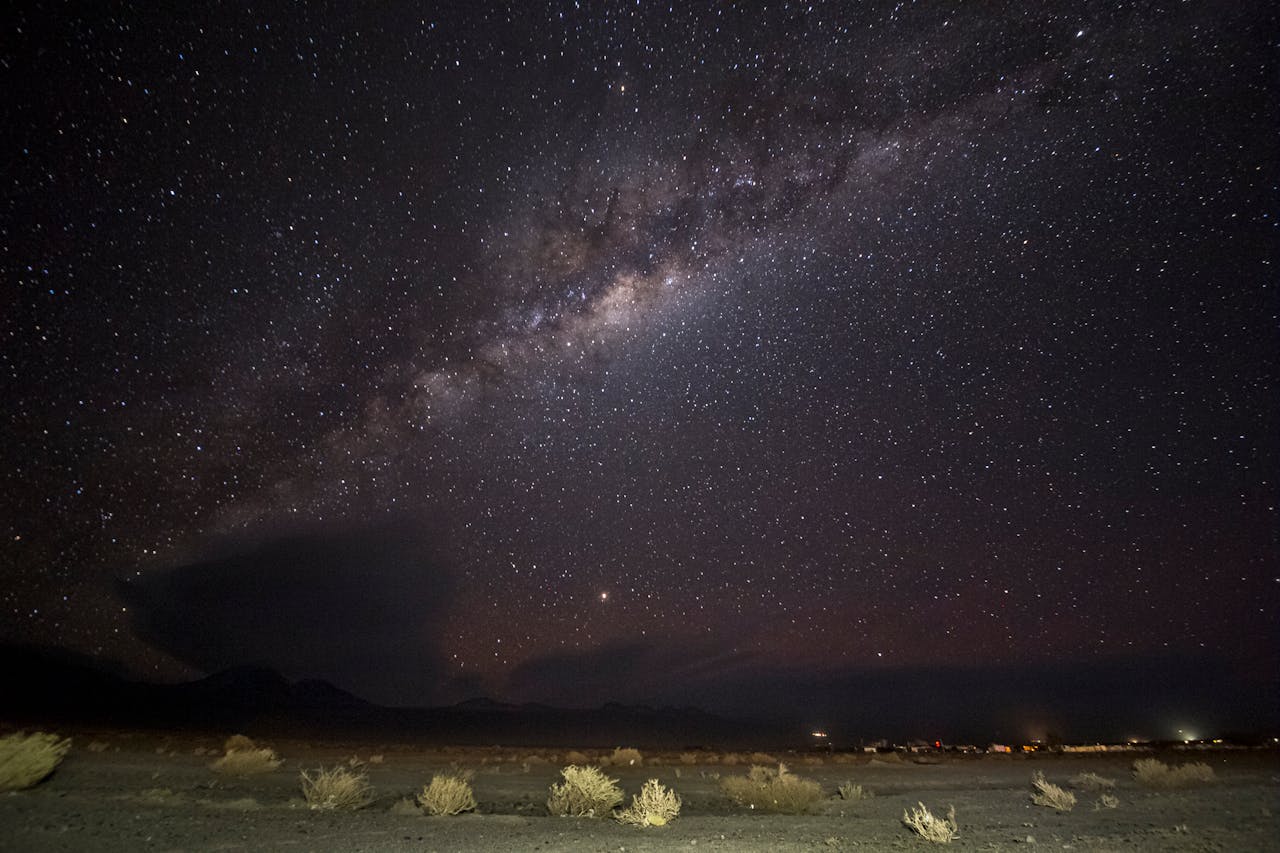
A $10bn industrial complex planned for Chile’s Atacama Desert has been scrapped, ending a confrontation that pitted global astronomy against heavy infrastructure at the edge of the world’s darkest skies.
The INNA green hydrogen and ammonia project, spanning 3,000 hectares and incorporating a port, transport corridors and three solar plants, has been formally withdrawn after discussions with Chile’s environmental evaluation service.
Its developer, AES Andes, confirmed it will cease execution following an internal review. For scientists, the relief is profound.
Why The Threat Was So Serious
The facility would have stood just 11.6 kilometres from Paranal Observatory, widely regarded as the finest ground-based astronomy site on Earth. That proximity alarmed researchers long before regulators reached a decision.
Light pollution was only the most visible danger. Astronomers warned of ground vibrations capable of disturbing ultra-sensitive instruments. Dust lifted by construction and industrial movement could have settled on mirrors polished to atomic precision. Even subtle atmospheric turbulence from large-scale activity risked corrupting measurements gathered over decades.
The damage, they argued, would not have been incremental. It would have been irreversible.
Telescopes With Global Consequence
Paranal’s Very Large Telescope, positioned 2,600 metres above sea level, has contributed to discoveries linked to three Nobel prizes. Nearby, construction continues on the Extremely Large Telescope, designed to become the most powerful optical telescope ever built.
Its targets are ambitious: probing the chemistry of Earth-like exoplanets, dissecting distant galaxies and tracing cosmic evolution to its earliest light. None of that is possible without stable air and near-perfect darkness.
An open letter led by Nobel laureate Reinhard Genzel in December urged Chile’s government to block the development, arguing there was no practical reason to site such a vast complex so close to observatories of global importance.
A Warning Beyond This Victory
“This cancellation means that the INNA project will no longer have a negative impact on the Paranal Observatory,” said Itziar de Gregorio, the European Southern Observatory’s representative in Chile.
Yet she stressed the episode exposed a deeper vulnerability: the absence of firm, long-term protection around Chile’s astronomical hubs.
Chile hosts around 40% of the world’s ground-based astronomical capacity. That dominance depends on geography, but survival depends on policy.
The Atacama skies remain unspoiled tonight. Scientists know the battle for their protection is far from over.
 Published by Kerry Harrison
Kerry’s been writing professionally for over 14 years, after graduating with a First Class Honours Degree in Multimedia Journalism from Canterbury Christ Church University. She joined Orbital Today in 2022. She covers everything from UK launch updates to how the wider space ecosystem is evolving. She enjoys digging into the detail and explaining complex topics in a way that feels straightforward. Before writing about space, Kerry spent years working with cybersecurity companies. She’s written a lot about threat intelligence, data protection, and how cyber and space are increasingly overlapping, whether that’s satellite security or national defence. With a strong background in tech writing, she’s used to making tricky, technical subjects more approachable. That mix of innovation, complexity, and real-world impact is what keeps her interested in the space sector.