
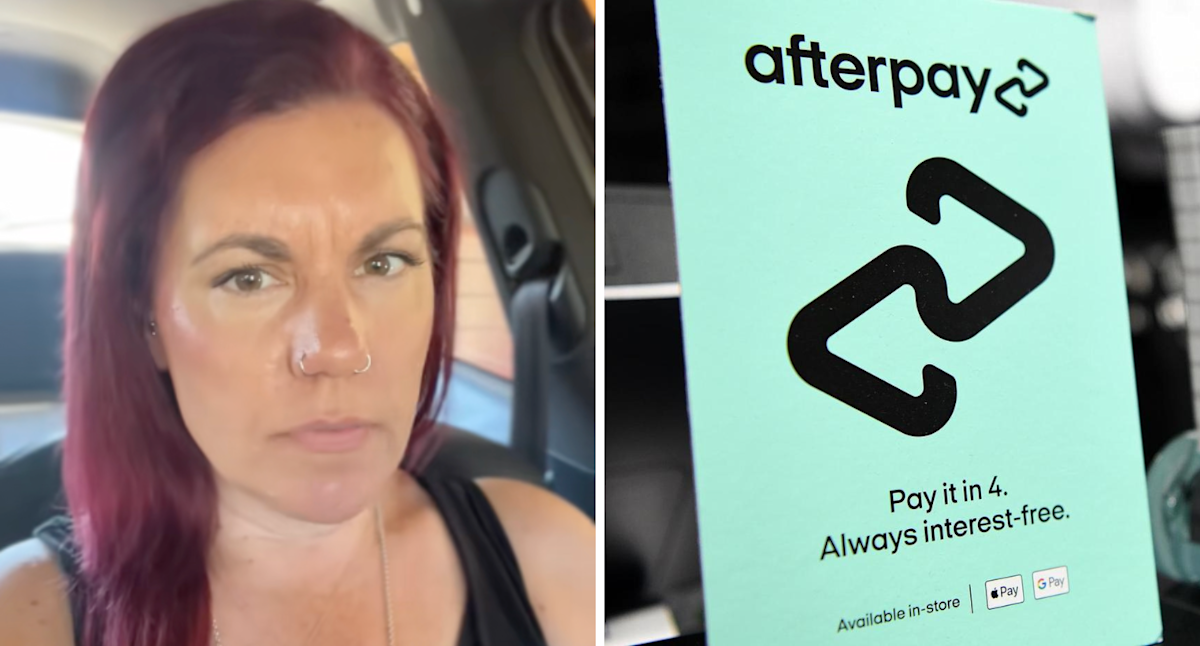
 Kellie Farley, owned of streetwear brand Bae Bands, says most people don’t realise how much Afterpay charges businesses in fees. (Source: TikTok/baebandsaustralia/Newswire)
An Aussie small business owner has revealed the little-known cost of using Afterpay to facilitate sales. Millions of Aussie shoppers use the buy now pay later platform, which allows them to pay for purchases over four instalments with no fees if they pay on time.
But that doesn’t mean it’s free for businesses. Kellie Farley, owner of streetwear company Bae Bands, says she gets as much as 40 per cent of her orders through Afterpay.
She told Yahoo Finance it was a “double-edged sword” for her business, because the fees charged by the platform can be “extremely costly”.
RELATED
AfterPay charges businesses a percentage fee of up to 6 per cent for each purchase, plus a 30 cent fixed fee and GST.
Farley gave the example of a recent customer order of $451.70. On that order, Afterpay took $30.14 in fees.
Commerce platform Shopify also charges her a 1.75 per cent fee for accepting Afterpay payments, as it does with card payments like Mastercard and Visa, plus a 30 cent fixed fee.
“With the economy the way that it is, people are leaning towards using Afterpay and the pay-in-four facilities,” Farley said.
“This is my stance on it. I find that a bit concerning because I’m a big believer that if you can’t afford to buy something straight out, then perhaps you should rethink your purchase.
“But then again, thank goodness that they are using Afterpay, because then I personally wouldn’t be able to afford things for my family” without those sales, she said.
Do you have a story to share? Contact tamika.seeto@yahooinc.com
 Farley says Afterpay is a ‘double-edged’ sword for businesses. (Source: Kellie Farley/Bae Bands Australia)
Afterpay has more than 4.1 million customers, most of whom are Gen Z and Millennials. It has around 129,000 merchants that use the platform.
Farley said many customers weren’t aware of the fees that were charged to businesses, and this prompted her to post about it on her social media.
“Thanks for showing this. [I] had no idea,” one viewer commented.
“That’s good to know, thanks. I will only use Afterpay on big companies from now on,” another said.
“I was only wondering the other day how Afterpay actually make money. I thought they couldn’t just rely on late fees. That’s actually a lot of money for you to be out of pocket. Ten orders a day is $300 and that’s a lot for small businesses,” another added.
Other business owners said they no longer offered Afterpay due to the high fees charged, while others said it was just part of doing business these days.
Story Continues
A recent report into Afterpay’s Economic Impact by research firm Mandala, commissioned by AfterPay, claimed Aussie merchants generated $13.4 billion in total sales via the platform in 2023 and puportedly enjoyed a $9.6 billion increase in sales.
The report also highlighted the platform’s ability to attract new customers and repeat purchases, along with bigger basket sizes.
Farley has been offering Afterpay for her online business for the last five years and said she would continue to do so because it was important to offer flexible options for customers.
“It’s just all part and parcel of running your business, unfortunately. It’s not cheap,” she said.
“We could lose up to 40 per cent of sales [if we didn’t offer Afterpay]. That could possibly cripple us.”
The business is in the process of introducing PayPal’s Pay in Four offering for customers, which charges lower fees to merchants.
Yahoo Finance contacted Afterpay for further information on fees charged, but a spokesperson said the company did not disclose specifics on merchant agreements.
It comes as Australia’s retail sector, particularly clothing, footwear, department stores, homewares and recreational goods, experiences a sharp deterioration in payment behaviour, according to CreditorWatch.
Retail insolvencies have risen steadily as inflation, high interest rates and cost-of-living pressures have put pressure on household spending, with data showing they are around 50 per cent higher than pre-Covid levels.
Consumers are adjusting their spending away from goods and towards services, with discount sales events like Black Friday changing shopping patterns. At the same time, scale is allowing bigger retailers to consolidate their market share at the expense of smaller operators.
“Consumer behaviour has fundamentally shifted, seasonal patterns have been rewritten, and the gap between large and small retailers is widening. For many smaller operators, the operating environment has become far less forgiving,” CreditorWatch chief economist Ivan Colhoun said.
Farley said it was a tough time for small businesses right now, with sales down at her business.
“It also comes down to essential items. Clothing and wire headwraps for the majority of people are not an essential item. So unfortunately, we’re on the bottom,” she said.
Farley encouraged merchants to batten down the hatches and consider their costs.
“It’s gonna be rocky times ahead,” she said.
Get the latest Yahoo Finance news – follow us on Facebook, LinkedIn and Instagram.