

A surprising and rare particle decay has left scientists puzzled as kaons, particles made up of quarks, are decaying in ways that defy current physics models. Could this anomaly indicate the existence of new, undiscovered aspects of physics?
Researchers studying kaon decay have uncovered an anomaly that challenges what scientists thought they knew about particle behavior. If confirmed, this finding could point to new particles or forces that go beyond the Standard Model of physics, which has been the foundation of particle theory for nearly a century.
The Kaon Decay: A Rare and Puzzling Event
Kaons are mesons, a type of particle composed of a quark and an antiquark, belonging to the broader family of hadrons. Like other mesons, kaons are typically produced when other particles decay, and they themselves decay into various elements such as protons or neutrinos. However, the specific decay recently observed in kaons is extraordinarily rare that the researchers’ models predicted less than a quarter of one instance of this decay in their experiment.
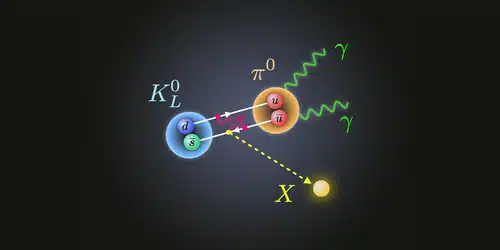 Illustration of a kaon decay process, possibly revealing new physics. Credit: K. Tobioka/Florida State University
What researchers found, however, was something much more unusual. Instead of a single instance, they observed four separate occurrences of this rare kaon decay. This raised significant questions: could this unexpected result be a sign of something entirely new in physics?
A Glimpse of “New Physics”?
If the findings hold up, the phenomenon could point to new physics beyond the well-established Standard Model. According to the study, published in Physical Review Letters, the increased frequency of this unusual decay suggests the involvement of an unknown force or an undiscovered unit. Some scientists have speculated that a new, long-lived particle might be responsible for the strange decay behavior, while others propose the possibility of a new physical force entirely.
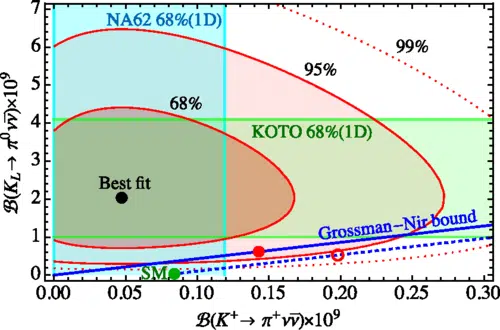 Graph of kaon decay limits from different experiments and the Standard Model. Credit: Physical Review Letters
The idea of “new physics” is both exciting and challenging for scientists, as it would represent a major shift in our understanding of how the universe works at the subatomic level. As the article explained, such discoveries often lead to a reevaluation of existing theories.
Why Subatomic Science is So Hard to Measure
Measuring the behavior of subatomic particles is notoriously difficult. Scientists often rely on indirect methods to detect particles, such as observing shadows or the way particles interact with light, rather than detecting them directly. This approach, while necessary, leaves room for potential errors or misinterpretations of data.
Kohsaku Tobioka, a researcher involved in the study, noted that even a small amount of measurement noise could skew the results. He explained that:
“In this case, expectation of noise is very low, so even one event or observation is very striking.” he added, “and in this case, there were four.”
The fact that four events were observed makes the anomaly even more intriguing. To resolve this, the researchers are working to rule out measurement errors and determine whether this is a genuine new discovery or a statistical fluke.