
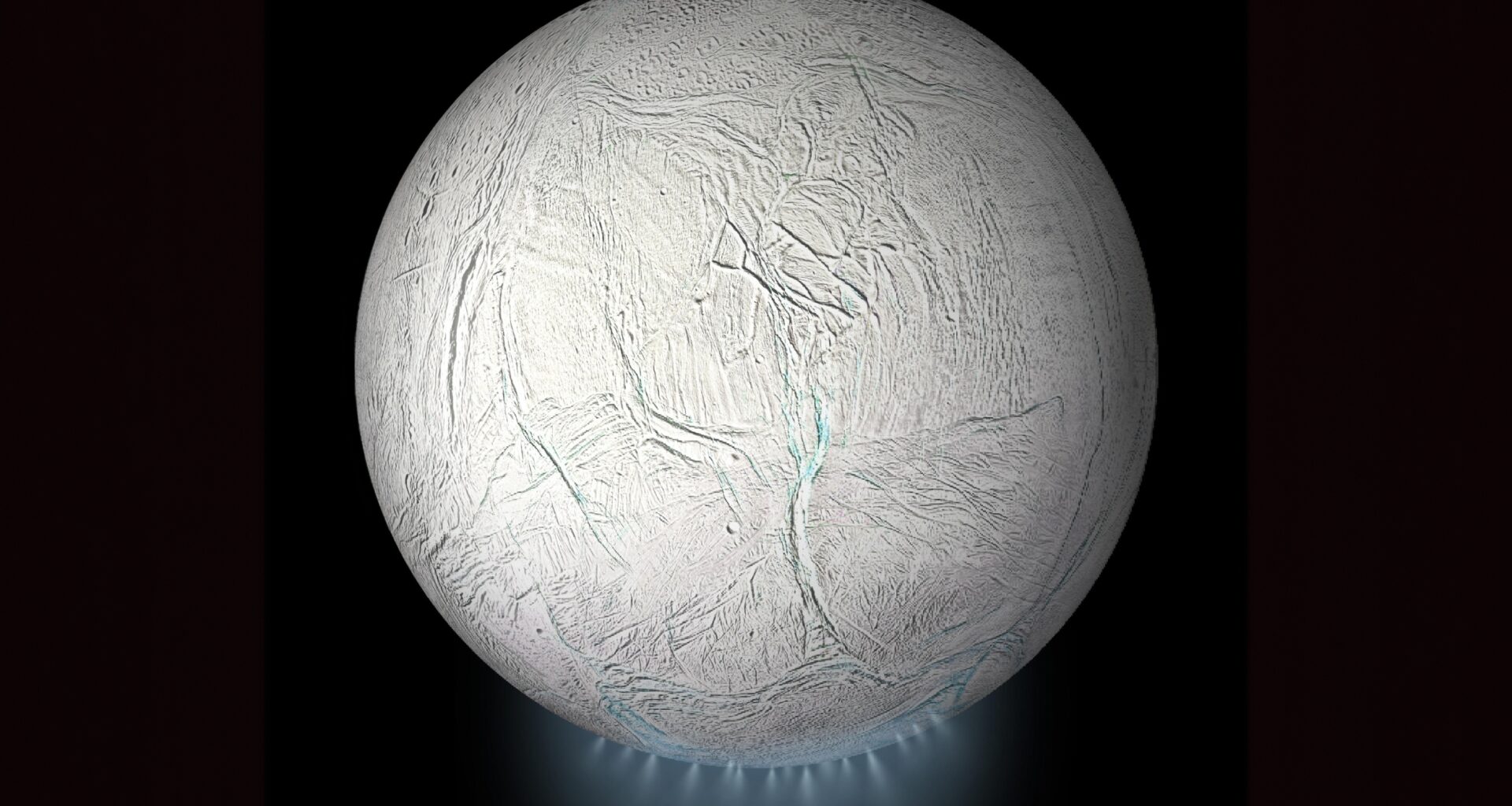
Saturn’s moon Enceladus has long fascinated scientists for its towering geysers and hidden ocean, but new research suggests this small icy world influences Saturn far more than previously understood.
Instead of acting only as a local source of water vapor and ice, the moon appears to function as a powerful electrical generator within the planet’s magnetic environment.

As charged particles from Enceladus’s plumes interact with Saturn’s magnetic field, they create electromagnetic wave systems capable of transporting energy across vast distances.
The results indicate that a moon only about 313 miles (504 km) wide can help drive currents, reshape plasma flows, and redistribute energy throughout a significant portion of Saturn’s magnetosphere.
Cassini reveals a structured wake
Throughout the 13-year Saturn mission of the Cassini spacecraft, repeating magnetic disturbances traced a structured wake trailing Enceladus along the planet’s equatorial plane.
Drawing on those crossings, Lina Hadid at the Laboratory of Plasma Physics (LPP) demonstrated that the wake forms a lattice of main and reflected wave systems magnetically linking the moon to Saturn’s upper atmosphere.
Instead of fading near the moon, the pattern persisted across dozens of encounters, including passes far from any close flyby, revealing a connection that spans both hemispheres.
Such scale forces a closer look at how a body only 313 miles wide can drive currents and energy flows throughout a giant planet’s magnetic domain.
Plumes drive electromagnetic waves
Water vapor and dust jets from Enceladus’s south pole spray through surface cracks, feeding Saturn’s E ring and surrounding the moon with a cloud of gas and particles.
Sunlight and charged particles break many of those molecules apart, turning part of the plume into plasma – a gas so electrically charged that it can conduct current.
“Enceladus, Saturn’s small icy moon, is famous for its water geysers, but its actual impact and interaction with the giant planet has remained partly unknown,” Hadid said.
As this electrically active flow interacts with Saturn’s magnetic field, electric currents form and launch electromagnetic disturbances that travel along magnetic lines connecting Enceladus to the planet.
Physicists call these pathways Alfvén wings – wave-guided channels that carry electric current between worlds.
When the waves reach Saturn’s upper atmosphere, they reflect back toward the moon, while additional reflections from the ionosphere and the moon’s plasma cloud create the crisscross lattice later detected by Cassini.
Large wake trails moon
Downstream from Enceladus, Cassini found the strongest wave signatures lining up in a band that trailed the moon. Across four instruments, 36 separate crossings showed the same pattern, including 13 that occurred without any close flyby.
At its furthest, the wing system stretched beyond 2,000 Enceladus radii, turning a small moon into a planetary-scale source of electromagnetic activity.
Within the main wing, the spacecraft also detected that the waves were not smooth sheets but were split into thin strands – a process known as filamentation.
This break-up concentrates energy into narrow magnetic channels, allowing reflected waves to interact with the moon’s plasma cloud and still reach higher latitudes above Saturn.
The fine structure helps maintain the magnetic connection away from the equator and gives the wake a pathway toward the planet’s polar regions.
Saturn receives power from Enceladus
Each time Enceladus loads Saturn’s magnetic field with new charged material, the moving plasma slows and bends, transferring momentum into the magnetic system.
The resulting waves carry that energy outward as bursts of electromagnetic power. Near Enceladus the signals are strongest, but reflections spread the energy across a much wider region of space.
This means that Saturn can receive power from the moon even when a spacecraft is far from any close encounter.
High above Saturn’s clouds, some of these currents end in brief auroral glows tied to Enceladus’s orbit. When the waves strike the ionosphere, they can accelerate electrons downward, lighting the upper atmosphere.
Cassini detected wave signatures at both low and high latitudes, supporting the idea of a magnetic link that extends from the equatorial wake all the way to the poles.
Other moons may interact
Other moons with oceans or plumes may also push on their planets’ magnetic fields, even if they look small.
Conductive gas around a moon acts as an obstacle, forcing magnetized plasma to flow around it and launch Alfvén wings. Jupiter’s volcanic moon Io does this with more power, and Enceladus now follows the same playbook.
By pinning down the geometry at Saturn, the new results help scientists test similar links at Jupiter and beyond.
Future research missions
Gaps in Cassini’s path left some regions unsampled, especially the space just downstream where reflections should first rejoin the equator, and limited particle measurements made it difficult to track how electrons and ions traveled with the waves over time.
A future mission could allow LPP to trace repeated loops through the wake, then climb toward Saturn’s poles to watch how this coupling evolves.
With broader coverage, Enceladus would shift from an intriguing case study to a powerful tool for understanding magnetized planets across the galaxy.
That goal is increasingly important because Enceladus now appears to act as an electrical driver, with geysers feeding plasma that enables waves to move energy through Saturn’s magnetic system.
Future spacecraft equipped with advanced field and particle sensors could help LPP determine how often these wave “wings” form and where they ultimately deliver energy throughout Saturn’s environment.
The study is published in the Journal of Geophysical Research: Space Physics.
Image credit: NASA/JPL-Caltech
—–
Like what you read? Subscribe to our newsletter for engaging articles, exclusive content, and the latest updates.
Check us out on EarthSnap, a free app brought to you by Eric Ralls and Earth.com.
—–