
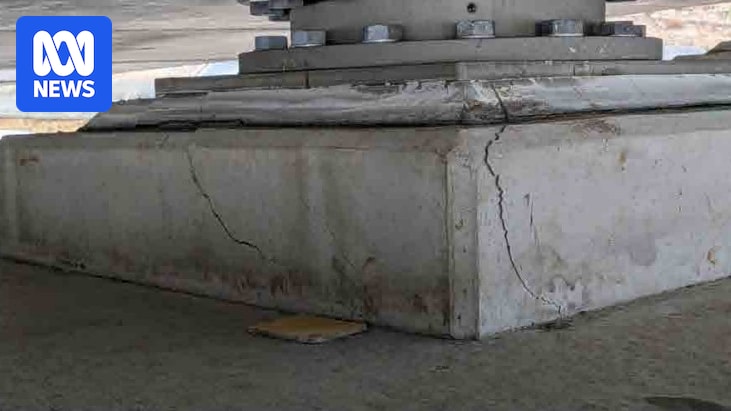
News this week of a crack that was reported just before the new Bridgewater Bridge opened to traffic in June last year prompted some of our audience to question how big a problem that was.
It also had some asking whether Tasmania was capable of building another major infrastructure project, the proposed AFL stadium at Macquarie Point in Hobart.
Right to information documents had shown a “large crack” was found on one of the piers of the new Bridgewater Bridge, days before its official opening.
We’ve put all your questions to engineering experts to better understand what’s happened.
First things first, concrete is expected to crack
Associate Professor Colin Caprani is the head of structural engineering at Monash University, and his research specialisations include highway bridge traffic loading and structural reliability.
“I’ll let you in on a secret: all concrete cracks. It’s just the degree to which it cracks,” Dr Caprani said.
“We usually try to keep those cracks really small, even invisible to the naked eye. Anything more than 2 or 3 millimetres is really indicating some distress.
“So, a crack in and of itself is not a particular problem or a concern.”
Cracking was found in one of the bridge’s piers. (Supplied)
The crack in the plinth, or concrete pedestal, at the top of pier 1 of the bridge was described as a “non-minor defect”.
The State Growth Department said “non-minor defect” was a “contractual term” and that it did not pose any risk to road users, and the bridge was safe.
The plinth connects to the “shear key” above it, which supports the deck of the bridge and helps keep any movement of the bridge, such as by thermal expansion, under control.
According to a department report, the shear key of that particular pier was designed to prevent movement in all horizontal directions, but load capacity had been miscalculated during the bridge’s design phase.
When asked whether it was normal to see this big a crack in such a new structure, Dr Caprani said it wasn’t “particularly normal”, but the bridge was a complex piece of infrastructure.
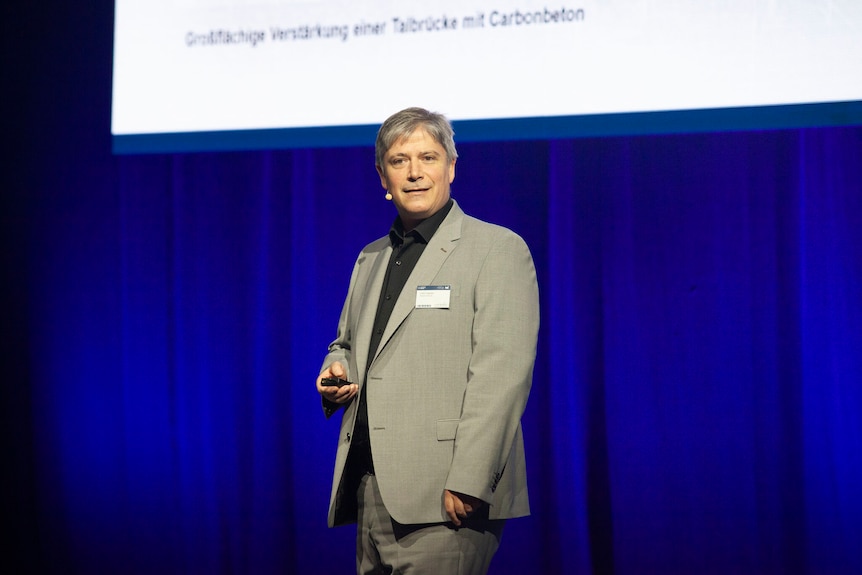
Colin Caprani says cracking does not necessarily mean the concrete has failed from a structural perspective. (Supplied)
“It’s got a horizontal radius and a vertical radius, and it has piers and abutments that are on reclaimed land, all of which require a degree of assumption around how they’re expected to operate once it does get constructed and off the computer screen,” he said.
“When I’ve looked at the context of what’s happened in this bridge, it’s not unforeseen in the sense that assumptions had to be made about the stiffness of the reclaimed soil.
“Those assumptions turned out to be a little bit different to what happened on site.”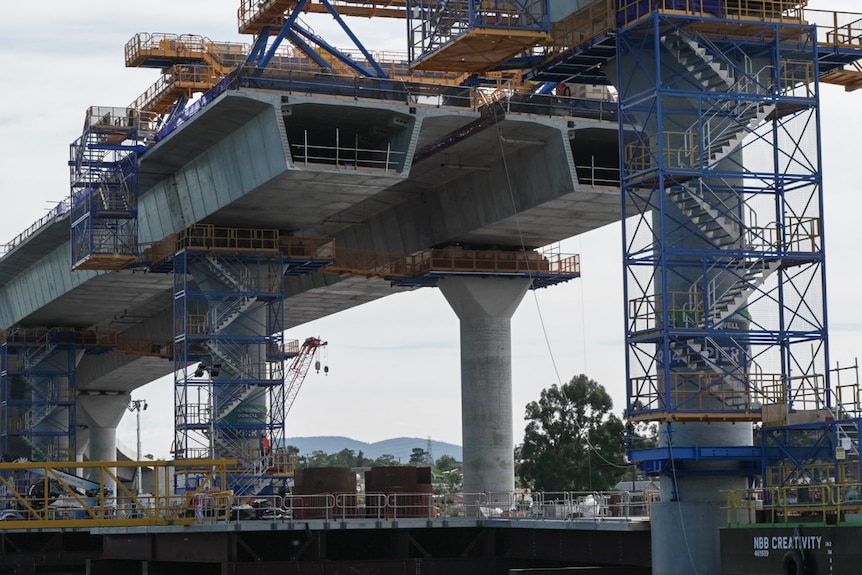
Concrete sections of the Bridgewater Bridge during construction in 2024. (ABC News: Jonny McNee)
The crack in the Bridgewater Bridge was visible to the naked eye — does that mean it’s a problem?
“When cracks do get bigger, as in this instance, and become very apparent, it’s the concrete telling us, ‘Look, I’m under distress, I’m getting more force than was intended,'” Dr Caprani said.
“That’s not the concrete, let’s say, breaking, or the reinforced concrete element breaking — it’s not a failure as such.
“And in this instance, the crack that’s there is what’s called an exceedence of the serviceability limit state, but what that means is that it’s cracked more than we would like visibly.
“But it doesn’t mean that the concrete has failed from a structural perspective.”
Dr Caprani said the shear key had performed as it should and gave the inspection team the indication that it was doing something outside of its normal operational bounds, allowing investigation and repairs to take place.
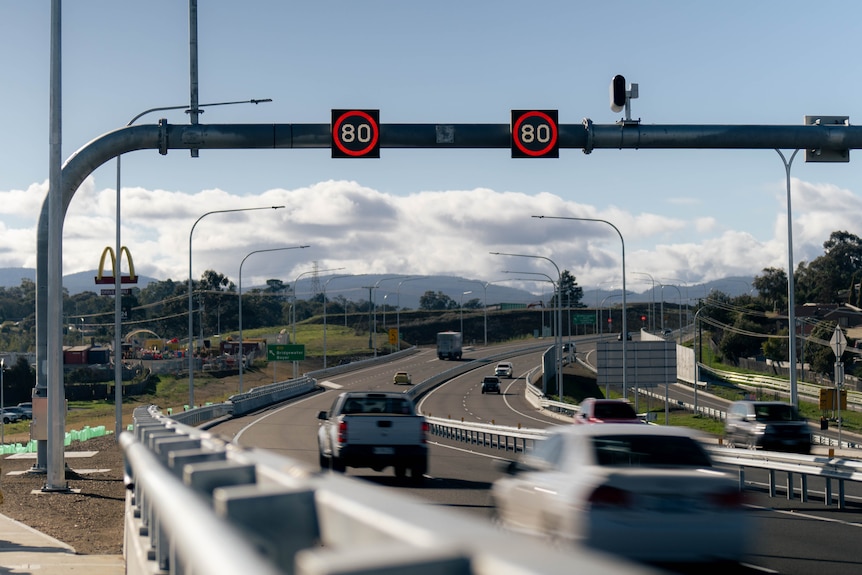
The Bridgewater Bridge cost $786 million to build. (ABC News: Ebony ten Broeke)
Pre-stressing and internal reinforcement are playing their part
Rebecca Gravina. (Supplied: Rebecca Gravina)
Rebecca Gravina is a professor in structural engineering at the University of Queensland, who has researched the long-term performance and durability of reinforced concrete and pre-stressed concrete structures.
“This is why I love concrete structures, because there’s a lot of redundancy in the structure, and when conditions are slightly different to what we expect, there’s a lot of room for movement, for redistribution of those stresses to less critical areas,” she said.
Dr Gravina said she could understand why people would be concerned when they saw cracks in structures.
“However, the beauty about concrete structures is that there’s a lot of redundancy in the structure,” she said.
“Stresses and defamations are able to redistribute to less stress areas when undergoing more stress than somewhere else.”
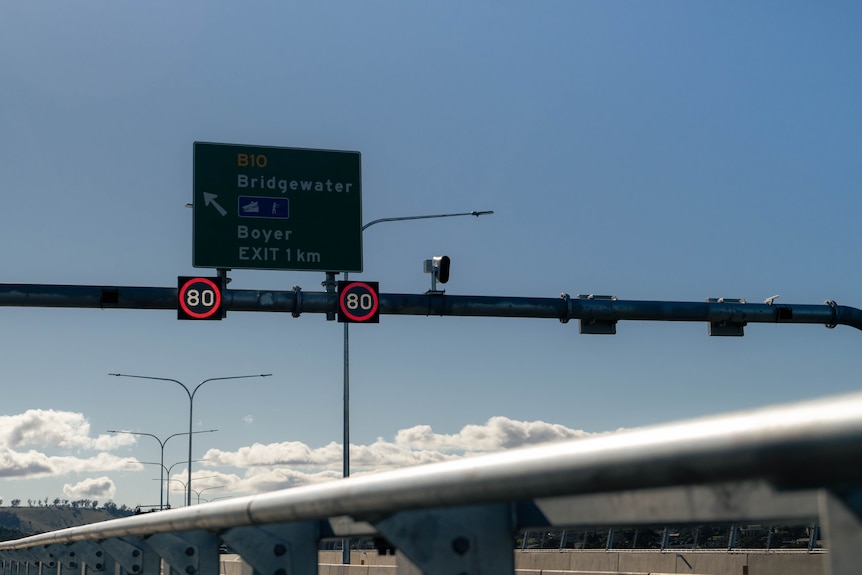
The Bridgewater Bridge is at the southern end of the Midland Highway. (ABC News: Ebony ten Broeke)
That’s where pre-stressing and internal reinforcement come into play.
“So, in this case, the strengthening or the internal reinforcement of the bridge pier and the plinth were doing their work, because as the concrete cracked, that crack opened up and all those stresses were redistributed to the reinforcing steel, so the reinforcing steel was doing its job,” Dr Gravina said.
“So, there’s no concern from a structural engineering point of view, or a physics point of view, that the structure is going to collapse.”
Dr Caprani is a strong advocate for ongoing monitoring to understand how the bridge is responding and to detect issues early.
“All these structures around us, they all move all the time, they just move imperceptibly to humans,” he said.So, what about the AFL stadium? Can the state tackle that big a project?
The experts say yes.
“Australia has very tight and rigorous construction procedures and processes,” Dr Gravina said.
“We’ve got great expertise in the country; there are some very expert engineers in the country who have built stadiums all across the world.
“So, it’s just going to come down to making sure that the contracts are delivered with the right teams of people and with the right expertise.”
Dr Caprani said engineering was a global profession, with most large consultancies operating internationally.
“So, there’s no particular need to have a very concentrated expertise in stadiums or in large-scale bridges, in Hobart, for example. We pull in expertise as we need to from around the world, and that’s just standard at this point in the industry.”