
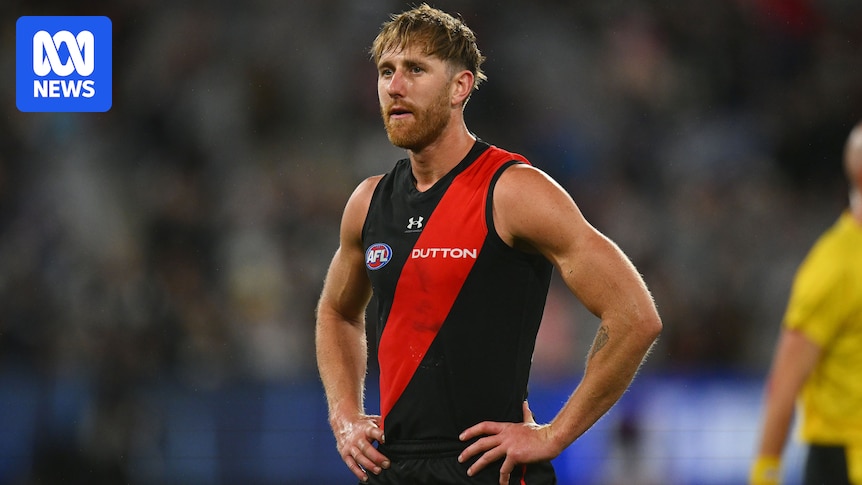
Former Essendon captain Dyson Heppell has spoken about the unhealthy relationship he had with food early in his career after entering footy’s “horrendous” environment around body image.
If you or someone you know needs help:Butterfly National Helpline — 1800 33 4673 or visit www.butterfly.org.auEating Disorders Families Australia — 1300 195 626Eating Disorders Victoria — 1300 550 236Eating Disorders Qld — 07 3844 6055Professionals Credentialed in Eating DisordersLifeline on 13 11 14Suicide Call Back Service — 1300 659 467Kids Helpline — 1800 55 1800MensLine — 1300 78 99 78
“You would set yourself a target and if you came back from your off season to your preseason and you didn’t hit that target, you would be put into a group that would have to do extra cross training — or some form of training to strip some fat off,” Heppell said on I’m A Celebrity Get Me Out Of Here.
“And the boys hailed this group ‘fat club’. It was a pretty vicious one, to be honest.
“The relationship with food and stuff was horrendous and body image and shocking.
“When I had a broken leg, so I’m on crutches all off season and I didn’t hit my skinny targets, so I’m in fat club for pre-season. I was like, ‘you kidding?'”
Heppell played 253 games for Essendon between 2011 and 2024.
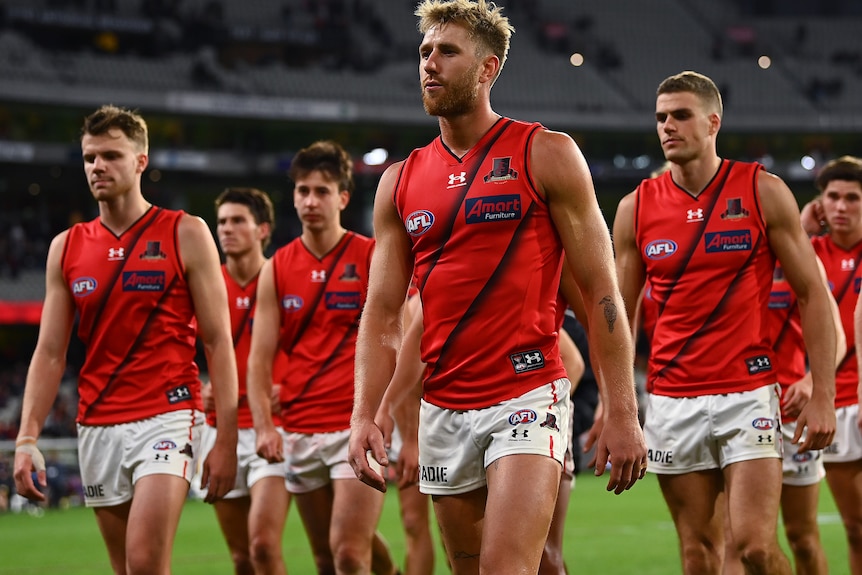
Dyson Heppell played 253 games for Essendon. (Getty Images: Quinn Rooney)
Heppell said he would often obsess over his eating, including pre-preparing meals and being wary of eating when the team was away.
“Early in my career, I ended up with a pretty unhealthy relationship with food. And [it] wasn’t a full eating disorder but it was … it was disordered eating,” Heppell said.
“I’d hardly want to go out and eat.”
Fellow contestant, former NRL player Luke Bateman, who played for the Canberra Raiders between 2015-2019, also said unofficial ‘fat clubs’ were present across rugby league.
In 2016 it was reported that Carlton had a ‘fat club’, set by then-Blues coach Brendon Bolton and his fitness staff.
The body image pressures impacting elite female athletes
Measured by skin folds, if a player had more than 12 per cent body fat, they would be put into ‘fat club’ and have to undertake intense training before rejoining the main group.
At the time, sports administrator Brian Waldron condemned the initiative, saying it was socially irresponsible to name the group the ‘fat club’.
“Surely they could call it something else,” Waldron said on SEN.
“There will be kids walking around school today being told they’re in the fat club and I think that is just social stupidity to be calling a group of players into a group they call the fat club.”
In 2024, the AFL banned clubs from conducting skin fold testing on prospective draftees in a move that was widely panned by footy media critics.
‘I hated my body’: Erin Phillips opens up on body image issues
For AFLW players and girls coming through the system, they could opt out entirely of being weighed.
A memo sent to clubs, addressed by Kate Hall and Grant Williams, read: “Body weights will only be measured by qualified High Performance/Sport Scientists, Sports Dietitians, or Medical Practitioners, in a safe and private setting. All data collected must be kept private.”
Former AFL premiership-winning coach Paul Roos was among those critics, telling the ABC’s new AFL Daily podcast that if players were worried about skin folds, they should “go and find another job”.
However, former players continue to speak out about unhealthy habits around food and weight obsession during their playing days.
Recently, former GWS player Cooper Hamilton has spoken widely across social media about body dysmorphia and his struggles with an eating disorder during his career.
He said he would avoid seeing friends or doing anything socially if it involved food and would often go into games under-fuelled.
Loading Instagram content
Moreover, the ABC uncovered elite female athletes’ struggles with body image and disordered eating in a recent survey.
While the AFL has taken significant steps to reduce the emphasis on player weight and body image obsession in recent years, it remains an issue across clubs.
When Heppell was asked if AFL clubs still did ‘fat club’, he answered emphatically: “Still a thing.”