

When chef Nelize Pretorius felt her vision blurring — first one eye and then the other — it was initially brushed off as conjunctivitis.
But when the swab came back negative, her GP and hospital doctors struggled to understand what was making her eye inflammation progressively worse.
“I could hardly see,” she said.
“I was losing my vision and nobody was able to tell me why.”
The cause was nothing to do with the eye itself — instead it was due to a years-old tattoo on Ms Pretorius’s back.
The condition, known as tattoo-associated uveitis, can lead to permanent vision loss, glaucoma, and patients requiring immunosuppressants for the rest of their life.
“You get a tattoo, and you think the risk is that you might regret it later in life,” Ms Pretorius said.
“[The real risk is] you could potentially lose your vision.”

Nelize Pretorius has spent thousands of dollars on treatments to protect her vision from deteriorating. (Supplied: Nelize Pretorius)
While tattoo-associated uveitis was thought to be extremely rare, research published in the journal Clinical and Experimental Ophthalmology has documented 40 new cases of the condition in Australia — doubling the number of published cases detected around the world since 2010.
The research, undertaken by a team of Australians, suggests this complication, while still rare given the number of people who get tattoos, may be more common than we thought.
Experts are calling for more research to understand and try to limit the vision-threatening disease.
Eyes in the immune ‘crossfire’
Josephine Richards, the ophthalmologist who treated Ms Pretorius is no stranger to immune diseases.
Working in the field of eye inflammation, she’s seen plenty of cases of uveitis — a dangerous condition where immune mechanisms begin to damage the eye.
It can be a complication of autoimmune arthritis, and a number of other autoimmune diseases where the immune system mistakenly attacks a part of the body.
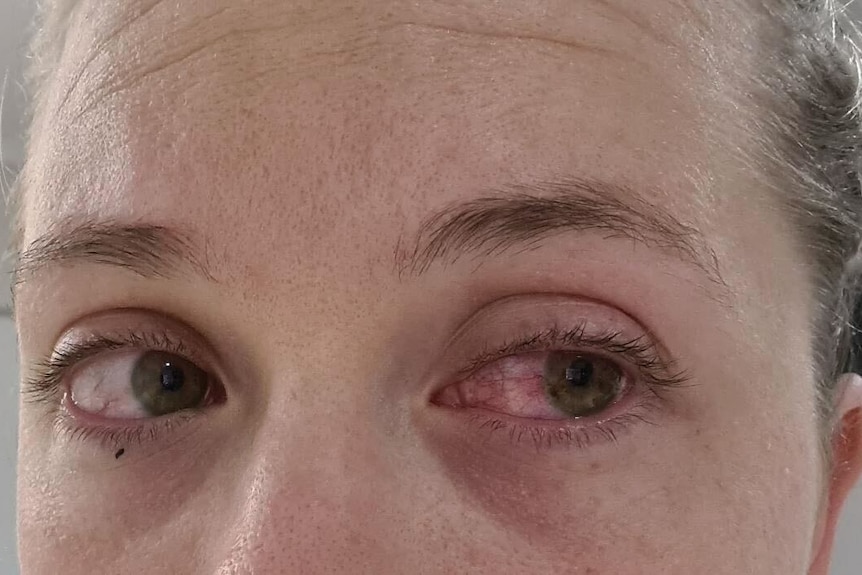
Nelieze was unable to work at her job as a chef as her vision deteriorated. (Supplied: Nelize Pretorius)
Early symptoms of uveitis include blurred vision, light sensitivity, pain, and — if it is left untreated — glaucoma, and permanent vision loss.
“We do not know why the eye gets caught in the crossfire,” Dr Richards said.
“There is something about the immune reaction that targets the eye.”
Do tattoos increase your risk of cancer?
But in recent years, Dr Richards has seen a rise in cases of uveitis caused by injected tattoo ink — sometimes long after the tattoo was done.
Doctors can tell the uveitis is caused by a tattoo because it can look slightly raised and inflamed.
“I only became aware of it about four or five years ago, and then once I was aware of it, I had all these patients all of a sudden,” she said.
And she wasn’t the only eye doctor seeing this.
At a conference of ophthalmologists interested in eye inflammation, the specialists realised that many of them were being referred cases of young people with tattoos who had ended up with this same issue.
“So we said, ‘OK, we better look at this and see if it’s becoming more common.'”
“And just since our last conference [in November 2025] we’ve got four more cases in Western Australia. Probably the other states have got more too.”
In the recently published research, most cases of tattoo-associated uveitis needed to go on long-term treatment including immunosuppression, and only three of the patients had no vision loss throughout the treatment.
Ms Pretorius continues to use steroid eye drops, and has spent thousands of dollars on treatment. She remains in touch with Dr Richards to deal with regular flare-ups.
“What really worries us is that we’re just not managing to get these people off the drugs,” Dr Richards said.
“Usually with an immune disease, we treat for two years and then slowly wind back treatment and hope that the person’s going to be OK off the treatment. But mostly we’re not managing to wind back the treatment.”
Why is this occurring?
While it is unknown exactly what causes some tattoos to produce this reaction, the new research offers some clues.
Of the people with tattoo-associated uveitis studied in the paper, it was mostly black ink tattoos that seemed to have caused the inflammation, but pink and red ink was also recorded in one case each.
In most of the cases it was also long after the tattoo had been completed, on average around a year or two, but in one case up to 35 years after the tattoo was done.
According to Dr Richards, some, but not all people, had their tattoos done overseas, including in Bali.
This makes it particularly difficult for researchers to work out what in the ink might cause this reaction.
“It is just so hard to find out what dye was used,” she said.
Dr Richards said it was important to be able to identify why the dyes caused the reaction.
“I hope we will understand why it’s happening and be able to identify what it is about the dyes that are triggering it and take those out of the mix,” she said.

While black inks seem to be present in most tattoo-related uveitis cases, it’s also the most common ink used. (Getty Images: Rawpixel)
Despite the increase in cases appearing over the past few years, Nicole Carnt, a vision scientist at the University of Sydney not involved with the research, noted that it was still a rare condition given about 20–30 per cent of Australians have at least one tattoo.
“There’s millions of people who have tattoos and don’t have any problems,” she said.
“So what is triggering this in some people?”
Both Dr Carnt and Dr Richards suggested genetic susceptibility and the microbiome might be involved.
Dr Richards said the condition looked very similar to an immune disease called sarcoidosis, where inflammatory cells clustered around the body in red swollen lumps.
“You can take a biopsy of an inflamed tattoo, and it looks almost the same as what you’d see in the chest with sarcoidosis,” she said.
“With all immune diseases, there is some genetic predisposition — some way that your immune system deals with the world — and then you get exposed to something and that sets you off,” she added.
Dr Richards noted that those with a familial risk of immune diseases like sarcoidosis might be more likely to have this tattoo-associated infection occur.
How to make tattoos safer
The researchers are well aware they are unlikely to convince people to stop getting inked, especially for a rare disease that may occur years down the track.
“So many people get tattooed, and I feel like it would be very hard to stop people from doing it,” Dr Richards said.
Even Ms Pretorius wasn’t sure if her younger self would be convinced.
“I don’t know if 18-year-old Nelize would have listened but 33-year-old Nelize certainly would,” she said.
Instead, Dr Richards hoped to focus on what in the inks might cause this, and trying to ensure it could be removed.
“If you were able to make it safer, that would be the best outcome for everybody.”
Dr Carnt agreed, suggesting more research was needed to find out what was causing some people to be vulnerable but not others.
ABC Health in your Instagram feed
Dr Richard is also working on ensuring that more people, and their doctors, know about this disease, so they can be referred and treated faster.
“It wouldn’t change the decision for many people. Some of my tattooed patients that are on immunosuppression still carry on having tattoos because that is so important to them,” she said.
“But I would like people to at least know.”
Despite having a condition that she jokes “sounds made up”, Ms Pretorius feels lucky her situation isn’t worse.
“I think that my case in particular, was one of the first cases that Dr Richards had in Perth,” she said.
“It’s just lucky that she knew about it because if she wasn’t there on that day, I may still not know what the issue is.
“There’s a few people [with tattoo-associated uveitis] that lost their vision permanently, so relatively speaking I came off pretty good.”