
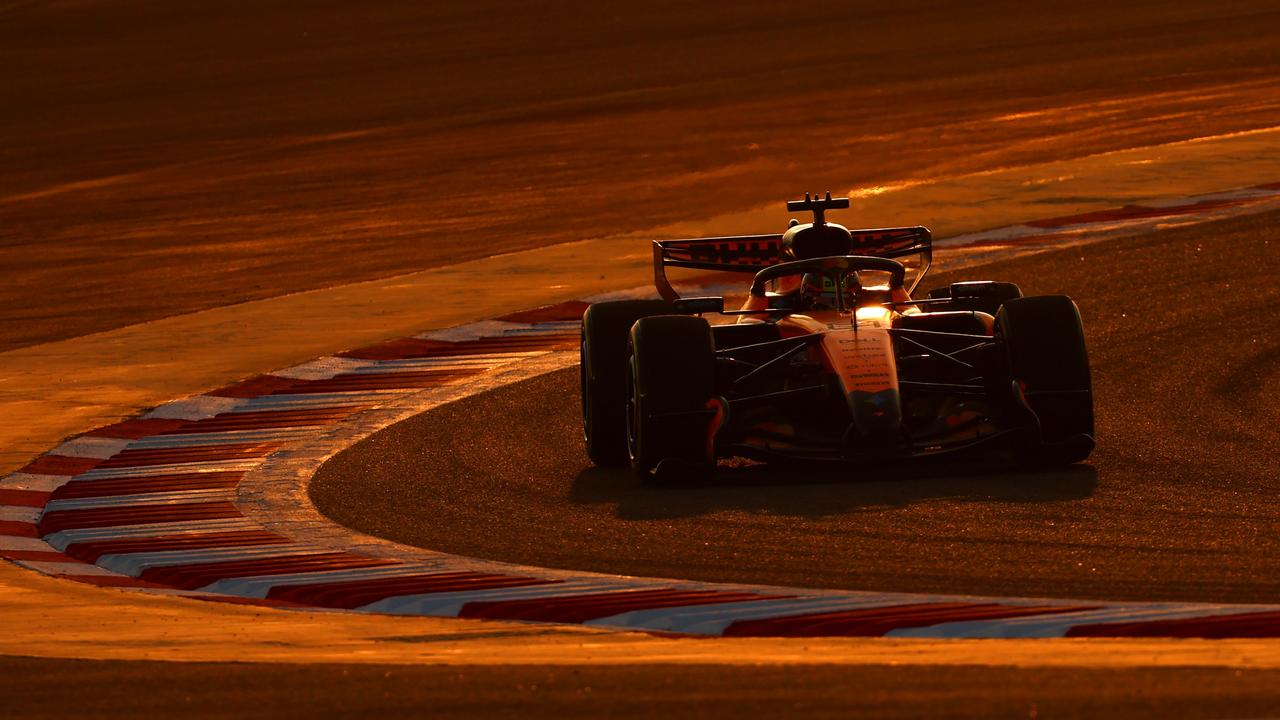
The second of three pre-season tests is in the books, and despite the biggest rule changes in Formula 1 history, the new form guide is beginning to look a lot like the old one.
It’s hard to be definitive when testing isn’t even finished yet, but it’s becoming clear that this year’s grid will be divided in a similar fashion to the grid of 2025.
The top four we’ve become accustomed to in recent years still exists, with Mercedes, Ferrari, McLaren and Red Bull Racing each other’s most likely rivals.

There’s a gap back to the midfield and then at least a couple of tailenders further adrift.
Fox Sports, available on Kayo Sports, is the only place to watch every practice, qualifying session and race in the 2026 FIA Formula One World Championship™ LIVE in 4K. New to Kayo? Join now and get your first month for just $1.
What order the teams are set to take in those divisions, however, is unclear.
The only certain thing is that no-one wants to call themselves the favourite. In fact most of the top teams seem keen to describe themselves as fourth at best.
Mercedes ended the second test with the fastest time and overcame some reliability niggles by the final day, but George Russell described the week as a “reality check” for his team, deflecting the spotlight to “scary” Red Bull Racing.
“They’re very much the team to beat,” he said. “Red Bull are going to be ahead, so we’ve got work to do.”
Red Bull Racing, unsurprisingly, believes quite the opposite.
“We are not the benchmark for sure,” technical director Pierre Waché said, per Autosport. “We clearly see the top three teams — Ferrari, Mercedes and McLaren — are in front of us.
“It looks like, from what our analysis is, that we are behind.”
Does Ferrari see itself as ahead, then?
“I think Red Bull have shown very impressive things power unit-wise since the start of the tests,” Charles Leclerc said, per The Race.
“Mercedes are showing some very impressive things as well sometimes, but I would say they are hiding a lot more.
“I would expect them two especially to be a bit ahead of us … it’s Red Bull and Mercedes in front, and then us.”
What does McLaren, the reigning constructors champion running the Mercedes power unit, think about the pecking order?
“Early indications from a competitiveness point of view definitely put Ferrari and Mercedes at the top of the list in terms of those that seem to be ready from a performance point of view in particular.”
WHAT DO THE TIMES SAY?
It’s always dangerous to read too much — or very much at all — into raw lap times during testing. There are far more variables at play, including the time of day — especially in Bahrain, with evening conditions faster than the heat of the day — fuel loads, engine modes, tyres used and run programs.
That’s compared to a usual practice session, when all cars are on track at the same time and teams tend to run similar programs in preparation for a grand prix.
But after three days of the second test, we can see a rough shape emerging that seems to tally with expectations and the general vibe.
Time by team, Bahrain days 1–3
1. Mercedes: 1m 33.669s (Andrea Kimi Antonelli, day 3)
2. Ferrari: +0.540 (Lewis Hamilton, day 3)
3. McLaren: +0.880 (Oscar Piastri, day 3)
4. Red Bull Racing: +1.129 (Max Verstappen, day 1)
5. Haas: +1.725 (Oliver Bearman, day 2)
6. Alpine: +2.137 (Franco Colapinto, day 3)
7. Audi: +2.622 (Nico Hülkenberg, day 3)
8. Williams: +2.996 (Alex Albon, day 3)
9. Racing Bulls: +3.139 (Liam Lawson, day 3)
10. Cadillac: +3.155 (Valtteri Bottas, day 2)
11. Aston Martin: +4.496 (Lance Stroll, day 3)
Note in particular that Red Bull Racing’s fastest time came on the first day of the test, when the track was at its dustiest. It’s hard to prescribe how much time that would have been worth, but it’s safe to say the gap is larger than it should be.
Then again, maybe Mercedes was loaded up on fuel or Ferrari had its engine turned down. Read with caution.
A better way to filter out some of this noise is to analyse long-run data. Every team conducted some race simulation running with different tyres, which means they all had to be filled with a baseline level of fuel, taking out at least one variable.
The results appear to back up the above order, with Mercedes and Ferrari appearing closely matched at the head of the field and McLaren a step behind.
Red Bull Racing looked on par with McLaren but with the caveat that it was Isack Hadjar, not Max Verstappen, behind the wheel in the afternoon. Hadjar also completed his race runs earlier in the day, so conditions may have played a role.
Then again, on Thursday both Norris and Verstappen conducted long runs that looked closer to the front, albeit with the Dutchman faster, thanks largely to his speed down the straights.
That’s all to say that there’s no definitive order at this stage of testing.
That should be underlined given Ferrari at least is poised to bring a major upgrade to next week’s final Bahrain test. The team launched the year with a basic car to analyse reliability and its basic aerodynamic concept. Next week’s car is the one it will bring to Melbourne.
That could change the picture again — as could upgrades for other teams or even just more information from three more days of running.
Watch this space.
3-Peat?! – McLaren unveil 2026 livery | 00:38
WILLIAMS GETS THE TEST IT NEEDS
Nothing will get Williams back the three days of testing it lost by not turning up to Barcelona, but the British team is making the most of the track time it has available.
Williams completed an equal-best 422 laps for the week in Bahrain, matched only by McLaren and fractionally ahead of Ferrari, in a bid to rule a line under its delayed start to the year and scotch rumours of a general lack of preparation.
Mileage by team, Bahrain days 1–3
1. McLaren: 422 laps (2283.9 kilometres)
2. Williams: 422 laps (2283.9 kilometres)
3. Ferrari: 420 laps (2273.0 kilometres)
4. Haas: 390 laps (2110.7 kilometres)
5. Audi: 353 laps (1910.4 kilometres)
6. Red Bull Racing: 343 laps (1856.3 kilometres)
7. Racing Bulls: 326 laps (1764.3 kilometres)
8. Cadillac: 320 laps (1731.8 kilometres)
9. Alpine: 307 laps (1661.5 kilometres)
10. Mercedes: 282 laps (1526.2 kilometres)
11. Aston Martin: 206 laps (1114.9 kilometres)
The team also burnt through both of its ‘filming days’ in the lead up to the test. The regulations allow teams to run their current cars on two 200-kilometre filming days each year, but these are often used as private tests. Many teams used one before Barcelona as a shakedown.
One of those tests was at Silverstone, but the other was in Bahrain earlier this week, adding around 36 more laps to its Sakhir total.
It’s as good an outcome as the team could’ve hoped for.
But it doesn’t undo the fact the team is three days of testing and two weeks of analysis behind its rivals, and that shows up in the team’s lowly place on the timing chart with a car that doesn’t yet look settled on track, according to trackside observers.
“We’re still not at the level of where we want to be in terms of comparing ourselves with top teams and the way they execute their winters, their preparations, their change of set of regulations,” Carlos Sainz said, per Autosport.
“We know there’s a massive margin of improvement in many, many areas, and yet when I came to Williams I knew this was going to be the case, and I’m here for trying to help in every area.”
It’s important to remember that Williams sees last year’s fifth place in the championship as its starting point in 2026. The team is targeting a step forward this year and hoping it might on pure pace consistently sit in the gap between the frontrunners and the midfield, opening the door to more steps forward next year.
It still has to prove the car is on that trajectory next week.
Cadillac F1 reveal 1st Livery for 2026 | 00:39
CADILLAC IS QUIETLY IMPRESSING
Cadillac has been the source of red flags throughout pre-season testing — unsurprising given its new-team status — but despite the stoppages, the team has quietly impressed the paddock.
That’s not to say the American-owned team will be anything other than a backmarker in its opening season. The task of building a Formula 1 team and car from scratch — and in perhaps the most complex regulatory era in history — is massive and not to be underestimated.
But there were genuine concerns that Cadillac would be so troubled, so slow, that we’d see the team regularly fail to qualify for races in its first season as it stumbled into existence.
Those fears appear to have been allayed.
The above lap times — caveats notwithstanding — suggest it’s in the ballpark with the other teams at the back of the field. Reliability also improved in Bahrain, where it set more than 100 laps every day, putting its total for the week ahead of Alpine, Mercedes and Aston Martin and only just behind Racing Bulls and Red Bull Racing.
“Very productive,” is how team boss Graeme Lowdon described the test. “The objective here in Bahrain was to start exploring the car and how it reacts to separate changes and starting to look more at performance and race runs, and I’m really happy with the progress that we’ve made.
“We completed somewhere in the region of over 1700 kilometres, and that’s huge considering how much running we’ve been able to do as a team up to now, so I’m really happy.”
Lowdon said there was no particular area alarming the team two tests into testing, with general improvement the aim.
“We’re just generally look to move forward in all areas,” he said. “There’s nothing too concerning in any area. Formula 1 is relentless, so we know that we have to just keep pushing forward.
“But it’s just been so useful, and every single day I’ve seen the progression in how the team operates and how the car operates as well.”
Mercedes confident in new W17 Challenger | 01:30
ONE TEAM IS CLEARLY IN TROUBLE
Aston Martin started testing badly in Barcelona and hasn’t improved significantly in Bahrain, leaving it as the clear struggler in the pack, even with new teams like Cadillac and, to a lesser extent, Audi in the mix.
Aston Martin has been so troubled that it’s already been easily surpassed for mileage by Williams for total mileage for testing to date.
Mileage by team, pre-season to date
1. Ferrari: 860 laps (4322.1 kilometres)
2. Haas: 781 laps (3931.6 kilometres)
3. Mercedes: 784 laps (3864.0 kilometres)
4. McLaren: 712 laps (3634.4 kilometres)
5. Alpine: 656 laps (3286.8 kilometres)
6. Red Bull Racing: 647 laps (3272.0 kilometres)
7. Racing Bulls: 645 laps (3249.9 kilometres)
8. Audi: 596 laps (3042.1 kilometres)
9. Cadillac: 484 laps (2495.6 kilometres)
10. Williams: 422 laps (2283.9 kilometres)
11. Aston Martin: 272 laps (1422.2 kilometres)
Aston Martin is the only team yet to crack 100 laps in a day — it came close on Thursday, with 98 laps — leaving it well down on experience with only three days left.
What it has learnt hasn’t been thrilling, with Lance Stroll saying on Thursday that he thought the team was more than four seconds off the pace.
“We need to unlock more performance,” Fernando Alonso on Friday. “Missing [most of] Barcelona was not ideal.
“This is [effectively] the very first test for us, so we’re still going step-by-step into the car. We are a little bit on the back foot, we have to admit that, but hopefully there is time to improve.”
Alonso remained optimistic that the team had the ingredients to turn its dreadful start around, though he appeared to hint at an uncertain timeline.
“On the chassis there is no doubt we have the best with us,” he said. “After 30-plus years of Adrian Newey dominating the sport, I think no one will doubt that we will find a way to have the best car eventually.
“On the [Honda] power unit, we need to wait and see when we unlock all the performance, where we are and what is missing, and then work hard.”
Alonso warned at the team’s launch that Aston Martin should be judged by where it ends up this season rather than where it starts.
Development will be ferocious this year, but Aston Martin will have the most to do of anyone to end the season somewhere reflective of its ambition.