
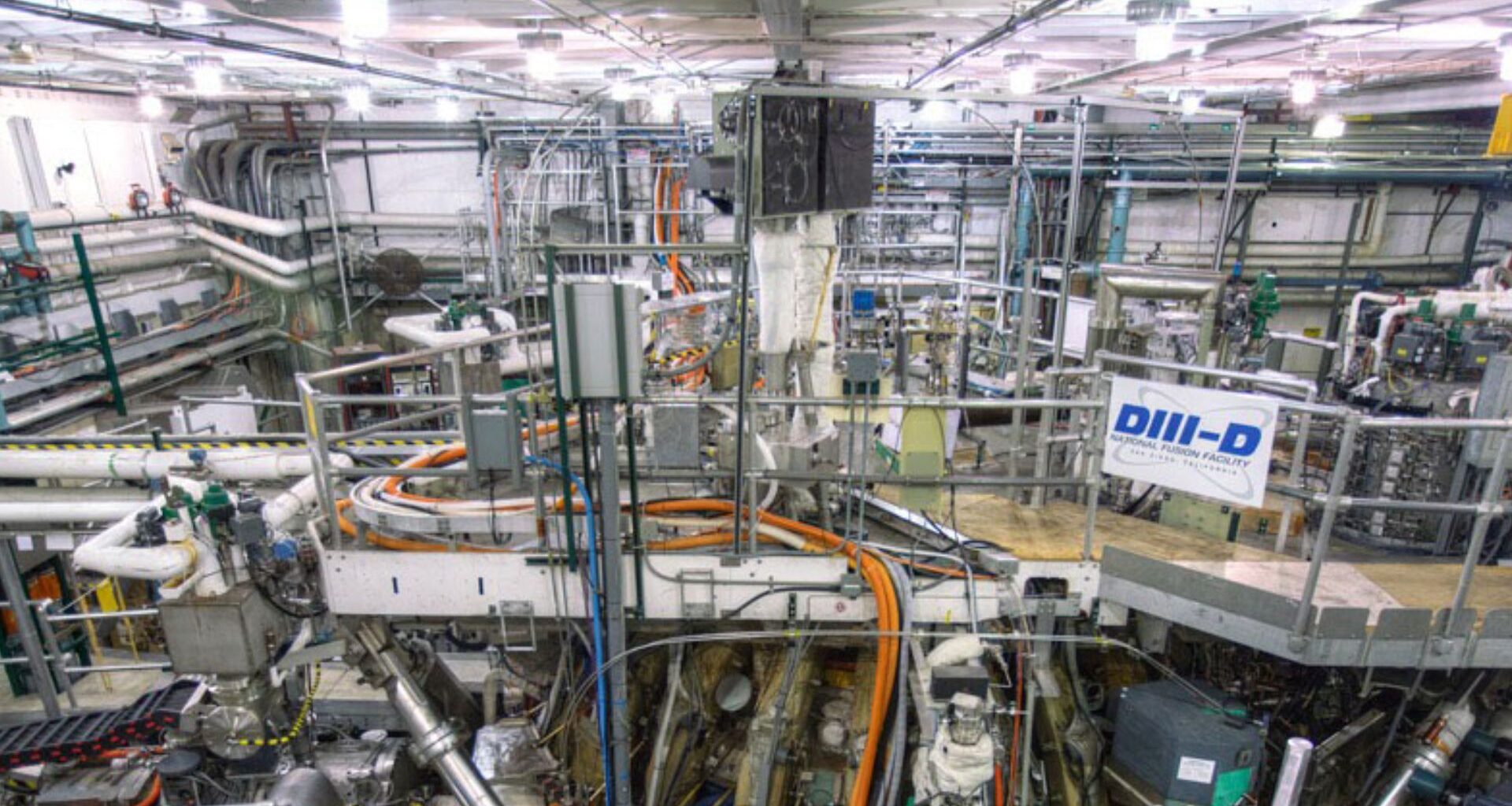
Researchers at the DIII-D National Fusion Facility have identified a new method to tame the destructive energy bursts that threaten the structural integrity of future power plants.
By precisely controlling the density of the plasma’s outermost layer, a team of scientists has successfully demonstrated a way to suppress large, damaging instabilities while maintaining the high-performance core necessary for power production.
“Tokamaks show great promise for fusion energy production. However, large disruptive bursts of energy can damage the device’s interior,” said the researchers in a press release.
“Future commercial devices will need to avoid this.”
The challenge of core-edge integration
To generate energy, a fusion reactor must keep its core plasma at millions of degrees.
However, this creates a volatile environment where the plasma can develop Edge-Localized Modes (ELMs)—sudden, violent bursts of energy that act like miniature lightning strikes against the device’s interior walls.
For a commercial plant to operate long-term without melting its own hardware, it must achieve core-edge integration: a state where the center remains hot enough for fusion, but the edge remains stable enough to protect the reactor’s “skin.”
“To avoid material damage while maintaining high performance in the core, devices must limit drastic swings in temperature at their walls. This is a scenario called core-edge integration,” explained the press release.
A physics-based solution
While scientists have long observed that higher density at the plasma edge could lead to smaller ELMs, the underlying physics remained a mystery.
Using the advanced BOUT++ simulation code to model hybrid plasmas, the DIII-D team discovered a specific regime where high density in the scrape-off-layer (SOL)—the region where plasma interacts with the wall—fundamentally changes the nature of these instabilities.
The study revealed a critical shift in plasma behavior, demonstrating that high SOL density stabilizes “peeling-ballooning modes”—the large-scale instabilities responsible for damaging bursts—to effectively suppress large ELMs.
Instead of one massive burst, the high density induces localized pressure spikes and “ballooning instabilities,” which result in frequent but harmless energy pulses that trigger benign turbulence.
Most importantly, unlike other suppression methods that can “leak” heat and lower efficiency, this approach ensures core performance is maintained by preserving the high-pressure core.
Impact on future reactors
The team’s experimental scans confirmed that by shaping the SOL density profile, they could reliably maintain these “tolerably small” ELMs.
Beyond the theoretical breakthrough, the researchers identified key diagnostic metrics for real-time control in future reactor-scale devices, such as ITER.
“This work provides actionable insights for the design of future fusion power plants,” the researchers noted, emphasizing that sustaining this “small ELM-only” regime is essential for steady-state plasma operation.
By solving the core-edge integration puzzle, the DIII-D facility is moving the needle from experimental science to practical engineering for a carbon-free energy future.
“Plans for commercial fusion energy production rely on the capability to produce a plasma with low heat flux at the edge and high confinement in the core,” concluded the press release.
“Recent work has shown that tokamak operation within a small ELM regime reduces heat flux at the divertor and improves impurity exhaust while maintaining high performance in the core.”