

Eco-activists in Australia’s south have reached an incredible milestone in the country’s ongoing battle to fight back against invasive seastars — removing almost 12,000kg of them in just five years. It’s believed they first arrived here in the 1980s as stowaways on ships, but have since absolutely exploded in numbers.
Estimates suggest there are now as many as 30 million Northern Pacific seastars in Tasmanian waters alone.
They’re a devastating problem because they’re both prolific breeders and hearty underwater warriors that prey on vulnerable native wildlife and have few predators of their own.
Tasmanian man Keith Thomas-Wurth, alongside other dedicated volunteers, has held seastar clean-up missions around the River Derwent — where they are most widespread — for the last five years.
He spoke to Yahoo News days after the Invasive Seastar Clean Up’s fifth anniversary event on Sunday, sharing the incredible success the team had once again.
While environmentalists acknowledge that complete eradication is unlikely, removal efforts remain crucial to protect endangered species and ease pressure on local wildlife populations.
Keith is determined to save the spotted handfish, which is particularly threatened.
“I have recorded 257,829 seastars removed for a total weight of 11,850 kilograms,” Keith said of the efforts over the last five years.
Do you have a story about an invasive species? Contact newsroomau@yahoonews.com
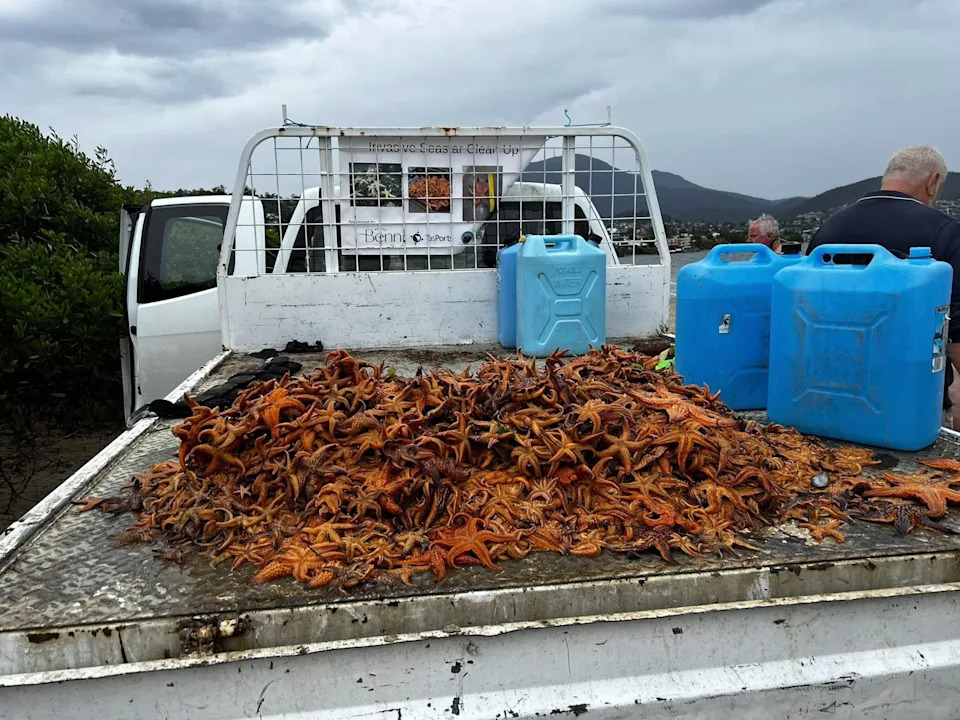
On the Invasive Seastar Clean-up’s fifth birthday, volunteers removed 676 individuals, weighing a total of 120 kilos. Source: Benita Vincent
On the event’s fifth birthday, he said “the river gods were smiling on us” and “even helped” with a little late rain to help wash the gear.
“[It was an] amazing result,” he told Yahoo.
“An incredible number of seastars were removed — 5,676 in total for a weight of 120kg.”
Related: Locals relentlessly fight back as invasive pest plagues Aussie waters
Keith thanked the 15 land helpers “sorting and counting” all the seastars, which were collected by a total of 27 snorkellers and 16 scuba divers.
And, naturally, “there was cake” to celebrate the milestone.
What makes the Northern Pacific seastar so destructive?
The Northern Pacific seastar is highly destructive because of its voracious appetite and rapid reproduction.
It feeds on a wide range of marine life, including mussels, clams, and other shellfish, often stripping entire areas of these key species.
Its ability to tolerate a broad range of temperatures and salinities allows it to thrive in diverse coastal environments, giving it a competitive edge over native species.

A permit is required to remove seastars from Tasmanian waterways, due to the fact they can be easily confused with natives. Source: Facebook/Keith Thomas-Wurth
Its regenerative abilities make it even more resilient. A single arm can grow into a whole new seastar, allowing populations to rebound quickly even after attempts at control.
This combination of aggressive feeding, fast reproduction, and resilience means the Northern Pacific seastar can dramatically alter marine ecosystems, displacing native species and destabilising the balance of local habitats.
In Tasmania, a licence is required to remove them from the state’s waterways so that their native counterparts aren’t impacted.
Love Australia’s weird and wonderful environment? 🐊🦘😳 Get our new newsletter showcasing the week’s best stories.
