
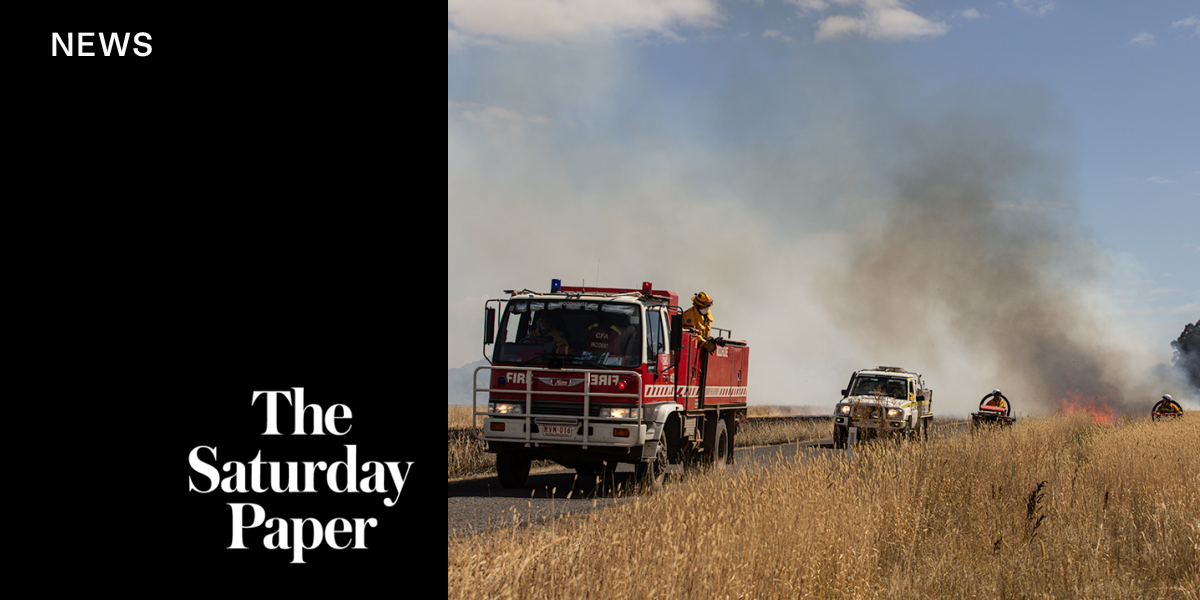
Bush community groups, firefighters and scientists have accused Victoria’s Allan government of worsening risks of catastrophic bushfire by setting low containment targets while relying on outdated equipment and debunked fire suppression methods.
Victoria is “effectively allowing one in five fires to grow beyond initial attack” by setting an “unambitious” containment target of 80 per cent, according to Kinglake Friends of the Forest (KFF).
This figure is “well below what frontline agencies have actually achieved in each of the past five years,” says KFF president Sue McKinnon, a former chemical scientist who moved into land regeneration.
Over this time, firefighters have achieved 92 per cent to 97 per cent success in containing fires “at first attack and/or under 5 hectares”, according to the Victorian Department of Energy, Environment and Climate Action.
The target is “effectively a declaration that what we’re doing now is more than sufficient”, says McKinnon. While climate change escalates megafire risk, frontline firefighters are left “operating with outdated equipment” and disproven methods, she adds, “without the support of new technology in rapid detection and suppression”.
United Firefighters Union secretary Peter Marshall confirmed early this month that protection equipment “has been compromised” and nearly half of Fire Rescue Victoria trucks are “out of date, dangerous, and should be off the road”. By this year’s state election, almost two thirds will be dangerous, he said. “Fire trucks are failing daily. Firefighters’ lives [are] being put at risk – as well as members of the community and their families.”
The government did not respond directly to questions about how it arrived at its 80 per cent suppression target.
Despite the global advent of rapid fire detection and suppression systems, Victoria has prioritised back-burning since it announced an end to native logging in 2024, when it scheduled 6000 kilometres of forest firebreaks – some 40 metres wide – for felling. A government spokesperson tells The Saturday Paper these firebreaks “enable firefighters to get access to the forest to respond to fires and carry out back-burning in the event of a major bushfire”.
Back-burning is a tactical tool used during active fires that involves lighting a controlled fire ahead of a bushfire.
These breaks potentially worsen the spread of bushfire and endanger firefighters by creating wind tunnels, according to Curtin University fire behaviour scientist Phil Zylstra, who is a former remote-area firefighter. Wind and compromised forest structure are primary drivers of bushfire spread, he says.
Back-burns often don’t behave as theorised and must be only a “last resort” tool, says Zylstra.
“Back-burns can spot firebrands for tens of kilometres, even creating winds to amplify the energy of the main fire front.”
Successive commissions and inquiries have found back-burns were frequently responsible for spreading wildfires.
Professor Marta Yebra, who heads the Bushfire Research Centre of Excellence at the Australian National University, agrees that back-burning “always needs to be a last resort, not a default tool”. She says it “can be a useful tool but should be used only when conditions leave very limited options”.
“When we looked at south-west Western Australia, we found that by ageing the forests into their low flammability, long-unburnt state, it’s possible to have less wildfire in 2100 than there is today, even under worst-case climate projections.”
Victoria’s chief fire officer, Chris Hardman, defends back-burning as “one of the key strategies” used by Forest Fire Management Victoria (FFMVic). He says back-burning has “been used successfully this summer to help contain major bushfires”.
“Globally, back-burning has been used as a core firefighting technique for decades.”
Yebra is among experts saying the state should instead prioritise investment in early detection technologies. “Early detection is one of the biggest single opportunities to stop fires and prevent escalation,” she says. The first 10 to 20 minutes of firefighting response “is roughly the most crucial”, and beyond this, “fires can become unmanageable, particularly under extreme weather conditions”.
Currently, Australian agencies may
be unaware of remote fires until they are too advanced to contain. In windy conditions, a fire can spread 1500 square metres every 10 minutes, according to CSIRO estimates.
Surveillance and open data systems can monitor millions of square kilometres, with some reportedly detecting fires within a minute of ignition. Integrated systems of drones, remote-sensing, remotely piloted aircraft, satellite data and tower cameras are being adopted globally because they can detect fires before they become uncontrollable.
ANU-developed tools include the AusSmoke dataset, which “has outperformed existing datasets”, says Yebra. Her team’s Australian Flammability Monitoring System, operating on Geoscience Australia’s Digital Earth Australia platform, generates data “not to replace people but to provide better information early so agencies can identify the ignitions most likely to escalate, and allocate resources appropriately”.
Hardman tells The Saturday Paper that FFMVic “is exploring the best methods to speed up fire detection and response times. The latest satellite and drone scanning cameras are able to get generated heat maps into the hands of fire operations within 20 minutes.”
Yebra says FFMVic’s trials of discrete technologies have suffered from a lack of rigour, standardisation and integrated systems.
“The problem lies at both state and federal levels. Australia does not have a nationally consistent way of measuring what works. From state to state, different technologies are procured without standardised evaluation or independent verification against technology vendors’ capability claims. There’s a lot of duplication and inconsistent methods, meaning agencies often struggle to compare systems, many of which are not tested under Australian conditions.”
Since each technology offers different capabilities, she says, “we need to integrate complementary systems” as climate change escalates the likelihood and severity of megafires.
ANU modelling in 2020 showed early detection investment could save Australia $8.2 billion over the 30 years to 2050, over which time bushfires would likely cost at least $30 billion.
A report compiled by disaster management research and development company Firetech Labs finds that despite recommendations from royal commissions, Australia “continues to spend approximately $14 on bushfire recovery for every $1 invested in prevention” and that “93% of Commonwealth disaster funding flows post-event, with only 7% directed toward risk reduction – and effectively zero toward prevention”.
Lead author Leigh Kelson, a global expert on nascent firefighting technologies, says the economic case for prevention “is overwhelming. Every authoritative study – from CSIRO to the World Bank– finds that $1 invested in prevention returns $2 to $11 in avoided recovery costs.”
A government spokesperson said the state’s investment in Victoria’s fuel management program is $159.8 million, which includes planned burns for “fuel load reduction” in forests.
Zylstra describes the fuel-load paradigm as “a 50-year-old” working hypothesis of United States pine plantations that is not backed by evidence. In Australian studies, “fuel load was found to have no effect on rate of spread, and only a very minor effect on flame heights”.
Recent studies find planned forest burns – a preventive strategy distinct from back-burning, which is a responsive strategy – can reduce bushfire risk in the short term but increase long-term risk. Studies by Zylstra and world-leading ecologists, including ANU Professor David Lindenmayer, show some forests hold the lowest risk when they haven’t had prescribed burns and become more resistant to fire when left unburnt.
In a recent article in The Conversation, they wrote that official records show “77% of all areas burned in over 500,000 hectares of forested south-west national parks this century were due to prescribed burns”. Only 23 per cent of the total fire area was bushfire, the records show, but nearly half (43 per cent) of this area was caused by escaped prescribed burns and back-burning.
If large-scale prescribed burning and back-burning ended, “the area burned annually would immediately fall 87%, leaving only fires started by lightning, accident or arson”.
Other university studies confirm long-unburnt south-east Australian mountain forests are much less flammable than recently burnt ones.
State burns – distinct from Cultural burns – increase fire risk by “killing tall midstories that calm the sub-canopy wind which fans fires, and replacing those tall plants with new regrowth that ignites easily”, Zylstra explains.
Clearing forests also emits carbon and contributes to climate change, a major driver of megafires. As Australia’s most cleared state, Victoria is one of the most fire-prone regions globally but could be world-leading in proforestation – allowing forests to mature – for reduced flammability, says Zylstra.
“When we looked at south-west Western Australia, we found that by ageing the forests into their low flammability, long-unburnt state, it’s possible to have less wildfire in 2100 than there is today, even under worst-case climate projections. We have to run the numbers for Victoria, but there are many of the signs present that it could work.”
Against the government’s 80 per cent containment target, Yebra commends a 100 per cent target of rapid and intense response for ignitions likely to become catastrophic. “Performance metrics should focus on avoided damage, reduced exposure of people and assets, and limiting high-severity fire, rather than purely on first-attack success rates.”
Sue McKinnon believes the government is prioritising short-term cost cutting by “choosing the cheap method of firefighting, a very risky method as these backburns often get away” but “the government has made the decision to not bring firefighting into the 21st century”.
“We need to fund what we know works, and that is early detection and suppression.”
This article was first published in the print edition of The Saturday Paper on
February 14, 2026 as “Trials by fire”.
For almost a decade, The Saturday Paper has published Australia’s leading writers and thinkers.
We have pursued stories that are ignored elsewhere, covering them with sensitivity and depth.
We have done this on refugee policy, on government integrity, on robo-debt, on aged care,
on climate change, on the pandemic.
All our journalism is fiercely independent. It relies on the support of readers.
By subscribing to The Saturday Paper, you are ensuring that we can continue to produce essential,
issue-defining coverage, to dig out stories that take time, to doggedly hold to account
politicians and the political class.
There are very few titles that have the freedom and the space to produce journalism like this.
In a country with a concentration of media ownership unlike anything else in the world,
it is vitally important. Your subscription helps make it possible.
Send this article to a friend for free.
Share this subscriber exclusive article with a friend or family member using share credits.

Used 1 of … credits
use share credits to share this article with friend or family.
You’ve shared all of your credits for this month. They will refresh on March 1. If you would like to share more, you can buy a gift subscription for a friend.
SHARE WITH A FRIEND
? CREDITS REMAIN
SHARE WITH A SUBSCRIBER
UNLIMITED
Loading…
Comment
Cities aren’t safe from the next firestorm