
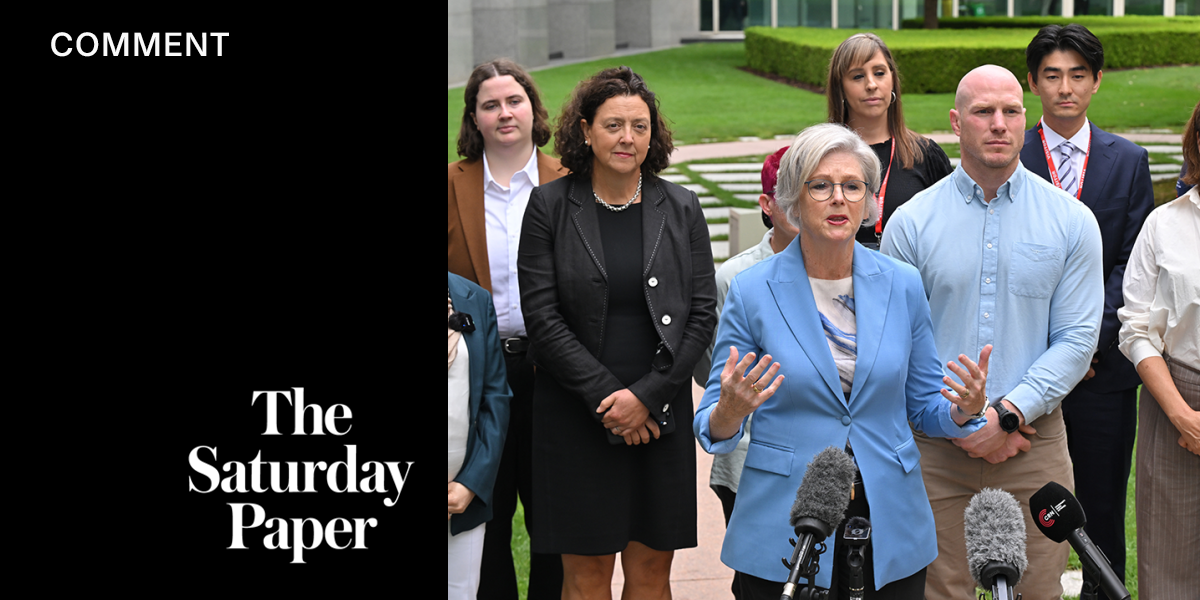
Since the last election, Australia has witnessed the biggest political on-again, off-again break-up of the 21st century. The slow, messy unravelling – and partial restitching – of the Coalition has dominated headlines, engaged television panels and consumed the press gallery’s attention.
For anyone interested in solving the real challenges facing the country, this C-grade melodrama is, frankly, boring.
It is not lost on critical constituencies that the Coalition’s absolute focus on themselves is at the direct expense of voters.
Regional Australians have long formed a reliable voter base for the Coalition – particularly the National Party. As the Coalition continues to play internal politics over policy, however, this once-reliable base continues to erode, to the point that they are not only fed up but fleeing.
A RedBridge/Accent poll conducted in late January showed the Nationals and Liberals with a combined vote of just 19 per cent – and One Nation at 31 per cent. The previous poll had the Coalition at 29 per cent. That is a rapid decline.
While cameras have been fixed on the corridors of Parliament House and studio doors have been flung open for any National Party MP willing to comment, the people most affected by this political dysfunction – the 30 per cent of Australians who live outside our major cities – are left hanging.
Among them is the Country Fire Authority volunteer who can’t get phone reception while responding to a bushfire. The cancer patient who must travel hours for life-saving treatment. The family couch-surfing because they cannot find an affordable home to rent, let alone buy, in the town where they work.
House prices grew by 10.3 per cent in the 12 months to January 2026, compared with 9.2 per cent in metropolitan Australia. Across the country, nearly six million Australians live in a childcare desert, meaning there are more than three children per available childcare space.
This matters, because the absence of genuine representation creates a dangerous vacuum. When people feel ignored, taken for granted or abandoned, anger seeds. When no credible solutions are offered, frustration hardens into cynicism. And when that happens, political forces that promise simple answers – or someone to blame – flourish.
That is the context in which we are seeing a surge in support for One Nation. The anger is real. The neglect is real. But One Nation’s right-wing populism is not the only option available to Australian voters. There is another way – and 30 per cent of voters at the last election took this option and put a community independent top of their ballot.
The electorate of Indi stretches across 29,000 square kilometres of mountains, valleys and plains in north-east Victoria. For decades, it was considered rusted-on Coalition territory. Elections came and went. We were a safe seat that barely got any attention. Decisions affecting us were made elsewhere, often without meaningful consultation, and accountability felt distant.
The Nationals have become obsessed with internal power in their coalition with the Liberal Party. They also have a desperate desire to stoke and fight culture wars that bear little practical relevance to improving the lives of the people they represent, but a strong resemblance to the rhetoric of Pauline Hanson.
People in Indi didn’t wake up one day and decide they wanted an independent member of parliament. What they wanted was to be heard. That desire gave rise to something quietly radical: a model of community-led representation.
Voting independent is not a protest vote. It is a genuine one. It sends a message to the political establishment that we expect better. More than that, it sends a representative to Canberra who can work in the best interests of their community and the nation, unimpeded by political party rivalries and endless infighting.
Regional Australia keeps this country running. We put food on the table, clothes on people’s backs and energy in homes and businesses. We are at the forefront of global innovation in agriculture and manufacturing. Our landscapes are changing as we are called upon to host the energy infrastructure transitioning the energy network; while at the same time facing the devastating loss of lives and livelihoods from floods, fires and droughts.
That’s a big job description in anyone’s language. It’s exhausting. Yet, too often, regional Australians get less – less access to healthcare, fewer housing options, poorer telecommunications, inadequate public infrastructure. The rental vacancy rate is just 0.9 per cent, and we wait longer for GP visits than our city cousins do.
A lack of long-term policy focus on rural and regional Australia is consequential. Take health, for example. Rural Australians have a shorter life expectancy than metropolitan Australians. This is an uncomfortable fact and nowhere more so than for the families in country towns isolated by poor roads, little to no public transport and local councils struggling to provide an ever-expanding array of services such as childcare and aged care with a small ratepayer base.
Housing tells a similar story. Australia is in the midst of national supply issue, but in the regions this problem is compounded by underinvestment in enabling infrastructure. You cannot build new housing without sewerage connections, power, water and roads. Without them, private investment developments are not viable and housing supply grinds to a halt.
The federal government’s Housing Support Program tasked to address this issue is woefully underfunded to address the screaming need in rural and regional areas. We need at least $2 billion invested in regional Australia alone.
Telecommunications completes the picture. Patchy mobile coverage and internet are not inconveniences, they are barriers to emergency response, education, healthcare and modern work – services and amenities that are taken for granted in the cities.
These are not ideological issues, they are practical ones, and they demand practical solutions. Historically, the National Party existed to advocate for exactly these concerns. My parents were farmers who voted for the Country Party – as it was then known – because it stood for regional people like us. Over time, however, the change of name brought a change of focus for the Nationals. Increasingly, their view is fixed on the big end of town, rather than the small country town.
The Nationals have become obsessed with internal power in their coalition with the Liberal Party. They also have a desperate desire to stoke and fight culture wars that bear little practical relevance to improving the lives of the people they represent but a strong resemblance to the rhetoric of Pauline Hanson. Their policy offerings for regional Australia have narrowed, even as the challenges facing regional communities have grown more complex.
Does anybody know if the Nationals have a health policy, housing policy, telecommunications policy? Nostalgic references to a glorious colonial past do not help us secure a mobile signal or find us a doctor. Enter One Nation, whose strategy is to exploit genuine distress in a world that is increasingly bewildering. They identify grievances, amplify then apportion blame using the most tenuous causal links. Immigration is the bogeyman of choice.
One Nation crafts clever cartoons that mock progressive politics in an attempt to divert attention from the lack of their policy offerings. Simply put: outrage, not outcomes. Australians deserve more than protest politics. They deserve progress.
I am as up for a fireside rendition of “The Man from Snowy River” as the next person, but I and countless voters in the regions are not content with being saddled with horses from Old Regret.
Though the next federal election is two years away, regional Australians face a choice. On one side is the radical right-wing populism of One Nation, on another is the confusion of the Nationals, and then there is the opportunity to elect genuine community independents.
Remarkable regional independents came close to breaking through in 2025. In Forrest, Western Australia, local doctor Sue Chapman secured 18 per cent of the primary vote. In Farrer, teacher and advocate Michelle Milthorpe cut Sussan Ley’s margin by 9 per cent, winning every booth in Albury. In Flinders, Victorian Father of the Year Ben Smith achieved 47 per cent of the two-candidate-preferred vote.
Regional Australians are not asking for special treatment, just a genuine seat at the table. We are not served by the melodrama of the Nationals or the Liberals fighting for centrestage within the Coalition, or by the divisive protest politics of One Nation. Independents show there is another way – one that listens, leads with integrity, offers solutions and does the hard work to negotiate with governments of any stripe for the betterment of the communities they represent. It’s time to rewrite the regional political storyline.
This article was first published in the print edition of The Saturday Paper on
February 14, 2026 as “Regions pay for this political drama”.
For almost a decade, The Saturday Paper has published Australia’s leading writers and thinkers.
We have pursued stories that are ignored elsewhere, covering them with sensitivity and depth.
We have done this on refugee policy, on government integrity, on robo-debt, on aged care,
on climate change, on the pandemic.
All our journalism is fiercely independent. It relies on the support of readers.
By subscribing to The Saturday Paper, you are ensuring that we can continue to produce essential,
issue-defining coverage, to dig out stories that take time, to doggedly hold to account
politicians and the political class.
There are very few titles that have the freedom and the space to produce journalism like this.
In a country with a concentration of media ownership unlike anything else in the world,
it is vitally important. Your subscription helps make it possible.
Send this article to a friend for free.
Share this subscriber exclusive article with a friend or family member using share credits.

Used 1 of … credits
use share credits to share this article with friend or family.
You’ve shared all of your credits for this month. They will refresh on March 1. If you would like to share more, you can buy a gift subscription for a friend.
SHARE WITH A FRIEND
? CREDITS REMAIN
SHARE WITH A SUBSCRIBER
UNLIMITED
Loading…
News
Fantastic. Great move. Well done Angus.
Karen Barlow
Angus Taylor secured a strong partyroom vote to depose Liberal leader Sussan Ley, whose departure from politics sets up an early test for her successor.