
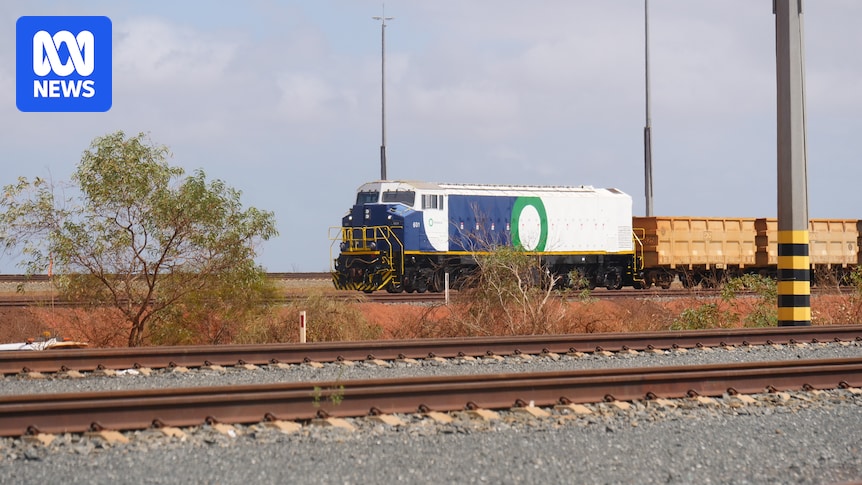
After years of delays, the rail routes of Western Australia’s resource-rich Pilbara are starting to whirr with the sound of battery-electric power.
Fortescue launched two battery-electric locomotives this week, rounding out its fleet of 70 diesel-powered machines hauling precious iron-ore from pit to port.
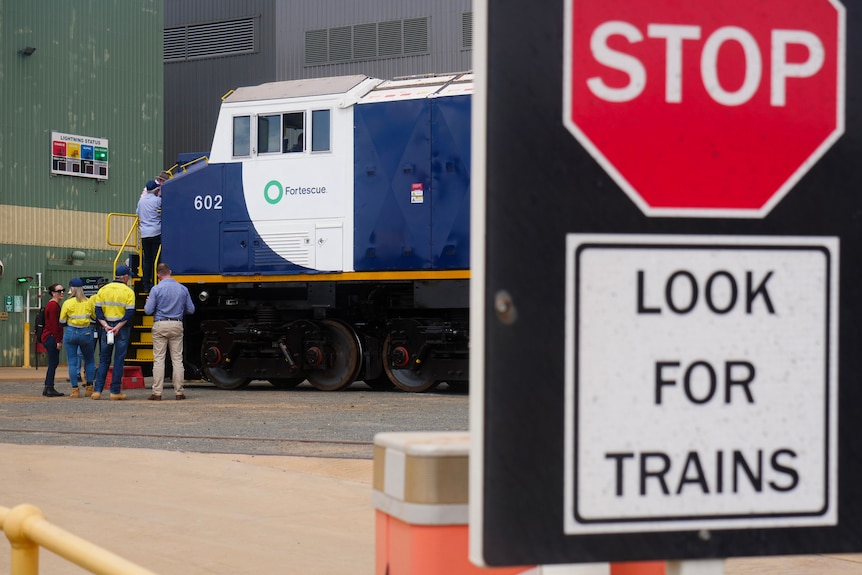
Fortescue put its latest battery-electric locomotives on show in Port Hedland. (ABC Pilbara: Alistair Bates)
Billionaire Andrew Forrest’s mining giant is the second of the region’s major companies, and among its largest carbon emitters, to test the technology.
BHP began its own Pilbara trials of battery-electric trains in November.
“We’ll test them with our conventional fleet and we want to understand exactly [their] performance … then we’ll pull the trigger on a fully decarbonised solution for rail,” said Fortescue chief executive Dino Otranto.
Rarely caught short on spectacle, the first of the blue-and-white locomotives pulled into Port Hedland’s Thomas Rail Yard to rock band Wolfmother’s 2005 hit, Joker & the Thief.
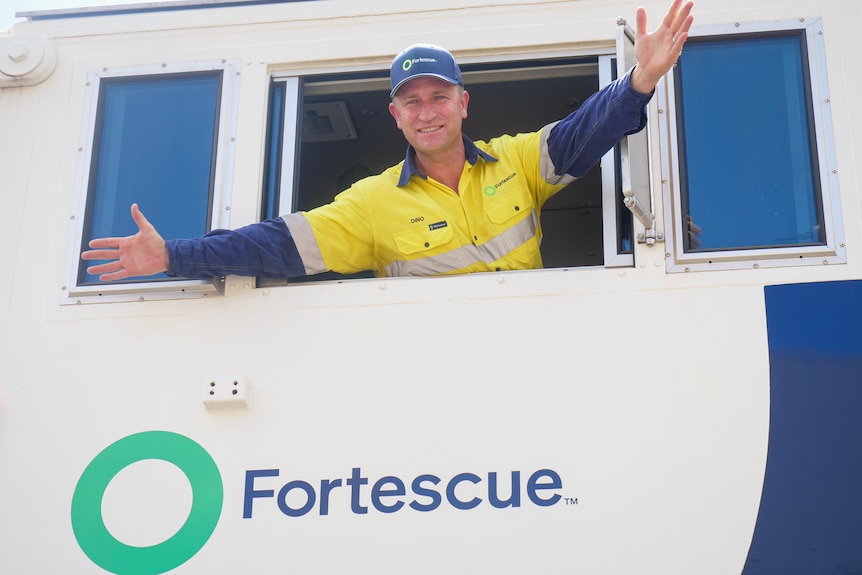
The locomotive’s battery is the equivalent of “200 to 300 average electric vehicles” and capable of powering a refrigerator for 30 years, according to Mr Otranto. (ABC Pilbara: Alistair Bates)
The locomotives, purpose-built by Caterpillar subsidiary Progress Rail, boast what Fortescue has called the world’s largest land-mobile battery, with a capacity of 14.5 megawatt-hours.
The pair will save the company 1 million litres of diesel each year, still just a fraction of the 80 million litres the company consumes annually.
“It is a large undertaking: these take probably a couple of years to manufacture, so once we pull an order, you can see it will take a couple of years to transition the entire fleet,” Mr Otranto said.
The company hopes to complete the transition ahead of its “real-zero” deadline of 2030.
Fortescue back on track
The locomotives’ massive battery will be charged in two ways.
The first is via Fortescue’s growing renewable energy apparatus, which it says it is expanding aggressively at a rate of more than 3,000 solar panels a day.
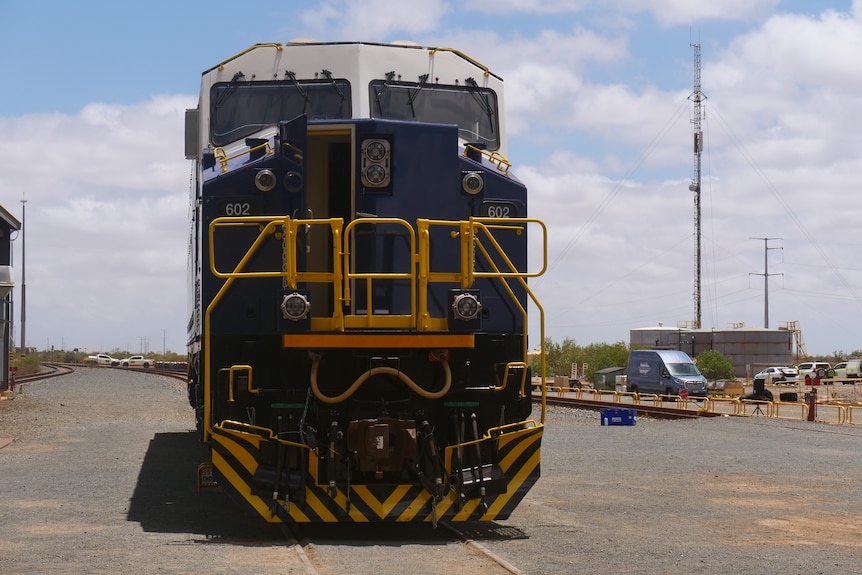
Fortescue plans to totally electrify its transport network over the next “couple of years”. (ABC Pilbara: Alistair Bates)
The second charging method is through regenerative braking, a mechanism drawing closely from the company’s stalled “Infinity Train” concept.
Andrew Forrest had previously touted an in-house electric rail model, developed with Australian engineering firm Downer Group, that generated all the power it needed using the uphill-downhill dynamics of the Pilbara ranges.
The project was canned, however, in September, axing more than 100 staff.
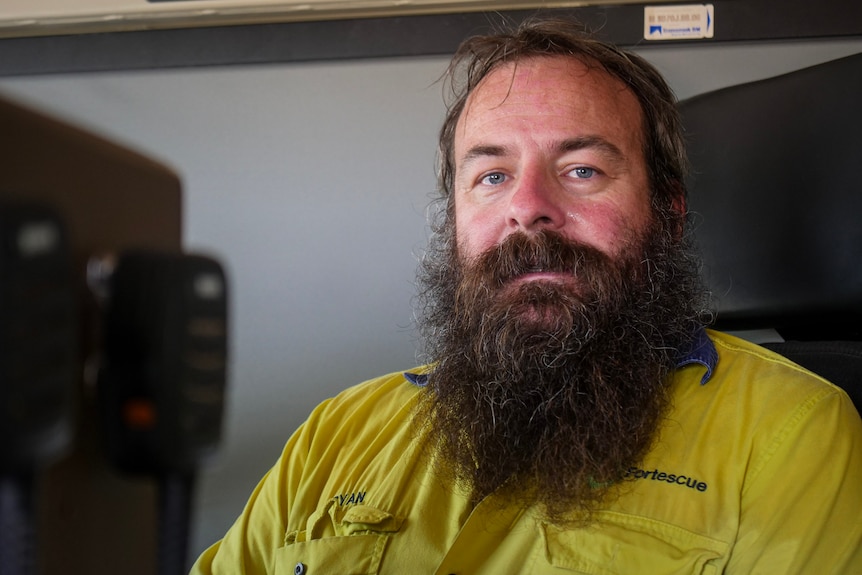
The significance was not lost on rail operations specialist Ryan Coy, who was among the locomotive’s first drivers. (ABC Pilbara: Alistair Bates)
Rio Tinto mothballs electric rail
Like its homegrown competitor, Rio Tinto has long emphasised the importance of rail to its decarbonisation efforts.
The British-Australian multinational ordered its first battery electric locomotives from American manufacturer Wabtec in 2022 and pledged to roll them out in the Pilbara in 2024.
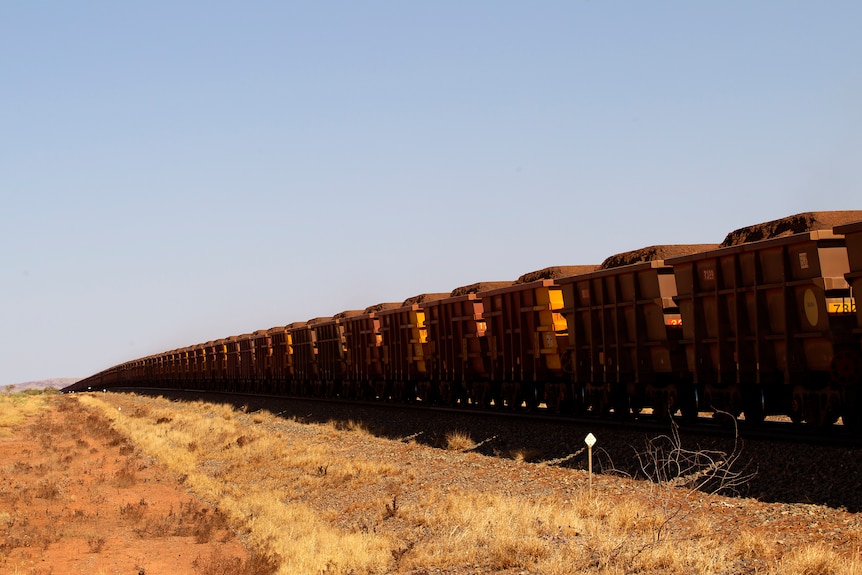
The transport of Pilbara iron-ore spans more than 2,000 kilometres of privately owned rail. (Supplied: Rio Tinto)
The eventual replacement of more than 200 diesel locomotives was supposed to slash roughly three per cent of Rio Tinto’s total emissions, although that milestone is far off.
The ABC understands Rio Tinto recently shelved its partnership with Wabtec.
“While battery locomotives represent an important area of technological development, our analysis indicates that current battery technology is not yet viable for our Pilbara rail operations,” a spokesperson said in a statement.
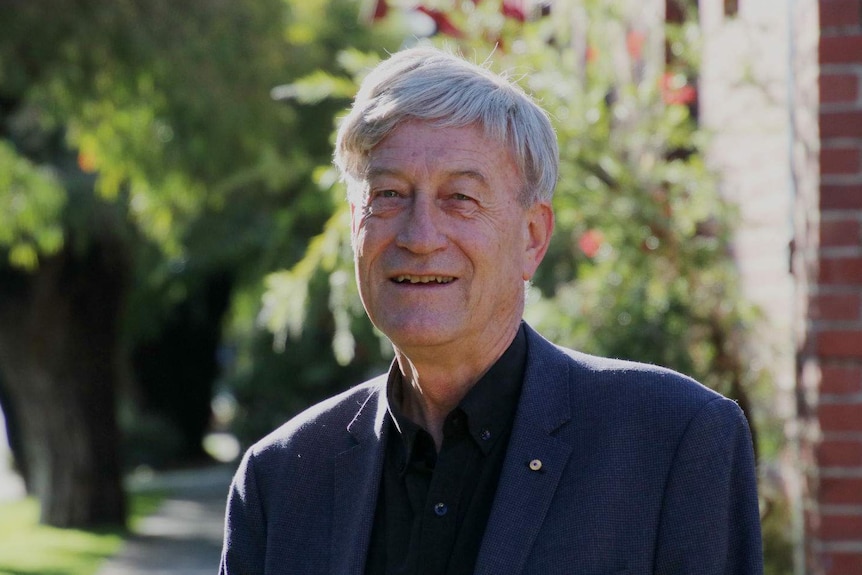
Peter Newman was critical of Rio Tinto’s reluctance to pursue battery-electric rail. (ABC News: Benjamin Gubana)
Curtin University professor of sustainability Peter Newman slammed the company’s “backwards step”.
“They will regret not going down this net-zero path quickly because it is going to be cheaper, better for their markets, better for their company in general,” he said.Race to decarbonise
The Pilbara region produces about 40 per cent of WA’s carbon emissions, despite being home to just 2 per cent of its population.
It is overwhelmingly produced by the iron-ore industry, from which a quarter of the state’s annual revenue flows.
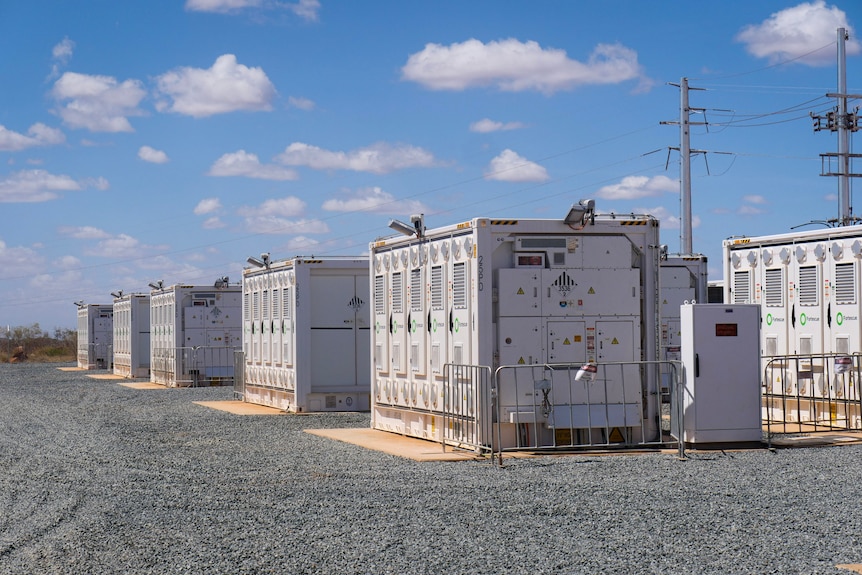
Fortescue has developed rows of BYD battery banks to store solar energy collected near its Iron Bridge mine. (ABC Pilbara: Alistair Bates)
BHP vice-president of operational decarbonisation Daniel Heal said the company’s own Wabtec locomotive prototypes were undergoing “no-load commissioning”.
“The intent is that we’ll have those pulling iron ore in the Pilbara in the coming months,” he said.
“Diesel, for us, contributes about two-thirds of our emissions today.”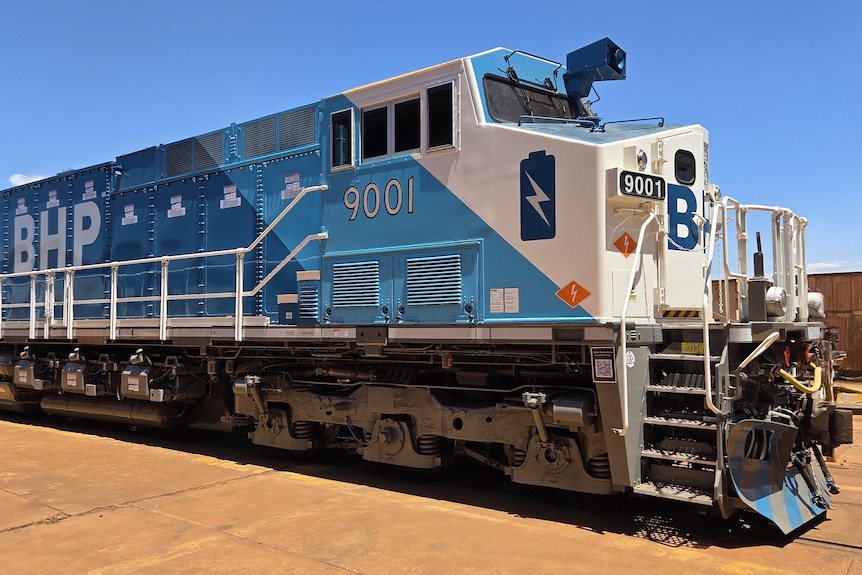
BHP said its Wabtec locomotives were still a long way from implementation at scale. (Supplied: BHP)
Mr Heal could not point to a fixed timeline for the trials and stood by the miner’s decision to slash its decarbonisation budget.
“We’ve moved that funding to the 2030s … the engineering challenges mean it’s going to take probably a bit longer than people anticipated.”
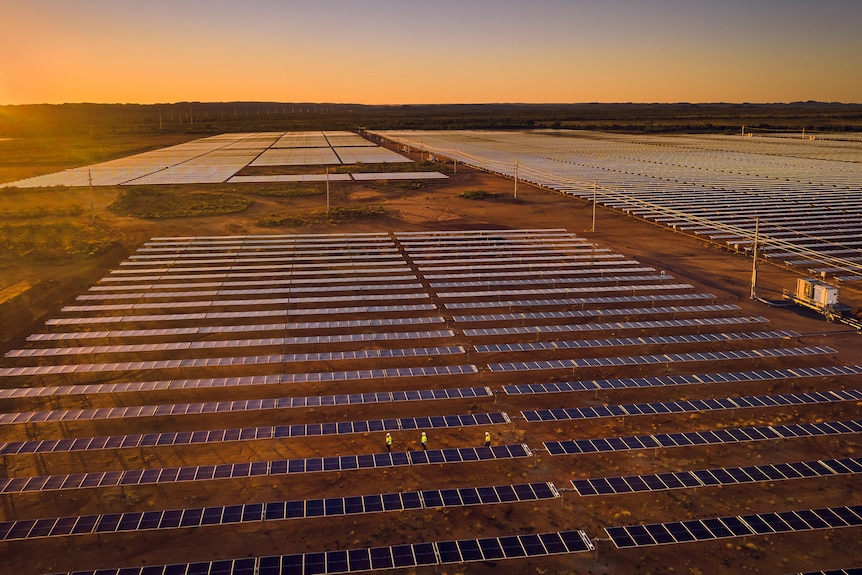
Fortescue’s solar farm near the Iron Bridge mine. (Supplied: Fortescue)
Dr Newman said Fortescue was not without criticism, accusing the company of neglecting “straightforward, practical solutions” for “wasteful” projects it had since abandoned.
The company has walked away from a host of green hydrogen projects in recent years, including a multi-billion-dollar hydrogen electrolyser plant once spruiked to be a global pioneer.
Mr Otranto defended Fortescue’s record with the new locomotive looming behind him.
“We have not slowed down with hydrogen whatsoever. In fact, our green iron plant at Christmas Creek in the Pilbara will be using Australia’s largest liquefied hydrogen plant to produce green metal,” he said.
Fortescue is resolute that it will reach its goal of zero carbon emissions with zero offsets by the end of the decade.