
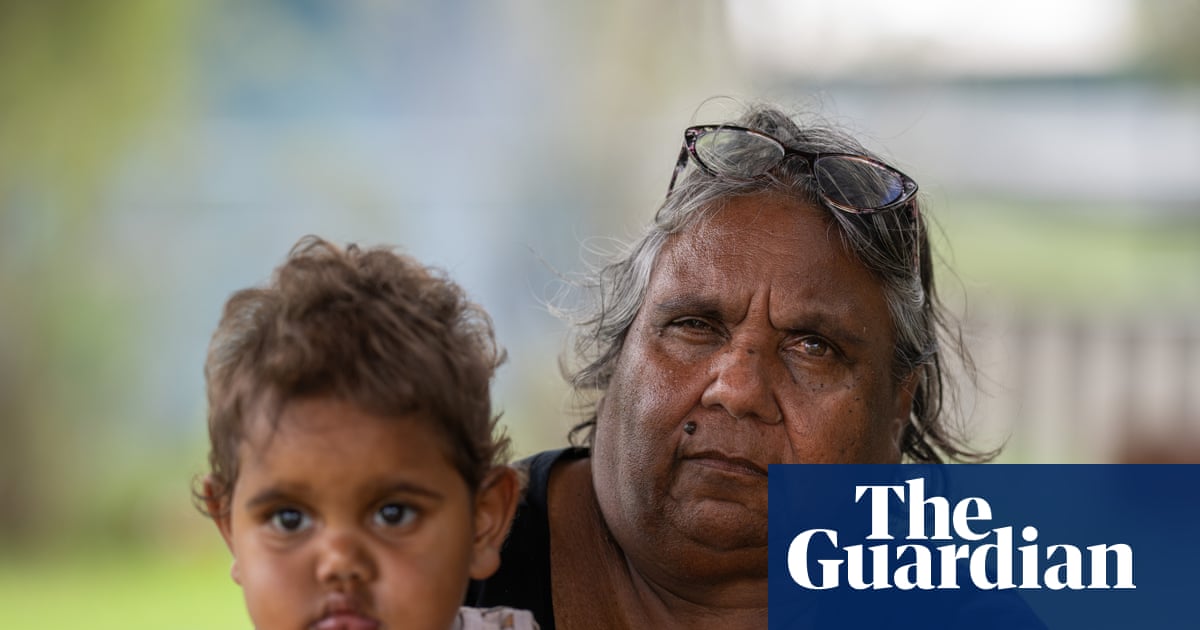
Since the start of summer, Vanessa Napaltjari Davis and her grandchildren have sweltered in their two-bedroom home. Temperatures in the southern half of the Northern Territory have been well above average and the electricity running their single air-conditioner has been regularly disconnected.
“We almost had 40 days over 40,” she says. “I was struggling to keep on top of the power bill and keep my little grannies [grandchildren] cool.”
Davis, an Arrernte and Luritja woman, lives with her granddaughter and two great-grandchildren in Nyewente, also known as Trucking Yards, one of 18 town camps that surround Alice Springs.
Her home, like others in the town camps, is state-owned and in desperate need of an upgrade. But since the NT government installed a prepaid electricity smart meter on her house a few years ago, she has been struggling to keep the lights on.
Napaltjari Davis is one of more than 65,000 Aboriginal people relying on prepaid electricity. Photograph: Rhett Hammerton/The Guardian
“I usually put $70 a week on my electricity when it’s normal temperature, and it will last me until the next pay week,” she says. “But because of this extreme hot weather, that $70 is only like two or three days.”
The NT has just experienced its 10th hottest January on record and it’s expected to get hotter, as the climate crisis drives even more extreme temperatures. There are already warnings that Alice Springs and the surrounding central desert communities could become too hot for humans.
To keep the electricity on, Davis must top up her prepaid card at the service station or local grocery. When credit on her card runs out, the power to her home automatically disconnects, cutting off access to lights, refrigeration and cooling.
She is one of more than 65,000 Aboriginal people relying on prepaid electricity in the NT, South Australia, Western Australia and Queensland. On average, these households experience 49 disconnections a year – or nearly one a week – due to unaffordable bills, a 2025 study by the First Nations energy justice organisation Original Power has shown.
Sign up: AU Breaking News email
As the sole provider for her household, living in one of the most impoverished communities in Australia, Davis has often had to choose between keeping the power on or buying food.
“What’s more important, the electricity or food? But to us, they are both important,” she says.
“We need the electricity to keep the fridge cool for the food to be stored in.
“If we don’t keep the electricity on then the food goes off, then a lot of people have to wait until their next payday to buy more food. This is the decision that we make every day – everybody.”
Davis provided Guardian Australia with a breakdown of her power costs since the start of winter last year. During June, July and August, she paid a total of $1331.12, thanks to the cold winter nights. In September, October and November, she paid $920.64.
For December and January, she has paid $663.97 – and lost power more than four times each month, because she was unable to afford to keep topping up her account.
A spokesperson for Jacana Energy, the energy retailer responsible for supplying electricity across the NT, said electricity prices in the territory were “regulated and subsidised by the Northern Territory Government”.
They said household electricity consumption “typically increases” during periods of extreme temperatures, adding: “Higher consumption can result in prepaid credit being used more quickly however the tariff itself does not change.”
“Prepaid and smart meters record electricity consumption. Charges are based on recorded electricity usage measured by the meter.”
They added that electricity supply was “temporarily interrupted only when prepaid credit is exhausted and can be restored immediately once credit is added”.
“Jacana Energy provides a range of safeguards and support measures including emergency credit provisions, friendly credit periods and proactive assistance through its Stay Connected hardship program,” they said.
Extreme heat causes ‘uptick’ in hospital admissions
Extreme heat is the most common cause of weather-related hospitalisations and deaths in Australia, and the baking temperatures and poor housing conditions of the NT make Aboriginal people especially vulnerable.
Dr Simon Quilty, who has worked as a physician in the NT for more than two decades and also works with the Aboriginal housing collective Wilya Janta, told Guardian Australia that heatwaves were “catastrophic to people’s wellbeing” in the Territory.“What I started to notice in 2014 in Katherine was how many people were coming to hospital because of their terrible housing stock,” he says. “You would see a real uptick in admissions and very serious illnesses in the really hot months.”
Extreme temperatures become even more unlivable for communities reliant on expensive prepaid electricity. Original Power made six recommendations on the back of its study last year, the most urgent of which was introducing a ban on disconnecting power if temperatures reached 40C or above.
But Lauren Mellor, co-director of Original Power’s clean energy communities program, says governments are “dragging their heels” on implementing a ban. They put forward a proposal to the Albanese government to conduct a trial banning electricity companies from disconnecting households when the temperature is above 40C.
“Poor quality housing and a reliance on box air-conditioners in many First Nations communities cause families to spend more to keep homes at safe temperatures,” Mellor says. “Prepayment customers already experience precarious energy access, so it’s critical that governments and electricity retailers offer protection from disconnection on dangerously hot days.”
A spokesperson for the federal government said it remained “committed to working with First Nations communities to address energy poverty and support the clean energy transition in remote areas”.
“The government thanks Original Power for their work on the Right to Power report and will continue to work with them, alongside states and territories, on how best to address and improve outcomes for remote communities,” a spokesperson for Senator Kate Thwaites, the special envoy for climate change adaptation and resilience, told Guardian Australia.
Meanwhile, the NT government said it had developed campaigns to educate customers “on how to use less power, keep meters topped up and use ‘emergency credit’ to avoid disconnection”.
A spokesperson told Guardian Australia the government was running “pop-up stalls in remote communities where we share information on government-run concession schemes, power-saving tips and more”.
They added: “While prepayment meters can present challenges, they also provide important benefits for many remote customers, supporting cultural mobility, shared living arrangements and more direct household control over energy use.
“The complex issues raised in the Original Power report require collaboration across government, regulators and communities to achieve lasting outcomes, and some recommendations will require regulatory change.”